The Best Full-Size Slab Rollers for Ceramic Studios

 
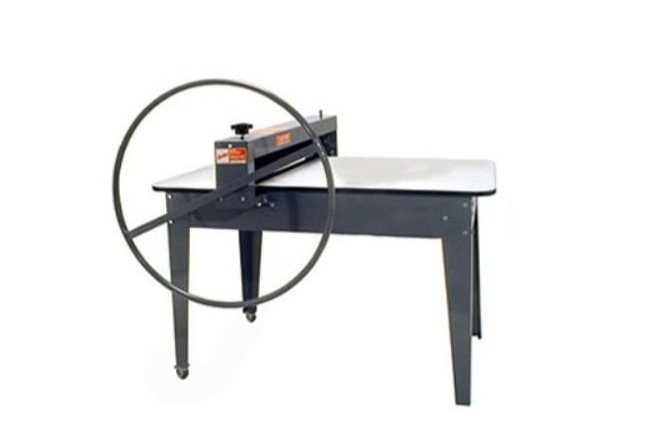
Bailey DRD / II ceramic slab roller machine

The Bailey DRD / II gear reduction slab roller pictured here with the shorter 51” table.


Slab rollers are great for slab-built pottery, tiles, and sculptures. While you might be able to get by with a rolling pin, if you use slabs regularly, a slab roller should be an integral part of your studio And while full-size slab rollers can take up a chunk of space, having the ability to easily make slabs is worth it.

This post covers all the full-size slab rollers on the market from five manufacturers: Bailey, Nidec Shimpo, North Star, Brent, and the Hi Roller. For a guide to smaller portable or table top slab rollers, click here.

Top Pick: Bailey DRD / II Gear Reduction models

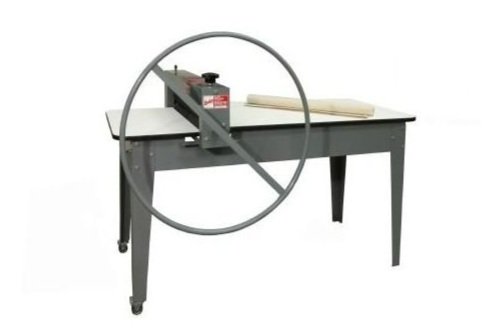
Bailey DRD / II slab roller with 69 inch table

The 24 inch wide Bailey DRD / II slab roller pictured here with the 69” table. Note the two wheels for ease of moving the table.

The Bailey DRD / II slab rollers with the gear reduction feature are the best slab rollers on the market. These slab rollers are a joy to use, can quickly take up to 2 inches of clay down to an even slab, and are extremely durable and long lasting, suitable for a professional, academic, or personal studio.

The machine features steel rollers, a large 34” wagon wheel handle for easy turning, and one adjustment knob that raises and lowers the top roller. The slab roller can be adjusted from an ultra-thin 1/16” up to 1 1/2” .

This machine feature a reverse-thread handle adapter to prevent damage to the machine, but be careful—what this means in practice is that you can unscrew the wagon wheel handle and it will fall off. (Make sure students are trained on this machine.) On the shorter 51” table, the 34” handle is quite large but it is easy to use and turn, even with large amounts of clay.

The only other (small) drawback is that if one is not careful, canvas can be pulled under the feed table and ends up wrapping around the bottom roller. But once one is accustomed to the roller, it becomes second nature to avoid this.

Bailey makes a few different rollers, but the DRD / II gear reduction models are what you want. The cost about $100 extra for the gear reduction but they are simply the best slab roller on the market.

The Bailey DRD / II gear reduction models are available in a 24” width as a machine only ($1,380), with a 51” table ($1,780), or a 69” table ($1,999). The 30” models have the same option and generally cost about $200 more.


Budget Pick: Nidec Shimpo SR-3050 Slab Roller

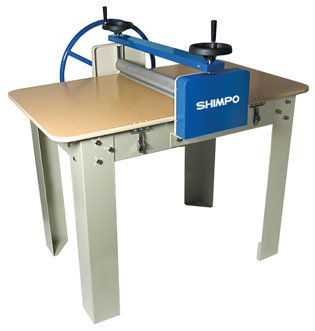
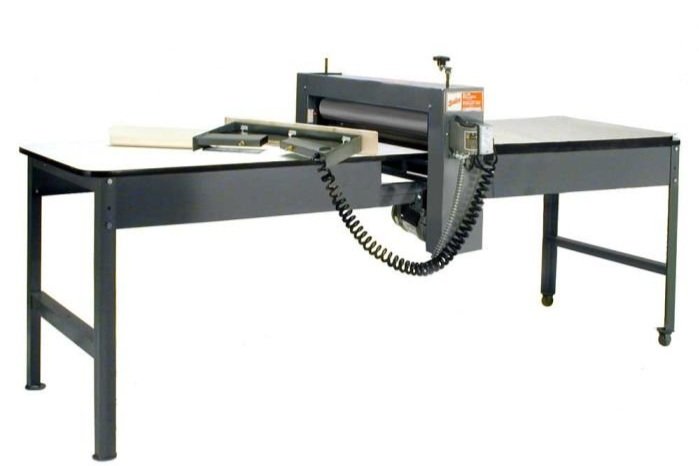
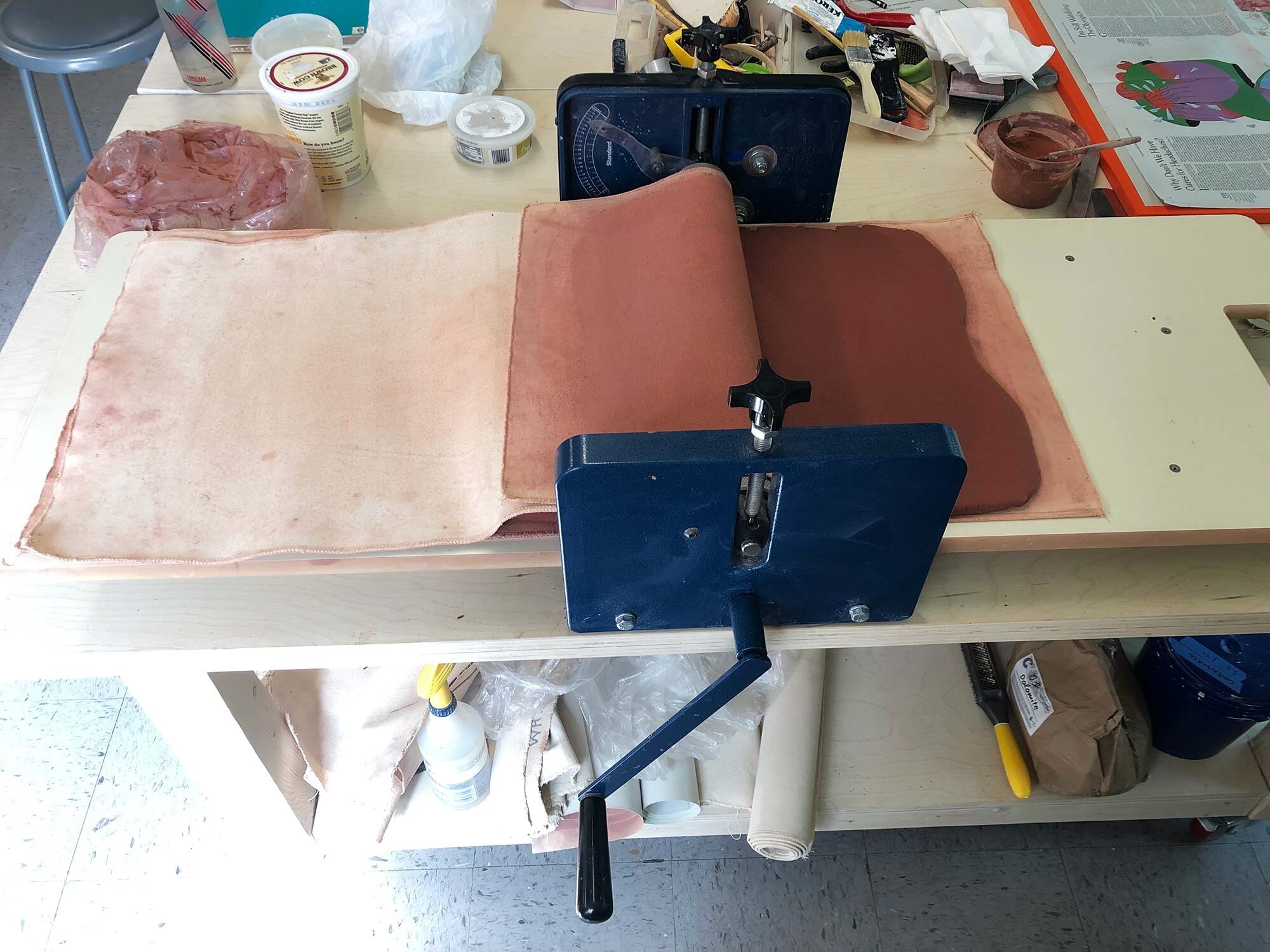
Nidec Shimpo ceramic slab roller machine

The Nidec-Shimpo Slab Roller

The Nidec-Shimpo SR-3050 slab roller is a studio workhorse that will turn out great slabs. It features a double roller that sits in the middle of a 30 x 50 inch table with a wagon-wheel handle. Slab thicknesses can range from an ultra-thin 0.1” up to 3 inches, and the top roller is adjusted by moving the two handles.

Adjusting the two rollers can be a bit annoying and the table is somewhat small, but all things considered, this is a great roller that is listed around $1,100 and often can be found for around $900. The short feed area can be fixed by adding a wing or placing the machine next to another table.

The Bailey DRD II and the Shimpo slab roller are just two of many full-sized slab rollers on the market. Keep reading for a complete guide, or click here to read about small and portable table top rollers.


Table of Contents

  1. Top Pick: Bailey DRD / II Gear Reduction Roller

  2. Budget Pick: Shimpo Slab Roller

  3. How to Shop For a Slab Roller

  4. North Star Slab Rollers

  5. The Hi Roller Vertical Slab Roller

  6. All Bailey Slab Rollers

  7. Brent Slab Rollers

  8. Slab Accessories

  9. Summary


How To Shop For A Slab Roller

It can be confusing to shop for a slab roller, as Bailey and North Star in particular make a variety of slab rollers that can be ordered with a variety of table sizes and features. Here’s a guide of how to shop and pick out rollers.

1. Start With Roller Width

Full size table top rollers range from 24 to 40 inches wide. In practice, your widest slab will probably be about 2 inches less than that. Even a 22 inch wide slab can be quite large! But if you are doing large tile projects, the 30 or 40 inch models will be needed. For an individual studio, a 24 inch roller might be quite large—maybe a table top roller is what you need.

2. Table Size

The important considerations here are the size of the table where you feed in the clay, the size of the “output” area, and the total size of the table. In addition to width, the table size will determine how long of a slab you can make. Once again, I’d suggest that a 22” wide slab by say 24” long is quite large! But if you have a larger table, you have more working area.

Shimpo, Brent, and the Hi Roller machines come in one size. But Bailey and North Star let you choose the table size. With Bailey it’s a 51” or 69” long table, and North Star options are 48” or 72” inches, and North Star also sells prop-up “wings” that extend the table. With Bailey and North Star, you can also buy the machine only and build your own table.

With any roller, measure the complete table and make sure it is suitable for your studio.

3. Rollers

Most high-quality rollers have a double roller. This will give your slab pressure from both sides, and results in a more even slab. Brent Rollers just have a roller on one side, which along with the heaviness of the table is why we don’t recommend Brent rollers.

4. Handle / Crank Mechanism

Most of these large rollers come with a wagon wheel handle, but some have a crank. A wagon wheel makes it easy to turn, but does take up more room. Consider the Bailey rollers with the short table: a 34” wide wagon wheel handle is paired with a 51” table. It’s a bit crowded. Smaller table top rollers generally have a crank rather than a wagon wheel.

5. Gear Reduction / Safety Mechanisms

Any slab roller should be treated with respect and they can be damaged if they are turned the wrong way or too much clay is forced through the rollers. Bailey makes a gear-reduction model that is even easier to turn, and also has a reverse-threaded wagon wheel so that you can’t turn the gears the “wrong” way and damage the machine.

6. Durability

All of the machines reviewed here are well built and will be long lasting if not abused. In my experience, the Bailey, Shimpo, and North Star machines hold up best under intense use in academic or community studios. The Hi Roller is fussy but can make nice albeit small slabs. The Brent rollers are extremely heavy and basically bomb proof welded steel, but if the shims get wet they can warp and the wires can snap if used improperly. So many academic studios have Brent rollers but the other four manufacturers make machines that are simpler, lighter, and easier to maintain.


North Star Slab Rollers

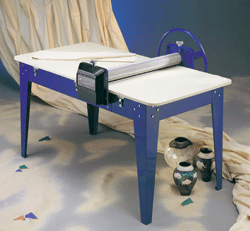
The North Star 30 inch wide Super Roller with table.

North Star makes two styles of slab rollers: the “standard” line has crank-driven 2 1/2” double rollers available in 18”, 24”, and 30” width as machine only, table-top portarollers, or in 48” long tables. (Our top pick for a portable roller is the 18” Portaroller from the North Star standard series.) The two larger rollers in the standard line can also be ordered with wagon wheel handles.

The “super” series features wagon-wheel driven 4” wide double rollers with a gear reduction in 24”, 30”, or 36” width in 72” long tables. If you are a production shop or a busy academic studio, the Super series is what you want, whereas the standard line is great for individual studios.

North Star also makes a variety of accessories, such as fold-out wings to extend the length of tables, and extra shelves for the roller table.

These are great rollers. The only drawback compared to the Bailey DRD / II models is that North Star has two height adjustment knobs, rather than one that moves the entire top roller. North Star mentions that this makes “tapered slabs” possible, but truth be told, that’s a concept I’ve only heard mentioned in their marketing copy.

North Star Standard rollers range from around $1100 to $1200 for a roller and table.
Super series rollers start at around $1500 for the 24” roller and table, and go up to $2355 for the 36” roller and table. All the models are available for less as machine only, if you want to build your own table.


The Hi Roller Vertical Slab Roller

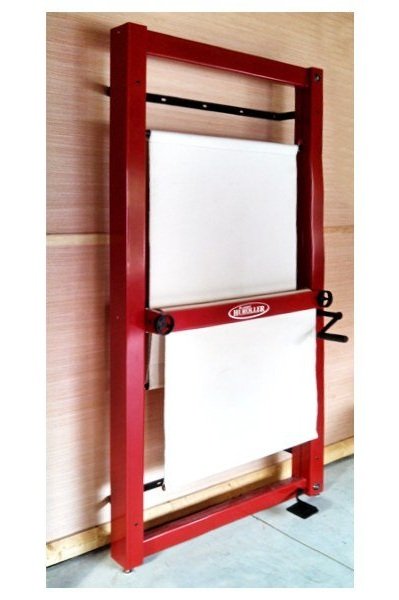
The Hi Roller vertical clay slab roller machine

The Hi Roller Vertical Slab roller is a space-saving machine that is easy to crank.

The Hi Roller is an interesting entry for the full size slab roller because it can be wall mounted or stand on its own, taking up very little space while providing great (if somewhat small) slabs. The rollers can be adjusted easily with a dial, clay is placed near the rollers, and a small crank easily moves the clay down between two pieces of canvas. Then, the clay is cranked back up, often sticking just enough to the canvas until you remove it.

This all sounds great, but in practice, this is a fussy machine. Sometimes the clay drops below the rollers and won’t come back up, and it’s hard to make large slabs. So there is some trade off but if floor space is a premium in your studio, this is the roller for you.

The Hi Roller is generally available for around $1,450-$1,500.


Bailey Slab Rollers

Bailey makes a somewhat confusing array of slab rollers so hopefully this outline of their product line will help.

The Bailey 40” DB Drive Board roller with electric motor.

The DRD / II slab roller from Bailey is the top pick for a slab roller (see top of post) and is available in a 24” or 30” model in either direct drive or gear reduction models. It’s worth the extra $100 for the gear reduction—why not make it easier to crank out slabs? The DRD / II models have 2 1/2 inch diameter rollers.

The original DRD model is still in production, and is available in 30” or 40” width. The DRD features 4” diameter rollers, designed for professional studios or heavy use by academic studios. These are amazing, big rollers. They are also available with electric motors.

Finally, Bailey also makes the DB or Drive Board rollers in 30” or 40” widths. These machines have a single roller on top and a drive board that travels with the slab, allowing for more even compression and protecting the slab from bunching or bogging down in the machine. These are best for tile and architectural tile work.


Brent Slab Rollers

Brent SR-30 Slab Roller

The Brent SR-30 Slab Roller

Brent makes three slab rollers with a wagon wheel (the SR-14, SR-20, and SR-30) and one model (the SRC) with a crank handle. All are rather overbuilt with heavy steel bases, and single wheels that move over the top of the slabs, and have wires underneath the roller table covered in sticky grease. The slab thickness is adjusted by adding or removing canvas-covered shims.

These slab rollers are quite common but I would avoid them whether new or used. Here’s why:

> Adding or taking out shims is a pain. Also, this process generally results in a lot of dust being created.

> Single roller, only pressure from the top rather than a double roller.

> Heavy. So heavy. You’ll need a forklift or about 6 people to move these. They are unnecessarily heavy.

> Hard to maintain. Have fun repairing the guide/crank wire when it snaps! (Misuse by students can easily break this wire)

> Warped shims: I once used a Brent roller that had water damage and all the shims were warped, resulting in uneven slabs.

And finally, expensive. All that metal costs money. These rollers ranged from $2,000 up to $3,700. Sure, if properly maintained and used you will get fine slabs, especially if you never change the slab thickness. But any other machine will be better.


Slab Accessories

A few things that will make working with slabs easier:

Slab Mats

Slab mat

Slab mats are available in a variety of sizes and are great for rolling slabs or handbuilding.

Slab Mats are a plastic fabric with one side smooth and the “working” side has a bit of a fuzz. They are less flexible than canvas, but are also great for putting through rollers, moving slabs around, or just as a working surface to protect your table tops. Most normal clay uses (fettling knives, craft knives, needle tools, etc) won’t cut through these. Small sizes can also be used as small bats for handbuilding, or get a larger piece to run through your roller.

Canvas

Unprimed, raw canvas is a great working surface that can be laundered.

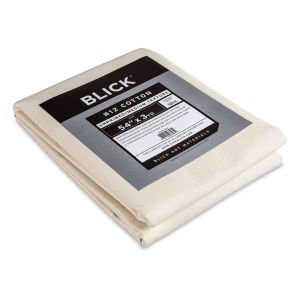
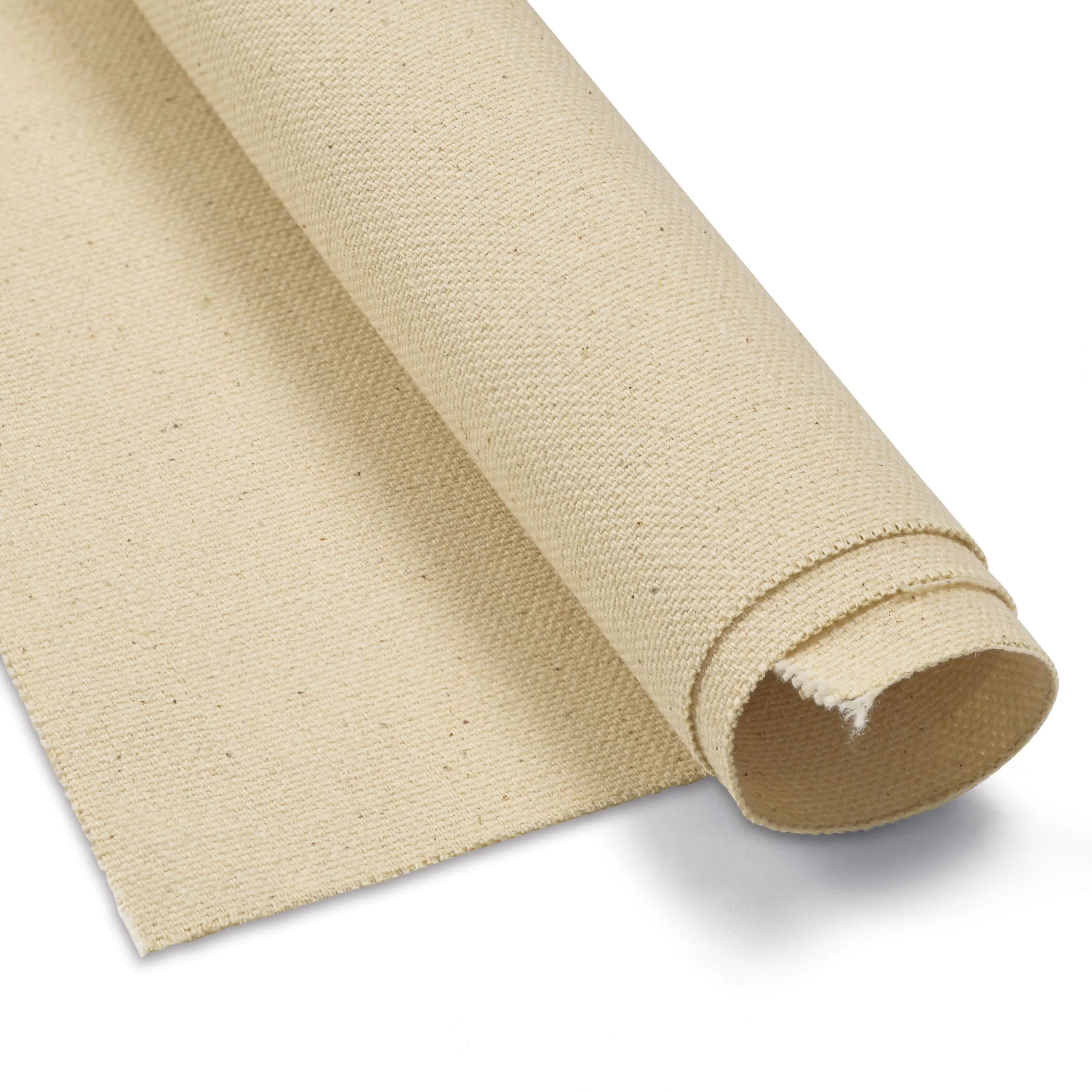
For slabs, unprimed canvas is also great for rolling and moving around the studio. With a canvas blanket, you can cut to your desired shape and either hem or leave the edges unhemmed. Canvas can be washed over and over again by hand or in the washing machine. Frequent washing will help keep the dust down, and does soften the material over time. #12 / 12 oz canvas is a great place to start, or go slightly thicker with #10 / 15oz canvas.

Rolling Pin

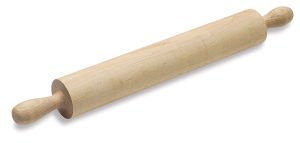
Solid maple rolling pin

A solid maple rolling pin is a useful studio tool that is easy to clean.

A solid maple rolling pin is a must-have for any ceramic studio, even if you have a slab roller. For small things, it’s usually easier to roll by hand. Pair this with a few wooden slats or yard sticks, and you’ve got an adjustable slab rolling system.

A solid rolling pin is better than a rolling pin with bearings or moving parts, because there is nothing to break and it is easy to clean the entire rolling pin with water. Rolling pins come in a variety of sizes but a 24” wide rolling pin is still easy to maneuver but large enough to make really big slabs. At around $30, this is an affordable studio tool that will last forever.


Summary

This post has covered every large or full-size slab roller on the market, including models from Bailey, North Star, Nidec-Shimpo, Hi Roller, and Brent.

The top pick is the DRD/II gear reduction slab roller from Bailey, but there are lots of options for a wide variety of budgets. All of these rollers, if properly used, will make great slabs but there are some superior options (Bailey, Shimpo, North Star) based on price, weight, and quality of features.

What slab roller do you use in your studio? Let us know in the comments.


How to Rip Sandpaper

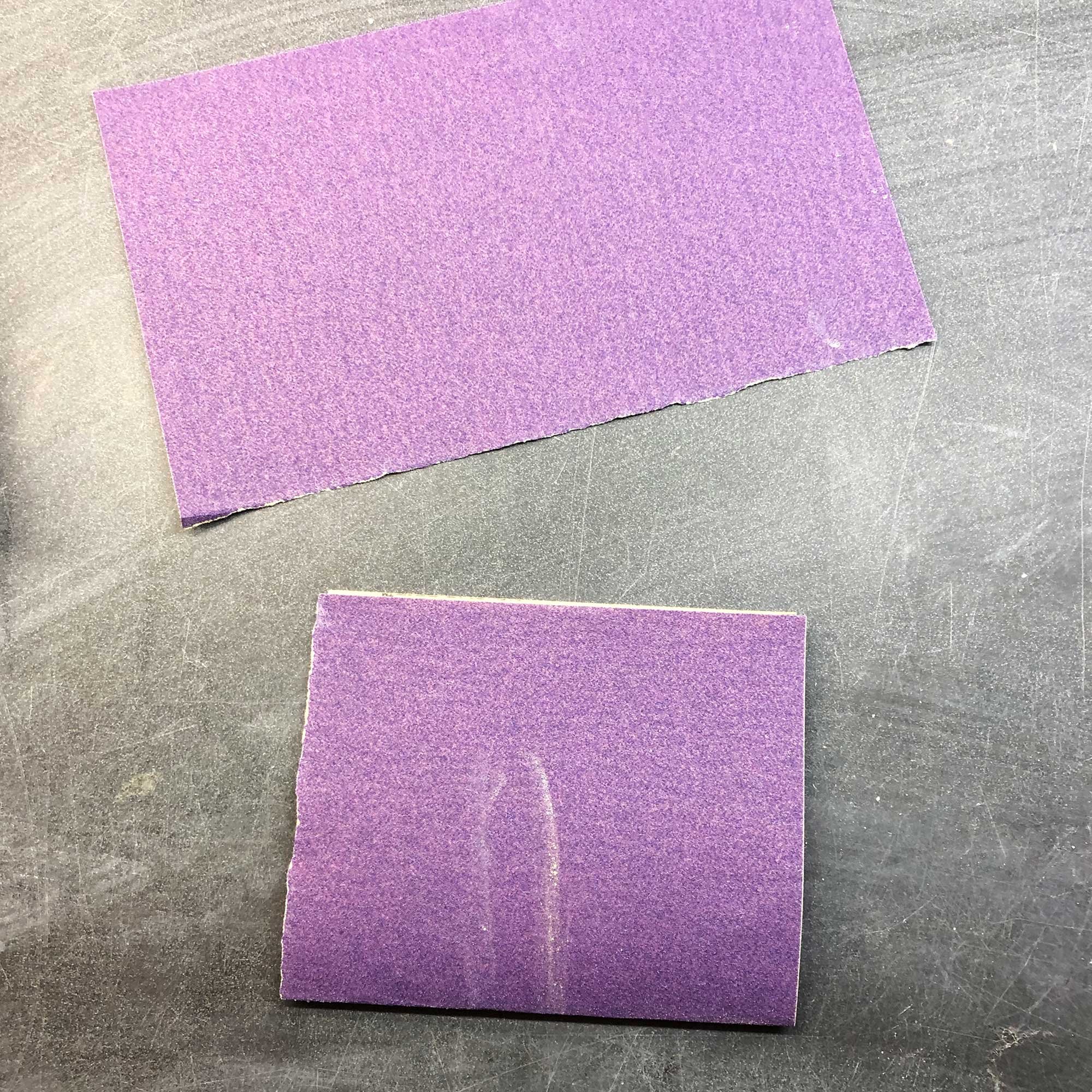
Sandpaper ripped into eight pieces.

Sandpaper is a great studio tool but you usually don’t need to use a whole sheet at once. This tutorial will cover how to easily rip sandpaper into eight even pieces that are useful for small jobs such as sanding pottery ware, cleaning up rough wood, or any job. It’s a simple technique that results in even, rectangular pieces.

If you are doing any studio task that create dusts, wear a good dust mask or respirator. (Read our guide here) Or if you can, sand wet so that no dust is created.

For a guide to sandpaper and abrasives, click here.

This tutorial uses 3M Pro Grade Sandpaper. It’s plastic backed, making it longer-lasting and suitable for wet sanding. It’s the best for ceramics and just about any other art studio use. Look for the “no-slip grip” sandpaper.

For sandpaper grits, I like to stock 60 and/or 80, 120, 200, and 400 grit.


How to Rip Sandpaper Into Smaller Pieces

Here’s how to rip a sheet of sandpaper into eight even pieces.

Step 1

Starting with a full sheet of sandpaper, fold it in half vertically (the long side) and crease.

Full sheet of sandpaper

Full sheet of sandpaper

Fold in half


Step 2

Ripping a creased sheet of sandpaper

Rip along the crease

Then, rip the sheet in half along the crease. You may rip a bit unevenly at first, but with practice you will get an even rip.


Ad


Step 3

Then on the long side of the smaller pieces you have just made: fold, crease, and rip.

Fold, crease, and rip again

Square pieces might be useful, but we’ll keep going.


Step 4

Continue to fold pieces in half, crease, and rip. I find that ripping a sheet into eight sheet results in a useful size.


ad


Step 5

Sandpaper ripped into eight pieces.

When you are at eight rectangular pieces, you are set. Now, find a small cup or box to store them in.


Summary

What sandpaper do you use in your studio? How do you rip and store it? Let us know in the comments.
You might enjoy:

Complete Guide to Sanding and Abrasives for Ceramics and Pottery

Best Wet Polishers

Best HEPA Vacuum for ceramics and woodshops

How to Make an Interchangeable Grinding Disc for Your Pottery Wheel

Shopping links:


Best Small Test Kilns for At-Home Firings on 120V

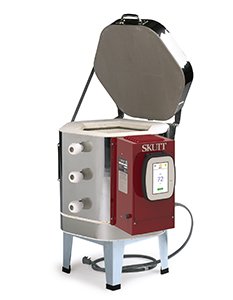
The Skutt KMT-614 Kiln Master Touchscreen Kiln, the top pick for a small at home electric kiln that can plug into a regular 120V outlet.

A small kiln or test kiln is a great addition to any studio. They allow you to quickly fire test tiles, small pieces, beads, jewelry, or doll parts. And the good news is that there are a variety of great options for test kilns that plug into a regular household 120V outlet on a 20 amp fuse, which means that you probably don’t need to rewire anything. (Although it is always recommended that you check with an electrician before installing an electric kiln.)

Test kilns are also a great addition to academic, teaching, or production studios because they fire hot and fast, allowing you to do tests or make small pieces without having to fill an entire large kiln. As with any kiln, safety is of utmost concern and test kilns should be kept in clean, fire-proof areas and be placed at least 12 inches from drywall, or anything flammable.

There are a lot of small kilns but most don’t go hotter than 2000 degrees, which is just enough for working with low-fire clay. This post will focus on kilns that can reach cone 6 or hotter, or around 2200 to 2350 F. The post includes kilns from Skutt, Olympic, Paragon, ConeArt, L&L and Cress that meet these specifications:

  • Fire on 120 V power with a 20 amp fuse (typically found in North America in households)

  • Can reach Cone 6 / 2250 F or hotter

  • Use a standard plug found in North America

The Skutt KM-614 is a supersized test kiln with an 11 x 11 x 13.5 inch tall kiln chamber, a standard Skutt controller, and can reach as high as cone 6.

TOP PICK: Skutt KM-614 or KMT-614

The Skutt KM-614 or KMT-614 models are more of a mini-kiln than just a test kiln, and either model is the top pick for a small test kiln because of it’s larger size and ability to reach cone 6.

The models are identical except the KM model has a push button controller and the KMT has a slightly more expensive touchscreen controller. This kiln runs on 115V and needs a 20 amp fuse (typically a standard fuse in a household breaker box), and measures 11 x 11 inches wide and 13.5 inches deep, for a 0.8 cubic foot kiln chamber. The kiln can fire to cone 6 or around 2250 F, and uses a standard plug. The kiln chamber is lined with three-inch-thick brick, and the outside dimensions are 29 x 28 inches by 28 inches high, with a weight of 88 pounds.

At 13.5 inches deep, this kiln really gives you a height option that is hard to find in a test kiln. The only drawback on this kiln is that it can’t go to cone 10, but otherwise it’s a great small kiln that will last for decades and comes with Skutt’s great reputation for build quality and support.

Skutt KM-614 pushbutton control
List Price: $2175
Retail Price: Often available for around $1,650-$1,700

Skutt KMT-614 touchscreen control
List Price: $2,560
Retail price: Often available for around $2,200


Runner Up: Paragon Caldera or Caldera XL

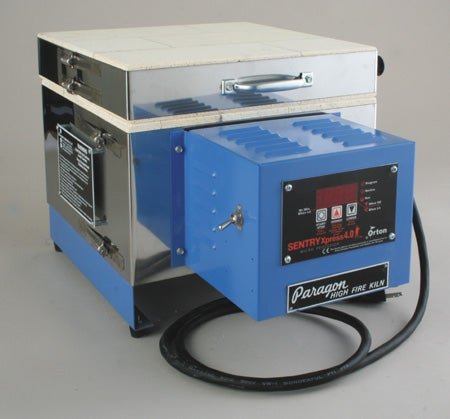
The Paragon Caldera is a square, top loading test kiln that can reach 2350 F.

The Paragon Caldera models are more of a standard small-size test kiln, but they are great for tests or small pieces. The Caldera measures 8 x 8 x 6.75 inches tall for a 0.25 cubic foot firing chamber, while the Caldera XL measures 7.5 x 7.5 x 9 inches tall for a 0.29 cubic foot firing chamber. The kilns fire on a standard 120 V plug and can reach cone 10 or 2350 F. These are great little kilns that just get the job done and can go hot.

The Caldera is listed at $1128 but can be found for about $1030, and the Caldera XL is listed at $1308 and can usually be found for around $1200.


Table of Contents

  • Top Picks

  • Skutt tests kilns

  • Paragon test kilns

  • Olympic test kilns

  • Cress test kilns

  • L&L test kilns

  • ConeArt test kiln

  • Summary


Skutt Test Kilns

The Skutt FireBox 8x6 LT, a small test kiln rated to Cone 6 / 2250 F.

Skutt makes four kilns that plug into a standard 115/120V outlet, the two KM / KMT 614 models detailed above, the FireBox 8x6 LT, and the FireBox 8x4 LT. The FireBox models are 8 x 8 inches square and either 4.5 or 6.5 inches tall. The FireBox 8x6 is rated to Cone 6 / 2250 F, and the FireBox 8x4 is rated to Cone 10 / 2350. The kilns are only available with push button controllers

The FireBoxes are interesting kilns, but they are just a few hundred dollars cheaper than the 614 model while being quite a bit smaller. With that in mind, I would go for the Skutt 614 unless a smaller kiln is all you have room for or need.

The Skutt KM-614 (detailed above) is the top pick for a small test kiln.


Paragon Test Kilns

Paragon makes numerous small and test kilns that plug into a regular 120 V outlet, but not all are suitable for temperatures above 2000 degrees. As detailed on the Paragon web site, only 4 of these small kilns are designed to fire to Cone 10 / 2350. Paragon also makes at least 6 kilns that will fire to low fire ceramic temperatures, or around Cone 1 / 2000 F. They also have a few small kilns that are a bit larger than a cubic foot, such as the Express 66-3 kiln, but these models require a different plug, breaker box, and power supply. As this review is focused on kilns that plug into a regular outlet, we’ll just cover the four kilns that meet that criteria and can reach Cone 6 or higher temperatures.

The Paragon Caldera test kiln.

The best Paragon option is the Caldera or Caldera XL. They fire hot—to cone 10 or 2350—and are 6.75 and 9 inches deep respectively, but they aren’t that wide, around 8 inches square. The Caldera measures just 0.25 and the taller XL is 0.29 cubic feet. But, if all you need is a small, dependable test kiln, they might be right for you.

Paragon also makes two cone 10 kilns that are smaller than the Caldera.

The FireFly Digital test kiln from Paragon.

The FireFly Digital is very similar to the Caldera, but the kiln chamber measures 8 x 8 x 4.5 inches tall, for a 0.16 cubic foot chamber.

The Q11 is another interesting cone 10 model from Paragon. It is a front loader, with a chamber that measures 6 x 6 x 6.25 inches tall.

Both of these models retail for around $1000. Because they are quite small, it seems worth it to upgrade to the larger Caldera model or consider a kiln from a different manufacturer.

The Paragon Q11 is a small, front loading test kiln.


Olympic Test Kilns

The HotBox 89E is the largest of Olympic’s 120V test kilns that can reach cone 10, measuring 8 x 8 x 6.5 inches tall

Olympic makes 12 small kilns that plug into a 120V outlet.

> Six of these kilns can reach cone 10 / 2350 F. These models range in size from a very small 0.11 cubic feet and top out at about 0.33 cubic feet. These include the five HotBox kilns, and the Doll E / Test E kiln.

> Three kilns can reach cone 6 / 2250 F and are a bit larger, ranging up to 0.58 cubic feet. These include the 129, 129 FLE, and 139 FLE models.

> Two kilns can reach cone 4 / 2100 F. One is the 1214 Raku E and the other is the 1214-120E, which is most comparable in size to the top pick from Skutt, measuring 11.25 x 11.25 x 13.5 inches for a kiln chamber of 0.86 cubic feet, but this kiln is only rated to 2100 or cone 4, whereas the Skutt 614 is rated to Cone 6.

> One Skutt kiln is rated to Cone 04-03 / 2000 F, the interesting model called the Traveler 120 V.

For more info, visit the Olympic website.


Cress Test Kilns

The Cress BT911T test kiln has an 11 inch diameter hexagonal chamber that is 9 inches deep, and is rated to cone 6 / 2250 F.

Cress makes a variety of kilns that are great build quality. Cress makes manual and digital/automatic kilns, but the only digital kiln that works with a standard 120V household plug is designed to top out at 2000 F.

For test kilns, there are six manual-fire options that reach at least cone 6. These manual kilns have a Dawson kiln sitter along with a limit timer, which allows you to safely fire the kiln with light supervision.

The three smallest models, the A4HKT, the A8HKT, and the BT511KT range in size from 0.11 cubic feet to 0.33 cubic feet, and will reach cone 10 / 2350 F. The largest of these volume wise is the A8HKT, which is 8 x 8 x 9 inches deep.

The Cress C11HT test kiln has an 11 x 11 x 11 kiln chamber, Dawson kiln sitter, and manual limit timer.

Cress also makes three slightly bigger models that will fire to cone 6 / 2250. These are the BT711H, the BT911T, and the C11HT. The BT711H and BT911T are 11” wide hexagons and are either 6.5 or 9 inches tall. The largest test kiln is the C11HT, which is an 11x11x11” cube that has a 0.77 cubic foot chamber.

For more info, visit the Cress website.


L&L Test Kilns

The L&L Doll and Test kilns feature a hexagonal 0.5 cubic foot kiln chamber and a variety of power supplies to meet your needs.

L&L is loved by many for their kilns with hard ceramic element holders, protected thermocouple, and easy to access electrical panels and they bring all these features to the three DL11 Doll and Test Kiln models. These three models are the same, except for different electrical components. The kiln features a 0.5 cubic foot hexagonal chamber that is 11 inches wide by 9 inches deep, and each model is listed at $1650.

> DL11-D is rated to cone 5 / 2170 F and uses a regular household plug on 120V.
> DLH11-D is rated to cone 6 / 2230 F and uses a regular household plug on 120V.
> DLH11-DX is rated to cone 10 / 2250 F but will need a 240 power supply and a socket for a NEMA 6-20 three prong plug. (Check with your electrician to see if this will work with your current box and fuses)

For more information, visit the L&L website.


Cone Art Test Kiln

The Tucker’s Cone Art doll / test kiln, pictured here with the Bartlett touchpad controller.

Tucker’s Cone Art makes one size of a small doll / test kiln, which is rated to cone 10 or 2350 F. Like all Cone Art kilns, the kiln features 2 1/2” thick brick backed by 1” of insulation. Typically, this allows the Cone Art kilns to reach higher temperatures on a lower amperage. In the United States, Cone Art kilns are also sold as Bailey kilns, the main difference being the color of the electrical box, but the test kiln size is currently not listed on the Bailey site.

The 119D Cone Art test kiln is available with a touchpad Bartlett controller, or with the upgraded Genesis touchscreen controller. Both models use as a standard 120V outlet. Although this kiln is smaller than the top pick from Skutt, the ability to fire hotter may make this the ideal kiln for your studio.

For more information, visit the Cone Art website.


Summary

This post has covered a wide variety of small doll and test kilns that will work with a standard plug on 120V, and will fire to at least cone 6. The top pick is the KM-614 from Skutt for it’s ability to fire to cone 6 and larger size, especially the 13.5 inch height. But there are many other options to suit and studio.

Test kilns are ideal if you work small, such as dolls, beads, or small sculptures, or you need a kiln that you can fire without having to fill an entire large kiln, such as for tests. They make a great addition to any ceramic studio.

What is your favorite small kiln? Do you fire at home with a kiln like this? Let us know your experience in the comments.


Gift Guide for Artists who Paint and Draw

This guide has more than 30 ideas for artists who paint, draw, and create. Most suggestions are priced between $25 and $100, along with a few higher ticket items. There are plenty of ideas for the painter or artist in your life, or perhaps you’ll find a gift for yourself. In general, this guide focuses on high-quality art supplies, equipment, and books.

Note: This site uses affiliate links for sites such as Amazon and Blick. If you click the links and complete a purchase, we may receive a percentage at no extra cost to you.


Blick Noir French Easel

The Blick Noir French Easel.

The Blick Noir French Easel.

Perfect for in the studio or on the go, this black French-style wooden easel from Blick is stylish, functional, and a great deal. The easel combines a sketchbox, easel, and canvas carrier into one unit. Folded, it measures a compact 22 x 16 x 6.5 inches, and it can extend up to 73” tall and accommodate canvases up to 34” tall. It weighs about 10 lbs. This is a great easel for someone setting up an at-home studio and can be carried or folded down for painting in plein air. It retails for around $100.


Golden A-Z Acrylic Explorers Kit

The Golden A-Z Acrylic Explorer Kit.

The Golden A-Z Acrylic Explorer Kit.

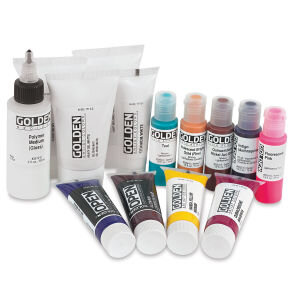
This popular set introduces artists to a variety of products Golden Acrylics—the company bills it as a workshop in a box and it basically is. It includes heavy body (i.e. thick) acrylics, fluid acrylics, high flow acrylics as well as pastes, gels and mediums. It’s a great intro to Golden’s high quality product line, and can really expand an artist’s skill set. The kit retails for around $28 and includes 4 tubes of paint, 5 small bottles of paint, 4 tubes of different mediums and a bottle of clear painting medium.


Aquabee Super Deluxe Sketchbook

The Aquabee Super Deluxe Sketchbook.

The Aquabee Super Deluxe Sketchbook.

The Aquabee Super Deluxe Sketchbook from Bee Paper is a favorite mixed media pad that came out on top in our recent review of mixed media pads. It can do everything from light watercolor to ink to marker, colored pencil, and anything else. The sketchbooks are available in a variety of sizes (9x12” is a great option) and has a stiff cardboard back and a leatherette cover with a wire binding for easy turning of pages. The 93 lb / 150 gsm paper is light cream color and is a pleasure to use, and the books range from 6x4 inches to 14x17 inches, with 50 or 60 pages per book.


Williamsburg Oil Paint Sets

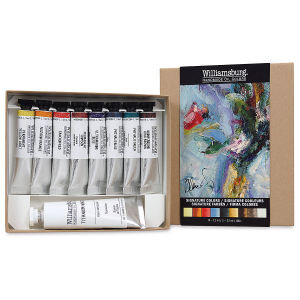
The Williamsburg Oil Paint Signature Series has 9 colors in 11 ml tubes.

The Williamsburg Oil Paint Signature Series has 9 colors in 11 ml tubes.

Williamsburg is known for its intensely pigmented, handmade oil paints that are the favorite paints of many professional artists. Available individually or in a variety of sets, try the Signature Series set of 9 for an introduction to these wonderful oil paints. An oil painter will appreciate this, or any set of the high quality Williamsburg paints. The Signature Series set has 9 tubes with 11 ml of paint each, or about 1/3 of an ounce.


The Artist’s Way by Julia Cameron

The Artist’s Way by Julia Cameron

The Artist’s Way by Julia Cameron

This classic, first published almost 30 years ago, helps artists, writers, and creative types unlock their full potential. Through a series of exercises, such as a letter to yourself and the famous “morning pages” of free writing (visual artists can just substitute sketching) everyone can discover their creative path in an open-ended way that accommodates everyone. At times a bit new age-y, this book is still worth a read for the ideas and exercises. The book grew out of a series of workshops that Cameron ran, and the book feels like you are in the room with Cameron’s gentle but insistent guidance.


Faber-Castell 9000 Series Drawing Set

Faber-Castell 9000 Series Drawing Set.

Faber-Castell 9000 Series Drawing Set.

Faber-Castell makes some of the best pencils and is the choice of professionals and serious artists. It’s easy to just reach for the signature green pencils first. This set of 12 pencils from F-C’s signature 9000 series has one pencil each ranging from the soft and dark 8B up to 2H. There’s also a set for designers that ranges from 5B to 5H. The sets come in a hinged metal tin or a soft bag and usually retail for around $15-$20. This is the perfect set for anyone who loves to draw. Pair it with a sketchbook and a sharpener for a perfect gift.


Tote Bag for Tools, Pencils, and Brushes

JJRing Nylon Tote Bag

JJRing Nylon Tote Bag

Every artist can use a little organizational help, and a tote bag keeps everything is at hand and easy to find. The JJRing nylon art/craft bag is has a 16 pockets, is available in eight colors, and is a great value, typically priced at $15 to $25.


Caran D’Ache Luminance Colored Pencils

The Caran D’Ache Luminance pictured here in the 20 pencil box.

The Caran D’Ache Luminance pictured here in the 20 pencil box.

The ultra-premium Luminance colored pencils are a joy to use and the entire set is 100 percent lightfast, which means that the pigments are designed to withstand UV rays. Under museum conditions, these colors will hold up for at least 100 years. The Luminance (and the Derwent Lightfast) were our top picks in a recent test of colored pencils based on the color intensity, quality, and the lightfast ratings. The Luminance also has an easy-to-use cardboard box where each pencil is inset into foam, so the pencils don’t jumble around. Prices range from a set of 20 pencils for $55 to a set of 76 pencils for around $225.


The Story of Painting: How Art Was Made

The Story of Painting: How Art Was Made from DK.

The Story of Painting: How Art Was Made from DK.

This 2019 book covers the entire 25,000 year history of painting with illustrations, texts, and guides to technique, composition, and subject matter. It’s a great overview for a beginning painter, or a wonderful reference book for the more experienced artist. The details, images, and texts make this more than just a coffee table book. It’s available in hardcover for around $25.

 
The book includes detailed examinations of numerous paintings.

The book includes detailed examinations of numerous paintings.


Utrecht Artists’ Watercolor Paint Box

The Utrecht Watercolor Box is a complete painting kit.

The Utrecht Watercolor Box is a complete painting kit.

This set has everything an artist needs to get started with watercolor painting and it’s made by Utrecht, the Brooklyn, NY company known for high quality, artist-grade paints and mediums. It comes in a beechwood box and includes a 9x12” watercolor block, four brushes, a flat knife, a needed eraser, plastic palette with 24 wells, and 18 tubes of watercolor paint. The box usually retails for around $225.

Utrecht also sells smaller sets of just watercolor paints.


Anker Soundcore Q20 Noise Cancelling Headphones

The Anker Soundcore Q20 Noise Cancelling Headphones.

The Anker Soundcore Q20 Noise Cancelling Headphones.

Over-ear noise cancelling headphones can really help you focus on your work, especially if you work in a shared or noisy environment. There are a lot of options for this type of headphone, but the Anker Soundcore Q20 strike a balance between quality and affordability, especially considering they will probably get covered in paint at some point. These headphones have an impressive 40 hour playing time, and a dynamic sound quality that while not quite audiophile level, really deliver a lot for the $50 price tag.


Liquitex Acrylic Gouache

The Liquitex Acrylic Gouache 12 color essentials kit.

The Liquitex Acrylic Gouache 12 color essentials kit.

Gouache is a type of opaque watercolor paint, and the Liquitex Acrylic Gouache is an interesting twist on this product that is really nice to use. Think of it as a matte acrylic paint that is fluid right out of the bottle and will result in a matte finish that doesn’t show brush strokes or cracks. It’s become a favorite acrylic paint of many. It’s available in small squeeze bottles—to use, just press out what you will need on a tray or palette. The colors are available individually or in a variety of sets. Try the 12 color essentials set for around $55 or the fluorescent set is also fun.


Blick Super Value Bulk Canvas Pack

The Blick Super Value Bulk Canvas Pack has 40 16x20” pre-primed canvases.

The Blick Super Value Bulk Canvas Pack has 40 16x20” pre-primed canvases.

Almost a gag gift for the extreme size, this bulk pack of 40 stretched canvases are great for anyone who paints a lot. These 16x20” canvases are pre-primed with acrylic gesso on 5/8” thick stretcher bars. At around $120, these canvases work out to about $3 each—an incredible value. And a gift like this will provide plenty of surfaces for an artist to get to work.


Winsor & Newton Artisan Water Mixable Oil Paint

Winsor & Newton Artisan Water Mixable Oil Paint.

Winsor & Newton Artisan Water Mixable Oil Paint.

Water mixable oil paint is an interesting innovation made by a variety of manufacturers. It allows you to thin paint with water (although most companies do make some mediums as well) but more importantly, you can clean up this paint with water and soap. This makes it so much easier to keep hands, brushes, palettes, and everything clean, especially if you are painting at home. Winsor & Newtown makes a great line of water mixable oil paint called Artisan, and it’s available individually and in sets. The set of 10 colors in the smaller 0.7 ounce tubes is a great introduction to this line.


Foam Daubers

Foam daubers aka sponges on a stick.

Foam daubers aka sponges on a stick.

These sponges on a stick are a fun craft tool for artists of all ages. Variously known as spouncers, daubers, or stick sponges, these are a great way to add polka dots and round shapes to any surface. Use with acrylic, watercolor, or inks. Available in bulk packs for around $10–20, they are a great tool for any artist.


Create Dangerously: The Power and Responsibility of the Artist by Albert Camus

Create Dangerously by Albert Camus.

Create Dangerously by Albert Camus.

This 1957 speech by the Nobel Prize winner was first published as a standalone text in 2019 in this small, pocket-sized book. A call to arms for artists to participate in society, it’s an interesting read for anyone considering a career in the art or who is interested in what role artists might take in civic discourse. The paperback usually retails for $8.


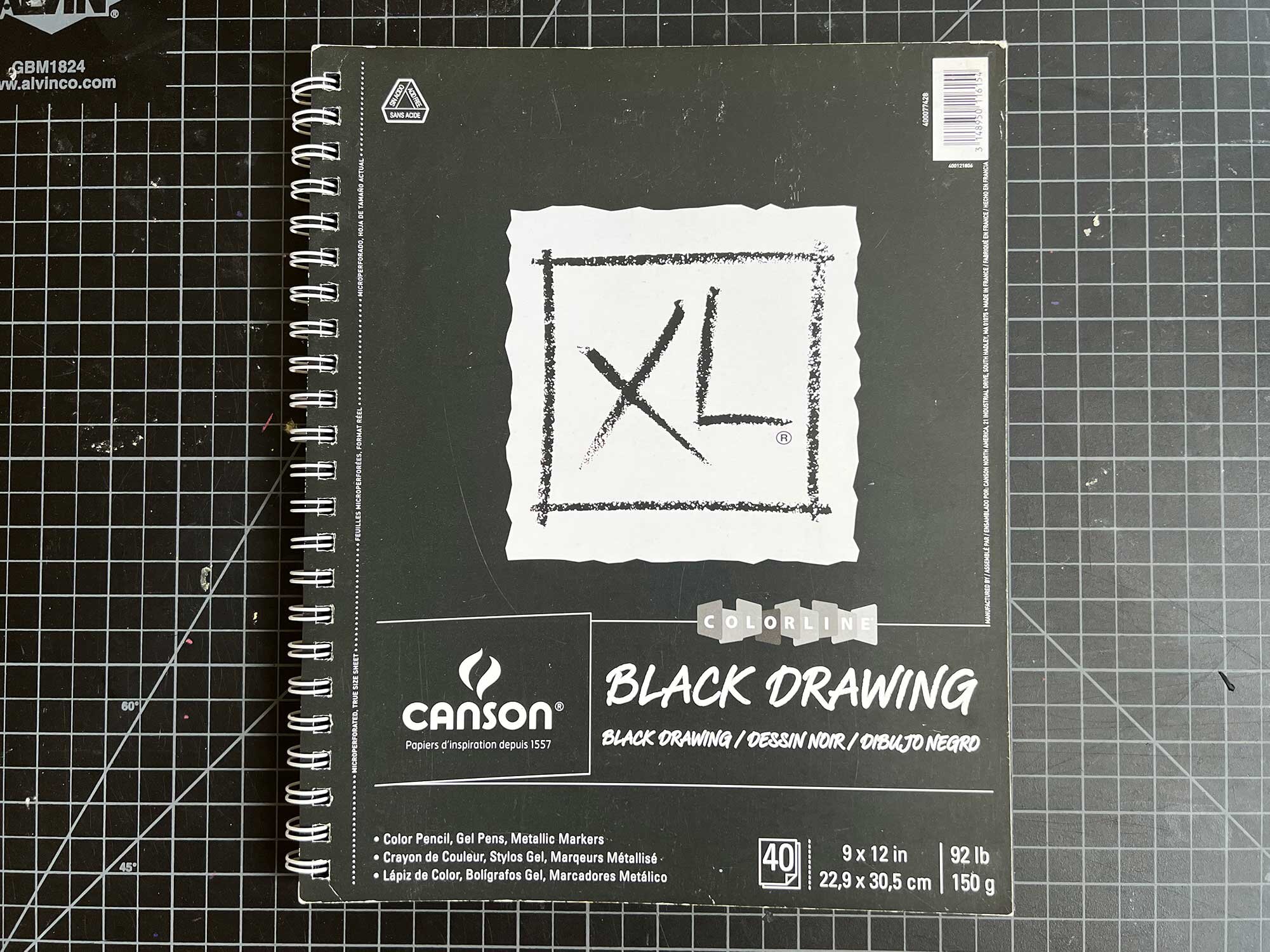
Canson XL Black Drawing Pad

The Canson XL Black Drawing Sketchbook

The Canson XL Black Drawing Sketchbook

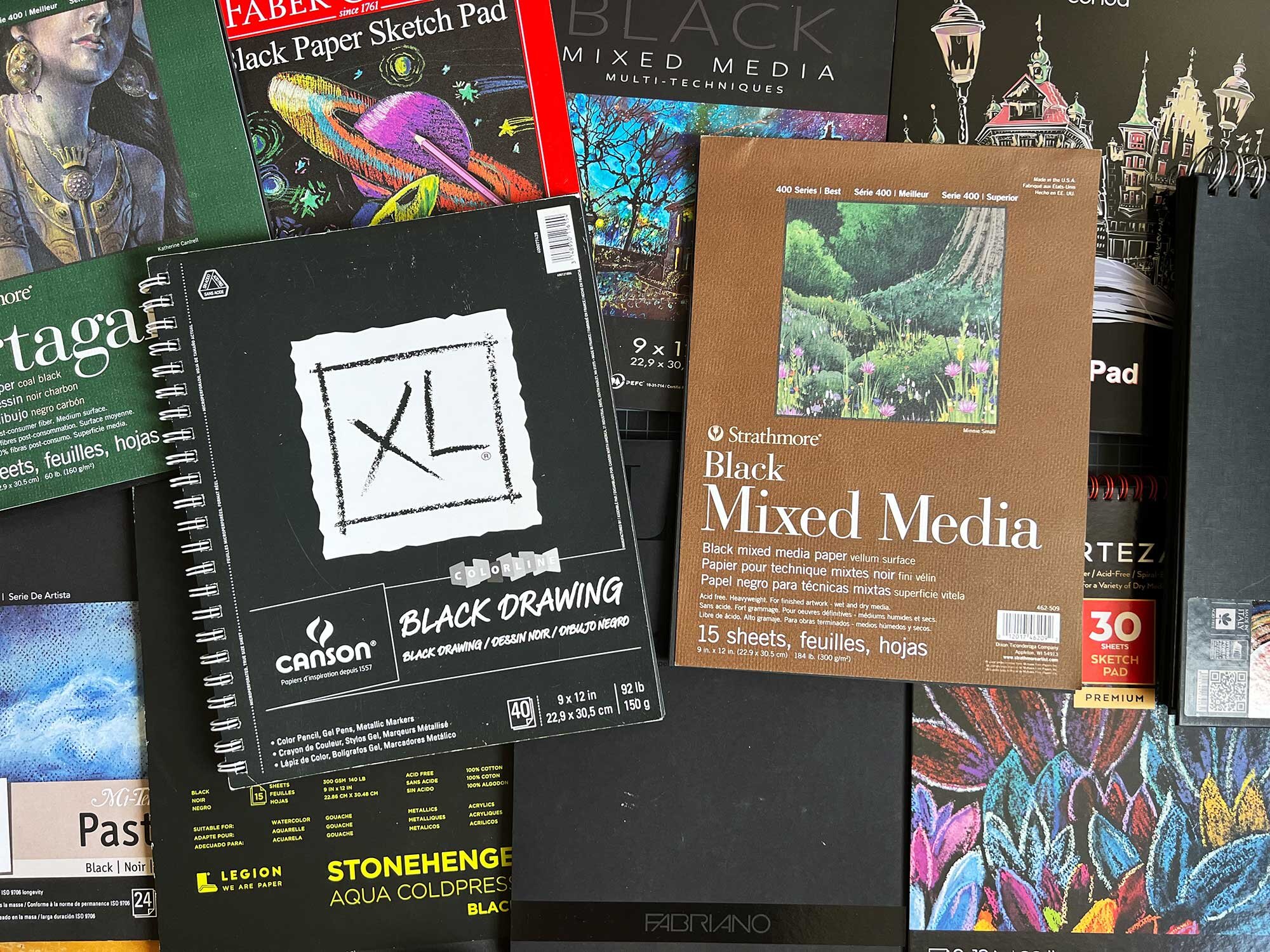
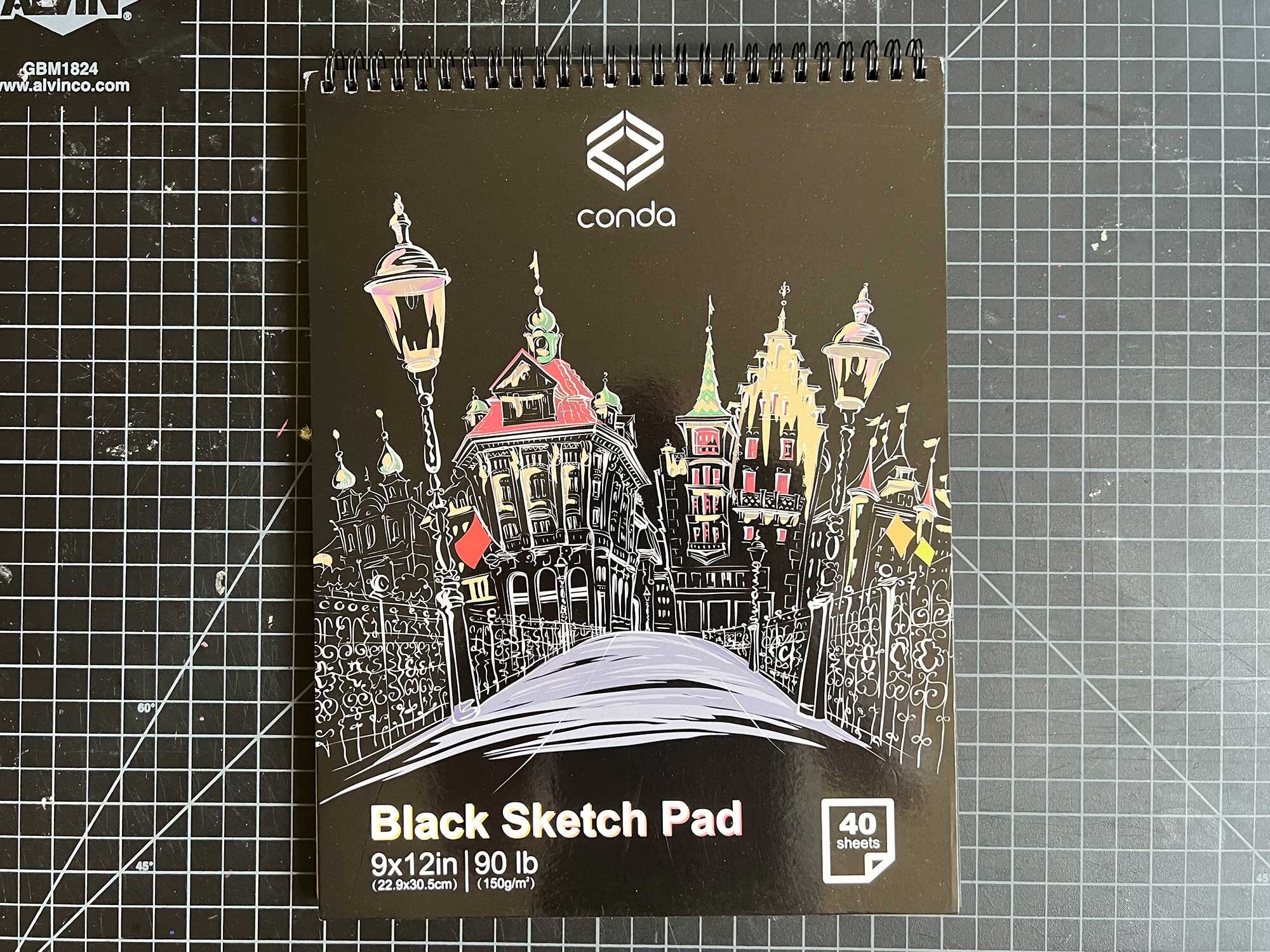
A sketchbook with black paper is a fun way to mix things up in the studio. Pair it with opaque colors from pens or pencils, and you’ve got a whole new way to approach color and design. A studio favorite is the student-grade Canson XL Black Drawing Pad. Each pad features 40 pages with 92lb black paper, with micro-perforations at the side if you want to remove a drawing for framing or other purposes. Available in 7x10” or 9x12”, expect to pay $7 to $10 for these pads. For a great gift, pair this with gel pens or colored pencils.


X-Acto Basic Knife Set and Case

The X-Acto Basic Knife Set with case.

The X-Acto Basic Knife Set with case.

Every artist needs X-Acto knives at some point, and this basic set of 3 knives and 10 replacement blades is a great introduction to the variety of blades from this venerable company. Use this for trimming watercolor paper, collages, or any art and hobby purposes, these will get used all the time. This set typically retails for around $23. Pair it with a cutting mat (see below) for a great gift.


Self-Healing Cutting Mat

Alvin Cutting Mats are one option for self-healing cutting mats.

Alvin Cutting Mats are one option for self-healing cutting mats.

Self-healing cutting mats are a great way to protect both your tables from cuts and it helps your knife blades stay sharp longer. Available from a variety of manufacturers (Alvin, Blick, Cricut, X-Acto etc) the main thing is to pick the size and color that works for your space. Traditionally available in green and black from Alvin, there are now a variety of colors and sizes. For at-home use, an 18x24” mat or 24x36” sizes are usually best, but you can go bigger or smaller. In addition to cutting, these make great surfaces for using liquid or hot glue, or for moving around drawings or paintings that are not yet dry. The larger sizes are also useful for covering tables used for drawing, painting, and crafts.


Arches Watercolor Blocks

Arches watercolor blocks come in a variety of paper thicknesses and finishes.

Arches watercolor blocks come in a variety of paper thicknesses and finishes.

Arches makes some of the best watercolor paper and watercolor blocks are a great way to try out their paper. Sealed on the side with glue, each sheet stays in place and won’t warp, and can then be cut off using a dull knife. Then the next sheet is ready to go. These come in hot and cold press in a variety of thickness. Cold press paper has a bit more texture and the mid-weight 140 lb / 300 gsm paper is a good place to start, such as an 8x10 block of 20 sheets that retails for around $33. Pair this with a high-quality set of watercolors (such as Sennilier, Utrecht, etc) and you’ve got a great gift for a watercolor artist.


Sennelier Watercolor Travel Set

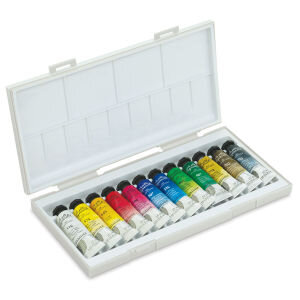
Sennelier La Petite Watercolor Travel Set

Sennelier La Petite Watercolor Travel Set

Sennelier makes some of the best watercolors that are rich in hue, depth, and just enough transparency. They are a pleasure to use and when paired with a watercolor block (see above) make a great gift. This travel set includes 12 tubes of watercolor paint and a small palette for adding water. The tubes hold 10ml or .33 oz of watercolor paint, which can go a long way—especially if they are mixed with water and used wet on wet. It’s a great introduction to the Sennelier line of watercolors, and generally retails for $35-$40.


JBL Bluetooth Speaker

The JBL Flip 4 portable bluetooth speaker.

The JBL Flip 4 portable bluetooth speaker.

It’s always great to have music or podcasts in the studio, and a portable bluetooth speaker makes it easy to play anything from your phone, tablet, or laptop. The JBL Flip 4 is slightly older (meaning it’s available at a discount) but is still a great option that sounds great, is easy to pair with devices, and comes with long-lasting build quality. For something bigger and louder, check out the JBL Charge line of speakers. The JBL Flip 4 is waterproof, available in a variety of colors, and usually retails for around $90.


Studio Designs Fusion Center Drafting Table

Studio Designs Fusion Drafting Table and Stool. (Cabinet is not part of the set).

Studio Designs Fusion Drafting Table and Stool. (Cabinet is not part of the set).

Studio Designs is known for high quality but affordable studio furniture (I’ve been using the Graphix II Workstation for years) and the Fusion Center is a great introductory table and stool for artists who draw, paint, or craft. Featuring a work area that is just under 24 x 35 inches, the table can adjust from flat to a 60 degree angle. There’s also a pencil and brush rack, and a slide-out side table, giving the table an overall potential footprint of 24x48 inches, and the table is adjustable from 26.75 to 35.35 high. It’s a great first desk for the serious hobbyist or art student who is ready for their own dedicated table. It typically retails for around $125.


Daybook: The Journal of an Artist by Anne Truitt

An older edition of Daybook by Anne Truitt.

An older edition of Daybook by Anne Truitt.

This classic journal by the American sculptor has been in print continuously since it was published in the early 1980s. In it, Truitt details her daily observations about artmaking as well as her history as an artist and mother. It’s an enlightening read that ranges from the mundane, to money concerns, to the theoretical underpinnings of her works and how she made them. It’s available new and used, including a recent digital edition that includes Daybook and two more books of Truitt’s journals. For more, check out this excerpt of the book. Daybook is available in paperback for around $15.


Holbein Artist’s Gouache Set

The 12 color set of Holbein Artists’ Gouache.

The 12 color set of Holbein Artists’ Gouache.

Gouache is the opaque version of watercolors and Holbein makes some of the finest gouaches around. These professional grade paints are vibrant, dry to a matte finish, and can be thinned with water if less intensity is desired. The colors are available individually or as sets, ranging from five colors for around $30 to all 84 colors for over $700. A set of 12 or 18 colors makes a great introduction to this line of colors and in the smaller .2 ml tubes, these sets range from $44 to $53.


Pentel Pocket Brush

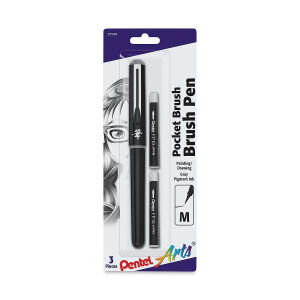
The Pentel Pocket Brush Pen with two refills.

The Pentel Pocket Brush Pen with two refills.

The Pentel Pocket Brush is a portable, easy-to-use, and refillable brush pen that can lay down a super-fine line or a heavier stroke. Perfect for travel and on the go ink sketches, it can also be used in the studio for finished work. It’s good for painting, cartooning, and more, and is available with gray, black, or sepia-colored ink. The brush and two refills typically retails for around $13, and refills are about $3 for a two pack. Pair this with a mixed media sketchbook (such as the Aquabee Super Deluxe Sketchbook) and you’ve got a great gift.


Alice Neel: People Come First

Alice Neel: People Come First is a 2021 monograph published by the Met Museum.

Alice Neel: People Come First is a 2021 monograph published by the Met Museum.

This 2021 monograph focuses on Neel’s history, social activism, and portraits. Published by the Metropolitan Museum of Art in New York and based on the blockbuster exhibition there, the hardcover book includes high-quality reproductions and essays on Neel and her work. A sense of life was in every mark that Neel made and this book is a deep look into a fascinating artist and her body of work.


Sennelier Abstract Kit

The Sennelier Abstract Acrylic Paint Kit with 8 tips.

The Sennelier Abstract Acrylic Paint Kit with 8 tips.

Sennelier Abstract acrylic paints are a new twist on painting. The paint can be squeezed out on a palette like any other paint, or try the various tips directly on these plastic pouches to squeeze paint right out of the bag. It makes the act of painting physical and immediate, and can open up a new way of working for any artist. The set includes 5 paints and 8 tips, and typically retails for around $35.


Blick Studio Black Cotton Canvas

Blick Studio Black Cotton Canvas are pre-primed and stretched and ready to paint.

Blick Studio Black Cotton Canvas are pre-primed and stretched and ready to paint.

Black primed canvases are a completely different way to approach painting, and these pre-primed and stretched cotton canvases from Blick allow you to get right to painting in acrylic or oil. Available in 5 sizes ranging from 8x10 inches to 20x24 inches, these canvases have a traditional 3/4” deep stretcher bar and are suitable for hanging or framing. Pair these with an acrylic or oil painting set for a great gift.


Golden Fluid Acrylics Set

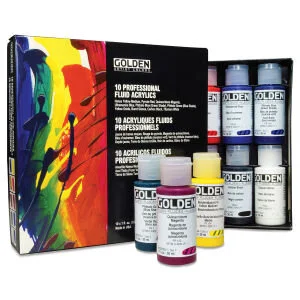
The Golden Fluid Acrylic Set includes 10 paints.

The Golden Fluid Acrylic Set includes 10 paints.

Golden fluid acrylics are high flow, thin paints for artist that spray, brush, stain, or paint. They are highly saturated with pigment and they are almost ink-like in how they lay down and dry. They are a great way to mix things up and can be used with various mediums or thinned even further with water. The set of paints includes 10 colors in 1 oz jars and usually retails for around $42


Blick Super Value Hardbound Sketchbook

The Blick Super Value Hardbound Sketchbook two pack.

The Blick Super Value Hardbound Sketchbook two pack.

Hardbound sketchbooks are great ways to keep all your sketches, thoughts, and notes in one place and this 2 pack is simply an incredible deal. At around $12 for two sketchbooks, it’s the same price you’ll pay for one hardbound sketchbook at other stores. The 65 lb paper measures 8.5x11 inches and is smooth, white, and acid free.


Caran D’Ache Pablo and Supracolor Gift Box

The Caran D’Ache Pablo and Supracolor box set.

The Caran D’Ache Pablo and Supracolor box set.

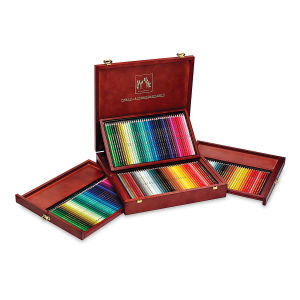
This handsome wooden box has a full set of Caran D’Ache Pablo colored pencil and Supracolor water-mixable colored pencils. The two lines blend together easily, giving you an unlimited range of possibilities for drawing, shading, blending, and working wet. At $464, it’s quite the statement gift but it includes 180 pencils, for an average cost of $2.58 each.


Other Gift Ideas

Classes: A set of classes at a local studio or art studio can be a great gift.

Magazine Subscriptions: Magazines are great sources of ideas and inspiration.

Tours, Trips, or Conferences: Look for painting-specific travel tours, retreats, or conferences.

What are your favorite gift ideas for artists? Let us know in the comments.

Gift Guides

Check out these posts:

Gift Guide for Potters

Gift Guide for Young Artists and Creative Kids


"If you can walk, you can dance" Louise Nevelson on making art

Louise Nevelson: Light and Shadow by Laurie Wilson

Louise Nevelson: Light and Shadow by Laurie Wilson

Louise Nevelson: Light and Shadow is a 2016 biography of the artist by Laurie Wilson. It’s a comprehensive, detailed overview of Nevelson’s life and approaches to art and is a great read.

From a young age, Nevelson was always making art but a combination of factors kept her on the margins of the art world until her late 50s, when she began to show in New York City and then, around the world. In her 60s and 70s, Nevelson became one of the most prominent sculptors in the world, working with installations, public art, and making numerous museum and solo gallery shows with her sculptural works.
It’s an inspiring story, and one that probably rings true to most artists in both the joy of art making but also the struggles to forge an artistic life and create your own path.

Below are a few excerpts from the book, with words by Wilson and quotes from Nevelson. The book is available in hardcover or digital editions.

Nevelson on making art:

“I’d rather work twenty-four hours a day in my studio … than do anything I know. Because this is living. It’s like pure water…. The essence of living is in doing, and in doing, I have made my world, and it’s a much better world than I ever saw outside.”

Sculpture is like a person…

One of Nevelson’s observations about this work could describe her aim as an artist: “I tell people who ask, that I don’t use wood; I don’t use black; I don’t make sculpture. If the sum of this wall doesn’t transcend wood and black and making something, then I’ve failed. Sculpture is like a person, who adds up to a lot more than a few cents worth of chemicals. I’m trying to communicate. Not to make something.” For Nevelson, this went beyond a statement about art; she was trying to articulate what she knew about the human condition: We are all alike and we are all different. And she saw her mission as expressing these contradictory truths, not in so many words, but through the formal decisions she made in her art.


On terra cotta clay, and approaches to different mediums.

Nevelson claimed that she worked on stone only when she was “a little exhausted creatively.” When she felt in full power, she preferred terra-cotta because “it gives flight and does not retard or restrict … the quick response of the clay to each idea; it permits a simplicity of approach.

It seems Nevelson was repeatedly driven to create new formats and new versions, when she approached a familiar medium, as though the tried-and-true was never quite so satisfying as what had yet to be attempted or seen.

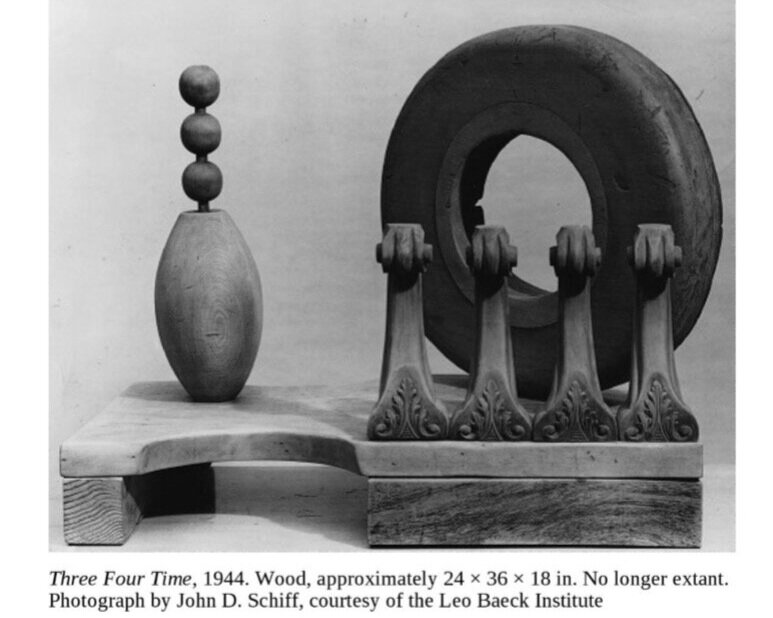
From the book: a 1944 experiment with found wood and a tire.

From the book: a 1944 experiment with found wood and a tire.

On sexism in the arts:

When asked if men treated her as an equal, Nevelson was quick to answer. “Originally, no—at 70 years, yes.”

“When I first started, nobody took me seriously. In the galleries—a woman! I’d look in the mirror and see the gestures they made behind my back. Meshugganah! A woman wanting to be a sculptor. A man sculptor said to me, ‘Louise, you don’t want to be a sculptor. To be a sculptor, you’ve got to have balls.’ ‘I’ve got balls,’ I said. But it hurt inside.”

Ferocious Bull, 1942. Another sculptural experiment that was lost.

Ferocious Bull, 1942. Another sculptural experiment that was lost.

If you can walk…

Jean Lipman, who had written Nevelson’s World a few years earlier, recalled a moment when Charles Kuralt asked Nevelson toward the end of the TV interview how, at age eighty, she could possibly maintain the energy and quality of the work that had made her famous. Nevelson paused for a full minute and said: “Look, Dear, if you can walk, you can dance.”


Louise Nevelson: Light and Shadow

512 pages, 2016, by Laurie Wilson.