The Best Boomboxes with Bluetooth and FM/AM for Your Studio or Workspace

Note: Originally published August 2022, updated and edited August 2025.

In my studio, music is almost always on. Alternating between FM radio and Bluetooth streaming, I wanted a device that could do both. Portable bluetooth speakers can sound really amazing these days, but they usually do not have FM capability. So I wanted to find one small system that can both play the radio, stream via Bluetooth, and maybe even do more, such as play tapes, CDs, or MP3s from a USB stick.

This post will cover the best options for small units that can do it all with these criteria:

  • Priced under $150

  • Bluetooth capability

  • Digital AM/FM tuner

  • Corded AC plug

Note that for under 150 bucks you are not getting audiophile quality. These units sound ok, maybe even above average, but the main goal was to find a small workshop / garage / studio boombox for playing the radio and streaming tunes from a device via Bluetooth.


Top Pick: Phillips Portable Boombox with Bluetooth

phillips digital boombox with digital tuner and tape deck and cd player

The Phillips Portable Boombox is our top pick for a Bluetooth device with a digital tuner.

This Phillips unit has everything you need in a small boombox these days, including a digital FM/AM tuner, Bluetooth connectivity, a CD player, tape deck, headphone jack, and a USB input.

This unit will give you decent audio quality for your workspace / studio / kitchen, but it may not be quite as good as a Bluetooth-only portable speaker, such as a JBL. But if you also want to listen to the radio, this is going to be an all-in-one package that will work for you.

Phillips Portable Boombox
Listed at $149.99, it’s often available for around $140.
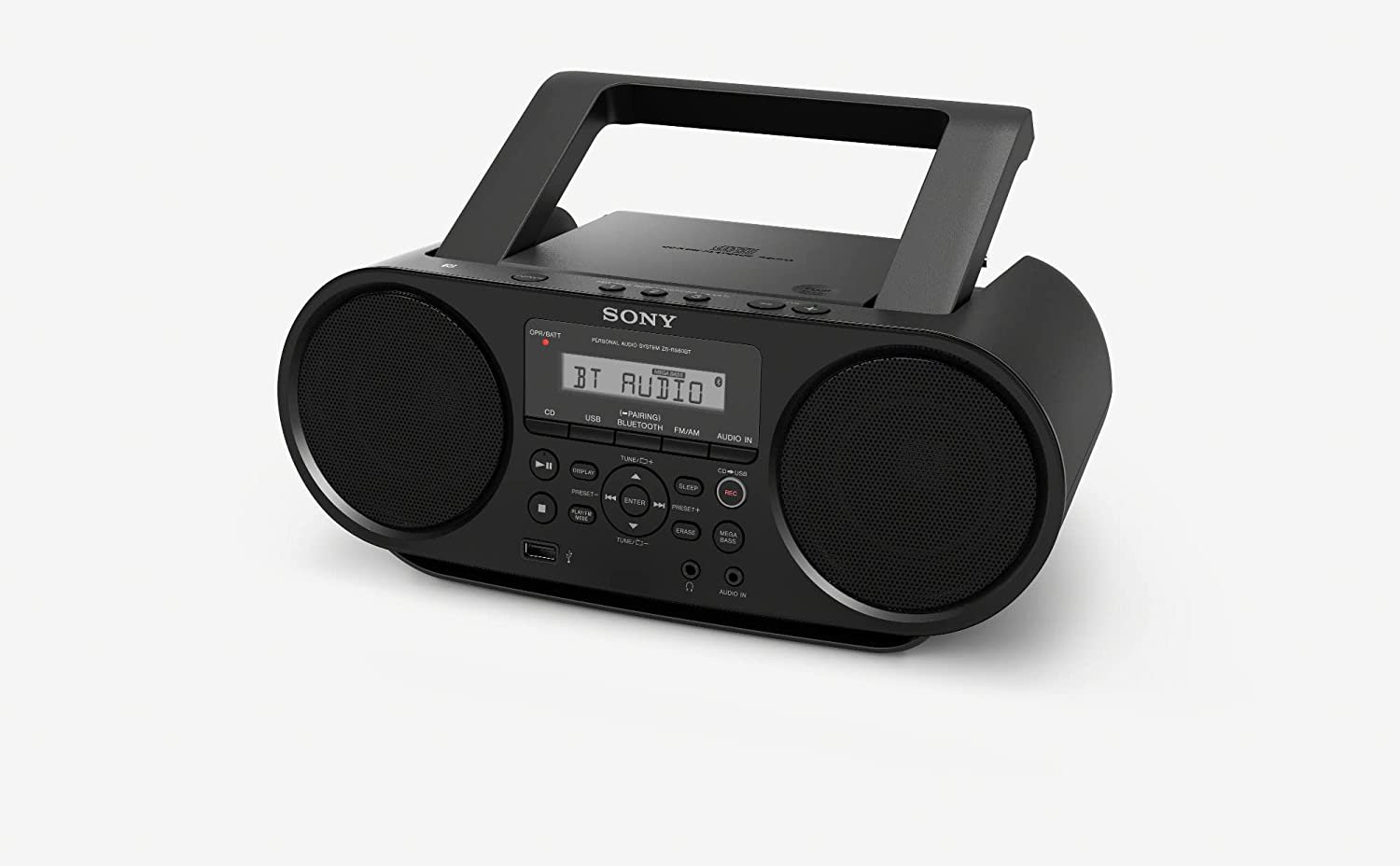

Sony Bluetooth boombox black

The Sony Bluetooth boombox has good sound and a digital FM/AM tuner with up to 30 presets.

Also great: (If you can find it) Sony Portable Boombox with Bluetooth and Digital Tuner

Our former top pick, this model is harder to find. It is unclear if it has been discontinued, but you can sometimes find it listed.

This little Sony unit has everything: Bluetooth, digital AM/FM tuner, USB playback, along with features such as a CD player and “mega” bass. It also has a dedicated button for each mode (Bluetooth / FM / USB / etc) along with plenty of other buttons, making it very easy to use and operate. This is the boombox I use in my own studio.

It has great FM reception, pulling in every low-power station in my area along with all the big stations, easy Bluetooth pairing, and decent sound. As other reviewers have noted, it doesn’t get super loud and the “mega” bass leaves a bit to be desired. You may find Bluetooth speakers with better sound (such as JBL speakers) but I wanted a radio and Bluetooth and this delivered on that. It’s a great addition to my studio and it sounds way better and louder than streaming music through my phone speakers, plus I can tune into the radio stations I enjoy. This unit seems to be the market leader for small, plug-in Bluetooth boomboxes priced at $100 or less.

Sony Portable Bluetooth Boombox: $95-$99
Power: AC cord or 6 C batteries


Table of Contents

  • Top Pick: Sony Bluetooth Boombox with Digital FM/AM Tuner

  • Budget Pick: Megatek Bluetooth Boombox with Digital FM/AM Tuner

  • Alternate Pick: KLIM B4 Bluetooth Bombox

  • Throwback Pick: Ion Audio Street Rocker 1980s Style Bluetooth Boombox

  • Other options

  • Summary


BUDGET PICK: Megatek Bluetooth Boombox with Digital FM/AM Tuner

Megatek portable bluetooth boombox in black

The Megatek portable bluetooth boombox in black.

Coming in at less than half the price of the Phillips Boombox, the Megatek Boombox has many of the same features at a budget price, including bluetooth connectivity, digital AM/FM tuner with 30 presets, MP3 playback via USB, an auxiliary-in port and it’s available in black, red or blue. It’s a decent option but some reviewers mention the sound isn’t quite as good as more expensive boomboxes.

Other drawbacks are that there aren’t as many dedicated buttons, so you’ll be pressing the mode button to switch between functions. But at $50, it’s a price that can’t be beat.

Megatek Bluetooth Boombox: $50
Power: AC cord in or 4 C batteries


ALTERNATE PICK: KLIM B4 Boombox with Bluetooth, FM, and Internal Battery

KLIM bluetooth boombox in black

The KLIM B4 Boombox features a clean design along with a remote.

KLIM makes a variety of Bluetooth boomboxes but the most interesting option is the B4 model which has all the same features as the Phillips but with an internal rechargeable battery and a remote. It also has more powerful 3 watt speakers as opposed to the 2 watt on the Phillips. It’s a great package with clean design that is listed at $70 but can often be found on sale for less, and is available in white, grey, or black.

KLIM B4 Boombox: $70
Power: AC cord or with internal rechargeable battery with 6 hour run time.


THROWBACK PICK: Ion Audio Street Rocker 1980s Style Bluetooth Boombox
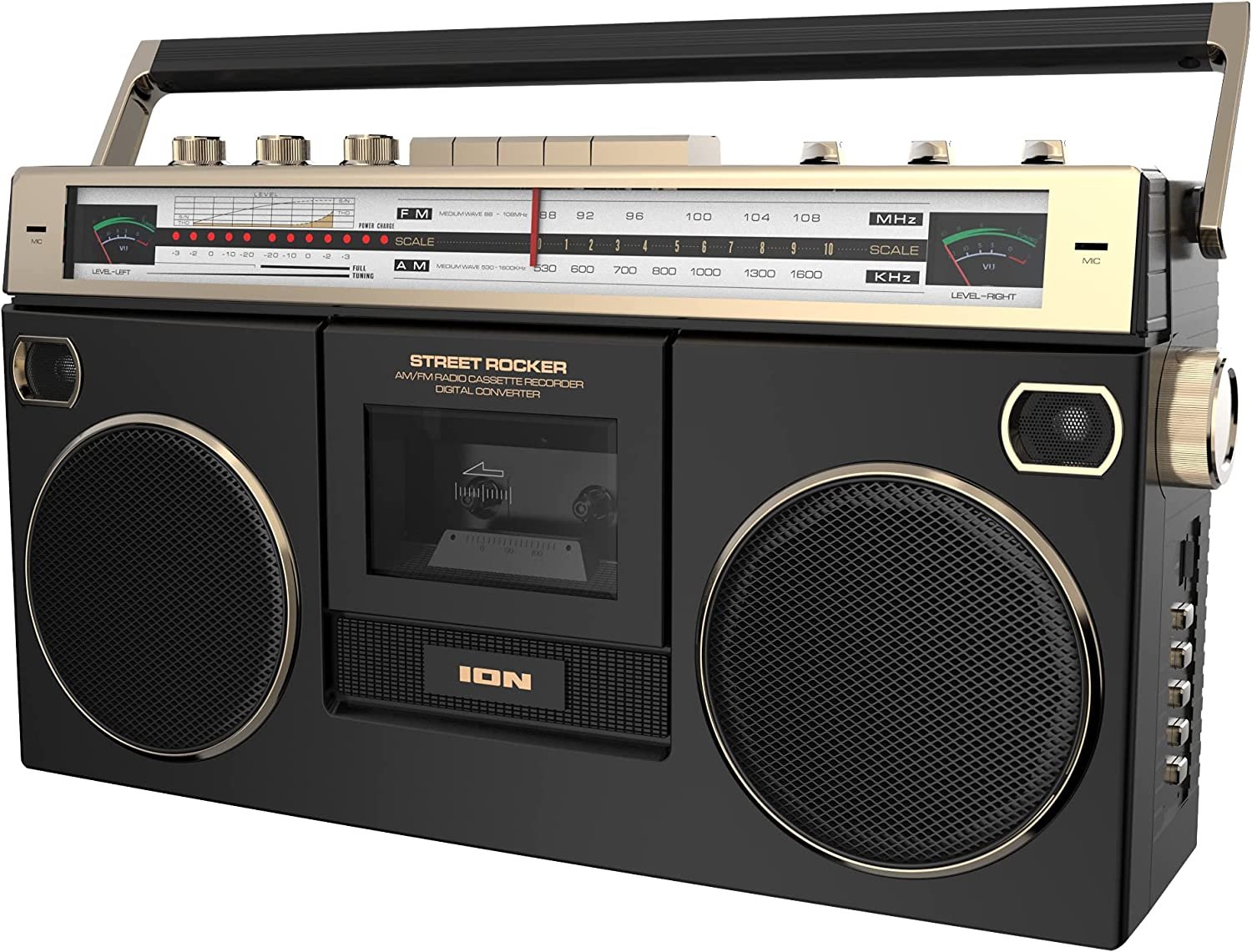
Ion Audio 1980s Street Rocker boombox

The Ion Audio Street Rocker 1980s Style Boombox features a cassette deck, bluetooth, and lots of old-school charm.

If you are looking for an old-school boombox with new features, Ion Audio has you covered. This unit features a cassette deck, bluetooth, AM/FM tuner (not a digital tuner though). The boombox has a variety of switches and dials that give that old-school feeling.

In theory I love manually scrolling through radio stations but at this point, the lack of a digital tuner is a real drawback for me (I know, I know…I’m complaining about a throwback style). But that aside, this is a cool option that would look great in any workspace.

Ion Audio Street Rocker 1980s Style Boombox: $130
Power: AC cord or 6 D batteries


Upgrade Pick: Dewalt Portable Bluetooth Radio

Black and yellow DeWalt portable radio bluetooth boombox

The DeWalt Portable Bluetooth Radio features roll bars that double as handles.

At $170, this option is a bit above the $150 limit set at the beginning of the post but it does feature some interesting options along with DeWalt’s tough build. This is a job site radio boombox, and can be plugged in or will run off DeWalt portable batteries. It will also play bluetooth music from your device with up to a 100 foot range. It also has a USB port, so it can be used to charge your device as well. All in all, a nice group of features in a bomb-proof design with roll bars that double as handles for carrying around. If you already have DeWalt portable tools and batteries, this could be a good option for you, especially if you need to move a radio around to different locations.

DeWalt Portable Bluetooth Radio
Power: AC cord or DeWalt batteries


OTHER OPTIONS

There are quite a number of Bluetooth-enabled boomboxes in the under-$100 category. Most seem to be around the $50-$60 range and are similar to the Megatek option listed above.

Insignia Portable CD Boombox with Bluetooth

Insignia silver CD cassette boombox with Bluetooth

The Insignia boombox has Bluetooth, CD, and a cassette deck.

Insignia, the house brand of Best Buy, has a $60 boombox option that has Bluetooth, digital tuner, CD player and a cassette deck. If you still use CDs and cassettes, this is the boombox for you.


KLIM B3 Boombox
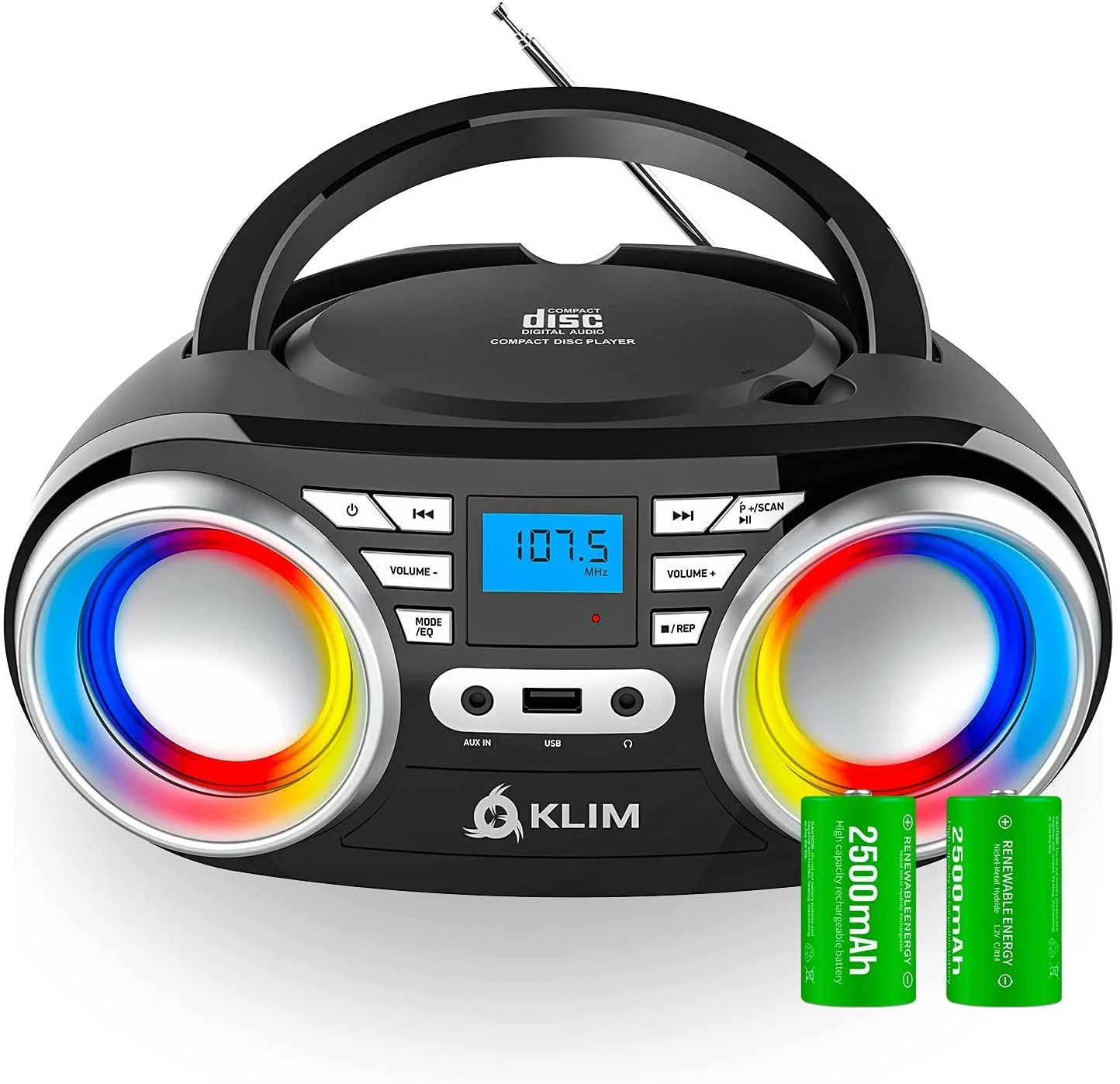
KLIM B3 boombox

The KLIM B3 Boombox has bluetooth, a CD player, and light-up speakers.

If you want more flare, the KLIM B3 Boombox has speakers that light up along with Bluetooth, digital tuner, CD, and USB playback. It also comes with rechargeable batteries, although it’s not a built-in battery. It’s a fun little unit that retails for around $40.


Avantree Boombyte

The Avantree Boombyte is a small portable FM / Bluetooth device.

This portable radio also does not meet one of our criteria—a dedicated plug—but it is an interesting little option if you want a portable FM / Bluetooth device with a long, 17 hour battery life. It doesn’t have the greatest sound, but it is a simple portable radio that can also stream music. It does not have an AM radio or an antenna, so it will only pull in strong, local FM signals. It’s listed at $60 and comes in four colors.

Avantree Boombyte
Power: internal rechargeable battery


AUDIOFILE UPGRADE

If you are willing to spend more than $100, you can get a nice workshop system that will have great sound for around $500 and up by pairing a receiver with quality bookshelf speakers such as the ELAC Debut 2.0 B5 pair of speakers. There are plenty of affordable receivers that will work with these speakers, which are known for their combination of great sound and relatively low price.

If you’re the type of person who wants great sound but at a price that still makes sense for a studio / workshop / garage, this is the set up for you. One drawback of receivers is they often don’t have great AM/FM tuners—plan to install the long antenna cord but even then, it may not have great reception.

Sony STRDH190 stereo receiver with bluetooth

The Sony STRDH190 stereo home receiver with bluetooth is an entry level priced receiver that is great for a studio or workshop.

There are lots of receivers out there but one of the best cheap receivers at the moment is the Sony STRDH190. It’s listed at $200 but can often be found on sale for less.


ELAC Debut 2.0 B5 speakers

The ELAC Debut 2.0 B5 speakers are great bookshelf speakers with 5” bass drivers and 1” tweeters.

For entry level speakers, you can’t go wrong with the ELAC Debut series. Try the 5 inch 5.0 speakers or if you want more power, the slightly larger 6.0 speakers. These are corded speakers and they sound great. For the price, you won’t find better speakers.

ELAC Debut 2.0 B5 Speakers: $269


Summary

This post has covered a variety of options for a small boombox that can stream via Bluetooth and play the radio. Focusing on the units for $150 or less, these are simple devices to add some audio to your studio or workshop at a budget price. The top pick is the Phillips Bluetooth Boombox for it’s ease of use and functionality, but there are other options. If you are an audiophile, check out the upgrade ideas which will deliver great sound but at a price that still works for a workshop.

What is your favorite device that can stream via Bluetooth and play the radio? Let us know in the comments.
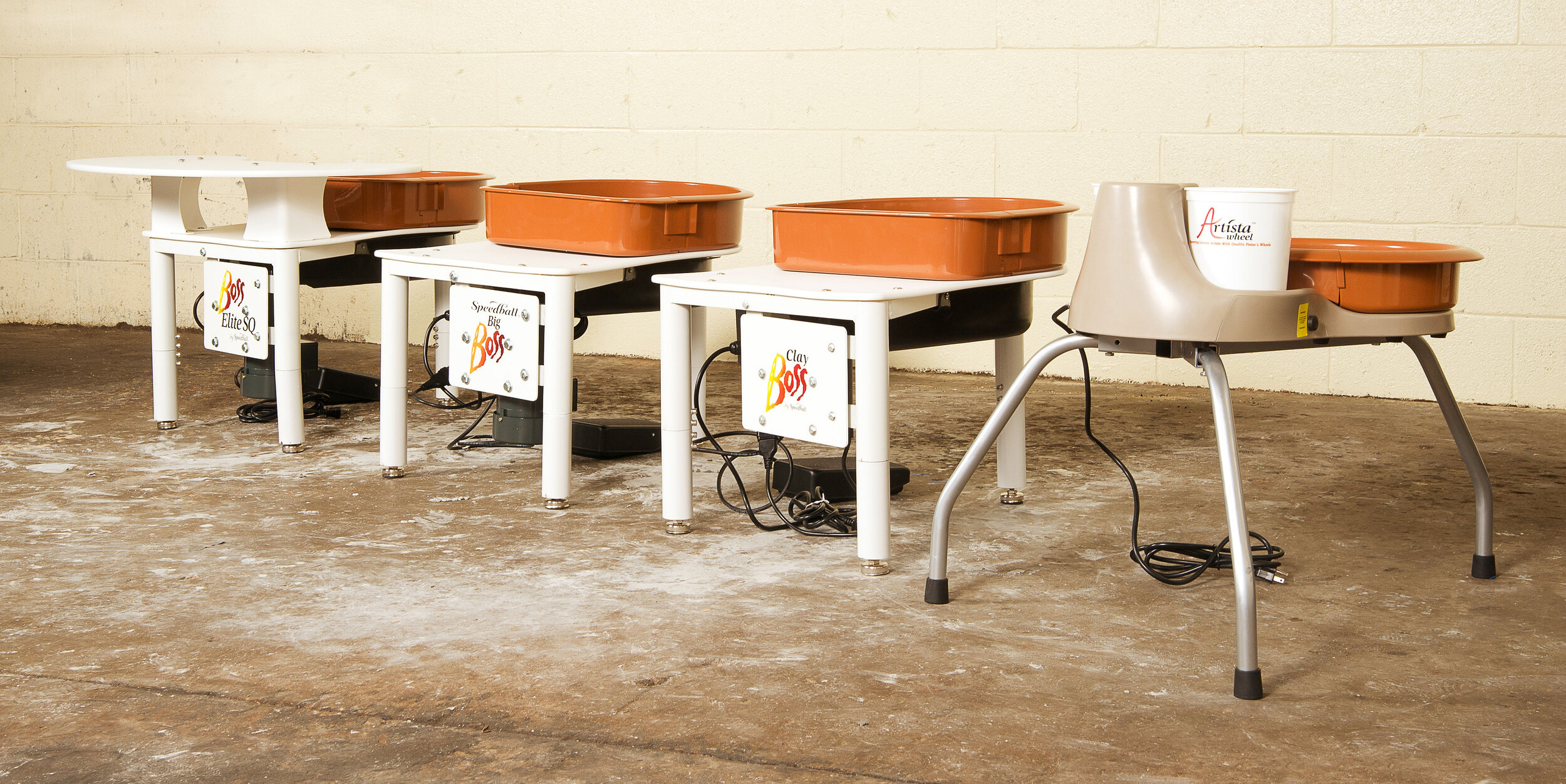
Table Top Pottery Wheel Buyer's Guide 2025

Note: Originally published 2021, most recently updated August 2025

A lightweight, compact pottery wheel can be a great option for throwing small to medium sized pots, and are priced more economically priced than full-size wheels, generally in the $300 to $550 range. Table top wheels are especially great for at home use, occasional classroom use, or if you have a small working space and need to take your wheel out and put it away.

You can get great results with table top wheels, but there are trade-offs in power and other options found in full-size wheels. If portability isn’t your biggest concern, there are also larger wheels that can be used on table tops, and these will be covered below

This guide will cover portable / table top pottery wheels and also review a few of the super affordable “budget” wheels that are lightweight and can be moved around.

The Speedball Artista table top wheel.

The Speedball Artista table top wheel.

Top Pick: Speedball Artista

The Speedball Artista is our top pick for a table top wheel. With an 11 inch wheel head, it’s almost as big as a full size wheel (usually they have 12 to 14 inch wheel heads) and with a 1/3 horsepower motor, it has enough power for small to medium size pots. And it’s light! The wheel weighs in at just 26 pounds.

The Speedball line of wheels. At right is the Artista with the optional leg and foot pedal attachments.

The Speedball line of wheels. At right is the Artista with the optional leg and foot pedal attachments.

The Artista wheel head has standard 10” bat pin spacing, a hand-controlled speed lever, and a variety of add ons such as a foot pedal and static or folding legs. The wheel comes with a 2 year warranty, and is available in right or left handed models. It is listed at $749 but typically retails for $625 to $650.

The optional legs and foot pedal will add about another $200 to $300 to the total cost, giving you basically a full size pottery wheel. Being able to store all these pieces is great, but if you are thinking of getting all the add ons, you might also look into the full size Nidec Shimpo VL-Lite pottery wheel for around $1,100. But if you need something that you can move around, put away when not in use, and set up in a variety of places, then the Speedball Artista is great option. It’s also a great wheel for kids, hobbyists, or something that you can add to the corner of a classroom or home studio.

Speedball Artista Portable Pottery Wheel
List price: $749, but typically retails for $625 to $650
Available in left and right handed models


For more on portable and table top wheels, please keep reading below.


Table of Contents

  1. Speedball Artist Portable Wheel

  2. Shimpo Aspire Portable Wheel

  3. Shimpo VL-Whisper

  4. U.S. Art Supply Table Top Wheel

  5. Other Lightweight Wheels

  6. Comparison Chart

  7. Summary


Nidec-Shimpo Aspire Table Top Wheel

The Shimpo Aspire table top wheel.

The Shimpo Aspire table top wheel, pictured here with the hand lever.

The Shimpo Aspire pictured with the optional foot pedal.

The Shimpo Aspire pictured with the optional foot pedal.

The Aspire is Nidec-Shimpo’s table top option, with a 1/3 horse power, belt-driven 7 inch wheel head. It is rated to a 20 lb centering capacity, and the wheel has a max speed of 230 rpm via the hand lever, and up to 250 rpm if controlled by the optional foot pedal. The whole unit weighs 31 lbs, making it relatively easy to put away on a shelf or closet when not in use.

The main drawback of the Aspire is that it has a small, 7 inch wheel head. There are a variety of bats and attachments designed for this wheel, but overall it feels more like a toy while the Speedball Artista feels like a portable version of a professional wheel.

The Aspire costs about the same as the Speedball Artista. It’s listed at $690 but typically available around $600 for the hand lever option, or more if you choose to add a foot pedal. The Aspire does not have optional legs.

Overall, this is a quality machine that might be the right wheel for your situation, but it is on the small side.


Shimpo VL-Whisper

With the legs removed, the Shimpo VL-Whisper makes a great table top wheel.

With the legs removed, the Shimpo VL-Whisper makes a great table top wheel.

The Shimpo VL-Whisper is our top-rated full-size wheel and is also a great option for table top use. While not exactly “portable” due to the weight, it has a flat design that can sit on a table top when the legs are removed. If you want a table-top or standing wheel with all the bells and whistles of a top-of-the-line wheel, this is a great option.

Rather than a motor and belt, the VL-Whisper is driven by a virtually silent series of magnets that spin the wheel.

Rather than a motor and belt, the VL-Whisper is driven by a virtually silent series of magnets that spin the wheel.

The VL-Whisper (VL stands for velocity) has a 1/2 horse power motor, a 14” wheel head, a reversible switch, and can center up to 100 lbs. At around 135 lbs, it is heavy, but it’s a sturdy machine with the quietest motor on the market. It has a unique magnet-driven wheel which is virtually silent and is the reason it can sit flat as there is no traditional motor hanging below the wheel head. At a typically price of $1,825, it hits that sweet spot of great performance and options, while being in about the middle of the price range for full size wheels.

But once again, the decision is do you need a lightweight, portable wheel or a heavier but still great table top wheel.


U.S. Art Supply Table Top Wheel

US Art table top wheel.jpg

Another option is the U.S. Art Supply 3/4 HP Table Top pottery wheel. It is sort of a hybrid of the Shimpo Aspire and Speedball Artista as it is a total unit that weighs around 43 pounds and it has an 11” wheelhead with a proprietary 3-pin bats,. It can go forward and reverse, tops out at 300 rpm, has a foot pedal, and retails for $400. (This model used to retail for around $600 so it has somehow dropped quite a bit in the past few years.)

The reviews on this wheel are really mixed. Some people love it and have had great success, recommending it for beginners or intermediate potters. Some say it wobbles but others describe it as quite sturdy. In general, everyone agrees that the splash pan is not the best. With a one-year warranty, it’s a bit of a risk compared to the Speedball Artista but with the new lower price, it is worth a second look for a small table top wheel.


Other Lightweight Wheel Options

In recent years, a number of very affordable wheels in the $200 to $300 range have popped up on Amazon and other places. A variety of pottery influencers have reviewed these wheels on YouTube and found them ok for very small pots, and I can attest that some of my students have tried them and liked them. But if you go this route be aware that there are some limitations, including very limited service and support if anything breaks, weak motors, small wheel heads, and no holes for bat pins if you want to start throwing more adventurous or wider forms. But if you want to try out pottery at a budget price, these may fit the bill for that. Do your research as many of these are available in a variety of permutations and generic options online.:

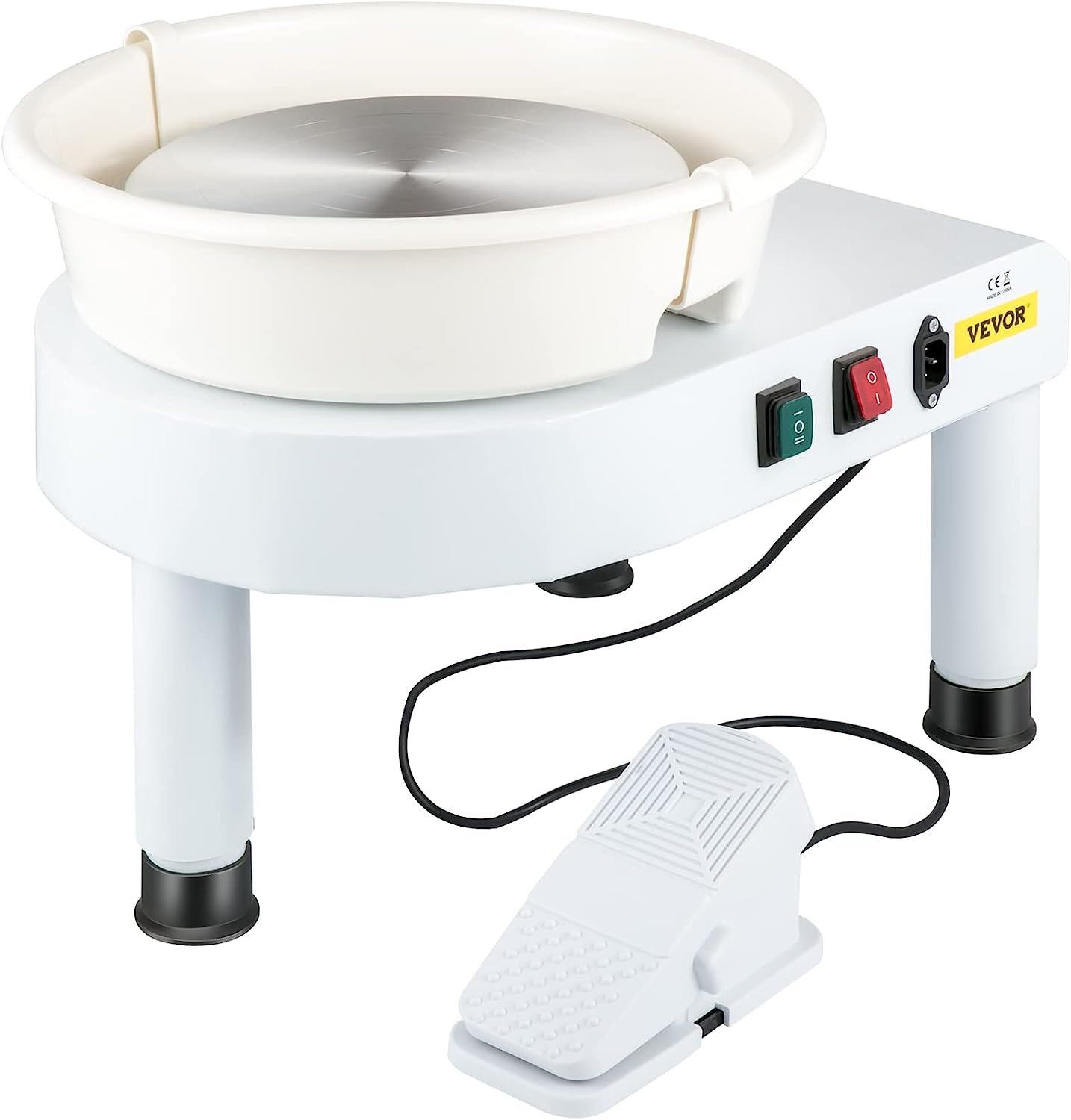
Vevor 11 inch pottery wheel

White Vevor pottery wheel

At $189, this little nugget of a wheel seems to be about the absolute cheapest you can go. It’s got an 11 inch wheel head and the legs are about 8 inches tall, along with a small foot pedal. In total, it weighs around 40 pounds.

With a wheel like this, you can throw up to 5 pounds of clay but there are tons of things you can make with just a pound or two of clay. If you want to try out wheel throwing, this might be the most entry level you can go. Just don’t expect it to last too long under heavy use.

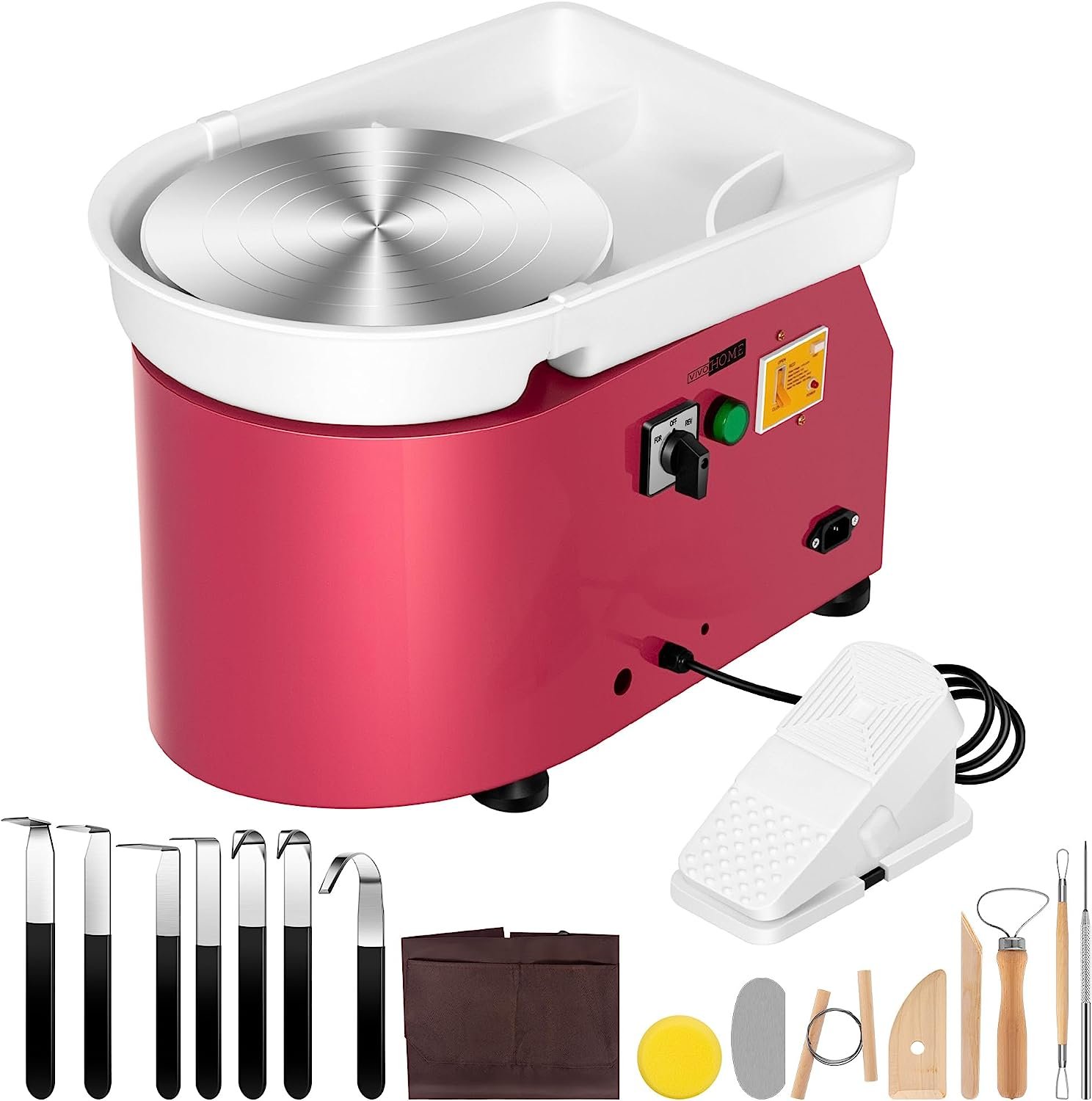
VivoHome 28 cm / 11 inch Wheel

The VivoHome 28 cm wheel and tool kit.

Another budget option is the VivoHome 28 cm wheel. Rather than 3 legs, it has a boxy unit feel along with a detachable foot pedal. I am recommending this one because while the unit is so small and low, the detachable foot pedal will allow you to raise the wheel a bit (with blocks?) while keeping the foot pedal on the floor. The models with the attached foot pedal look too small for an adult to use.

This Vivo Home wheel weighs almost 28 pounds and retails for $149 but it does come with a variety of tools.


Table Top Pottery Wheel Comparison Chart

Below is a chart with all the wheels mentioned in this post.

Table Top Pottery Wheels

Click the model name to shop at Dick Blick or Amazon.
Model Typical Price Motor (HP) Wheelhead
Diameter
Bat Pin
Diameter
Reversible Dimensions Weight Speed (RPM) Warranty Capacity
Speedball Artista $625 1/3 HP 11" 10" No, but available as R or L handed 24 x 18 x 9" 26 lbs 0-220 2 years 25 lbs
Shimpo Aspire $590 1/3 HP 7" 6" No 14.5 x 20 x 9" 31 lbs 0-230 hand, 0-250 foot pedal 5 years 20 lbs
US Art Table Top $400 3/4 HP 11" Custom 3 pin design Yes, switch 17 x 26 x 13" 42.3 lbs 0-300 1 year 25 lbs
VL-Whisper $1,825 1/2 HP, 400w 14" 10" Yes, switch 23.2 x 27.5 x 22.75" 122 lbs 0-250 5 years 100 lbs

For a comparison of all types of wheels including full size wheels, click here.

And for our buyer’s guide to full-size wheels, click here


Summary

Table top pottery wheels are great options for a wide variety of potters. This post has covered a variety of portable and table top wheel options, with our top pick being the Speedball Artista wheel for it’s full size wheel head and ability to go from a comfortable sitting down wheel, to table top, to being packed away on the shelf.

But there are other options out there to suit every type of potter and studio. What table top pottery wheels do you prefer? Let us know in the comments.


Sink Trap Buyer's Guide for Art Studios: For Ceramics, Sculpture, Plaster and More

Note: Originally published 2021, updated August 2025.

A sink trap is a vital tool for keeping clay, plaster, and other heavy particles from clogging your plumbing. If you are working with these materials, don’t just assume your plumbing will be fine; be proactive and install something! This guide will cover a variety of sink traps, and touch on DIY methods.

The first step for clear drains is to keep clay, plaster, and heavy particles out in the first place.

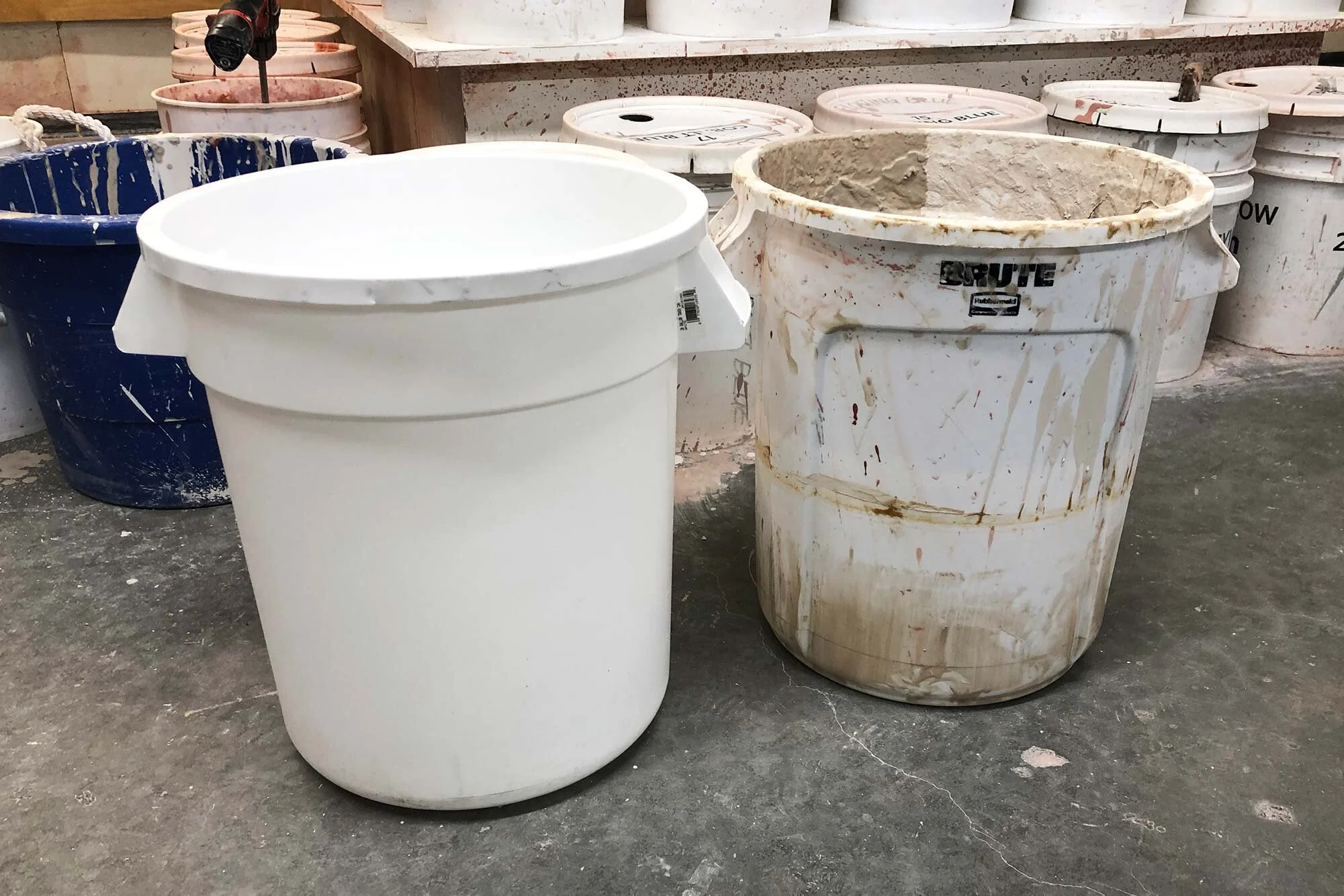
Let me repeat: pre-clean everything to keep clay and sediment out of the sink. And never pour wet plaster down a sink. You can pre-clean your clay and glaze tools in a bucket, bin or trash can filled with water. Let this settle over time, decant the clear water and discard the waste. Warning! It will get stinky. But so will a sink trap.

See more clean up advice and reommendations at the end of this article.

Even with pre-cleaning, it’s inevitable that some particles will go down the drain, so you will need some sort of trap. Many plumbers will simply install a grease trap or other system that is more appropriate for restaurants. But there are a few products designed especially for clay, plaster, and other sediment, and they are much easier to use and clean than a grease trap.

The Gleco Trap System, pictured here with 64 oz jars.

The Gleco Trap System, pictured here with 64 oz jars.

TOP PICK: Practicon Gleco 64 oz System

The top pick for a sink trap is the Gleco 64 oz Sediment Trap System. The Gleco is similar to other systems with an inlet and outlet pipe and a screw-top bottles that act as a settling tank. When full, the bottles can be disposed, or cleaned and reused. But the side drain is the big extra feature with the Gleco system. This valve allows you to drain standing water before removing the bottle. This feature really help keep your sink area clean and allows you to quickly and efficiently swap out the bottles as they fill.

The Gleco 64 oz System is currently around $107 to $117 for the kit.

The clearance needed for the different size Gleco Systems.

The clearance needed for the different size Gleco Systems.

The Gleco System with a drain has four jar sizes: 32, 43, 63, and 128 oz. All the jars are interchangeable. Due to the weight of the jars as they fill, many users recommended that the two larger sizes sit on something—plan to add wood shims or support underneath the jar. You’ll also need to measure your undersink area before selecting a jar size. The minimum clearance between the floor and outlet pipe ranges from 11.5 inches to 20 inches, depending on the bottle size. You may also need to get extra plastic piping to fit the system into your sink.

For more info on keeping your pipes clean and other sediment trap systems, keep reading.

Larger Settling Tanks: 3.5 and 5 Gallon Options

In recent years, Practicon Gleco has added 3.5 and 5 gallon settling tanks, which are simple settling tanks without a settling tank.

Practicon has added 3.5 and 5 gallon settling tank options to the Gleco line. These are simple settling tanks that are sealed into your drain system. They don’t have a release spigot, making them much cheaper, but they do have a pressure release valve that is released before changing buckets. The buckets can be discarded, or emptied, cleaned, and replaced. These are very similar to the Buffalo Trap-Eze system that has been on the market for some time, but at a slightly lower price.

The 3.5 and 5 Gallon systems cost around $60.


Shopping links At Amazon: The 43 oz and 64 oz Systems come with the pipes and two bottles, and replacements jars are available. These kits cost around $107 to $117. The 3.5 Gallon and 5 Gallon systems come with buckets and pipes, and cost around $60. Note that the 3.5 and 5 gallon systems are just settling tanks, they don’t come with the water drain valve that makes changing jars easier. But the larger systems are good for busier studios.

Gleco 43 oz System | Gleco 64 oz System | Gleco 3.5 Gallon System | Gleco 5 Gallon System

Gleco 32 oz jars | Gleco 43 oz jars | Gleco 64 oz jars | Gleco 128 oz / Gallon Jars


Table of Contents

  • Top Pick: Practicon Gleco Sediment Trap System

  • Buffalo Trap-Eze System

  • Keystone Metal Sink Trap

  • Rohde Sediment Tank

  • DIY Systems

  • Recommendations for keeping your sink clog-free

  • Summary


Buffalo Trap-Eze Systems

The Buffalo Trap-Eze 64 oz bottle system.

The Buffalo Trap-Eze 64 oz bottle system.

Designed for dental offices, these are also ideal solutions for pottery and craft studios. There are two basic models of this system: the 64 oz bottle system which is very similar to the Practicon Gleco system but without a side drain valve, and then a few simple bucket systems that attach to your plumbing with flexible hoses.

The Buffalo Trap-Eze 64 ounce system is a decent option, but if you were to get this style, I would choose the Gleco system. As of 2025, this 1/2 gallon system is still listed on the Buffalo Dental website, but it is hard to find it for sale.

 
trap-eze-clay-trap-3-5g-kit.jpeg

The Buffalo Trap-Eze bucket sediment trap.

But where the Buffalo Trap-Eze system really shines is the larger systems with 3.5 or 5 gallon buckets. This is a super simple settling tank that connects to your existing plumbing with flexible hoses. Easier to install (and cheaper) than the Gleco system, it’s a great option that just about anyone should be able to install without too much trouble. Just make sure you have enough clearance under your sink for the buckets and for the attachment to your outlet pipe. In recent years, Practicon has added very similar products to their line, so there are options to consider with this style of system.

These buckets don’t contain baffles or separate compartments, but if you make sure to preclean all your tools and hands, these will work well to trap those fine particles that do make their way down the drain. And the full buckets can be disposed, or cleaned and reused.

Some users report problems with these leaking. Make sure to tightly seal the lid to the bucket for this system to work. If you read clay forums, many potters use these traps without any problems. Both of these systems are around $65.


Keystone Metal Sink Trap

The Keystone Metal Sink Trap

The Keystone Metal Sink Trap

The Keystone Metal Sink Trap is a 2 gallon metal canister-style sink that also accommodates disposable liner bags. This style is somewhere in between the Buffalo Trap-Eze bucket systems and a regular grease trap. The metal fittings may be more long-lasting and durable than a plastic bucket, but you’ll also have to factor in the time of opening and cleaning. In general, if your system is easy to clean (like the Gleco) you’ll be more likely to do it often.

The Keystone Metal Sink Trap is available at a variety of ceramic suppliers.


Rohde Sedimentation Tank

The Rohde Sedimentation Tank, pictured here with the lid off.

The Rohde Sedimentation Tank, pictured here with the lid off.

Available in Europe, the Rohde Sedimentation Tank is a three-chambered plastic tub on a wheeled, stainless-steel base. It’s an ideal solution for any pottery studio, especially a busy community or academic studio. It measures 450 x 603 x 520 mm (17.7 x 24.8 x 20.5 inches). To my eye, it looks like a commercial version of many of the DIY settling tanks people make out of storage tubs and buckets. Rohde—if you are reading this, please start distributing worldwide!


DIY Sedimentation Tanks

Practically any ceramic forum has guides and instructions on how to build a DIY settling tank. While these may not be appropriate or up to code for a commercial or academic studio, these will work for home or private studios.

The basic idea is running your drain into a bucket or two for settling. These buckets are inside a larger storage tub, which has an outlet. And definitely build a small platform or casters so this can be moved for cleaning.

With the right tools, parts, and caulk, anyone can build a system like this. However, it might be easier to just order something like the Gleco or Buffalo trap system…but you’ll know what is right for your studio. Personally, I use a trap system along with extra-careful pre-cleaning (read below) and never have a problem.

Click here for a great guide to a DIY sediment trap system.


Clean Up Tips and Tricks

With just a bit of planning, you will never have a problem with your sinks or drains clogging from clay or other heavy particles. The solution: pre-clean buckets. Make it a goal to never have clay chunks come anywhere near your sink!

The Three Bucket System

A prewash bucket or three will give you plenty of space to wash and clean clay tools, splash pans, and dirty hands before using the sink. For an individual studio, this can be a simple tub or 5 gallon bucket. For a busy studio, it could be a trash can full of water. Or try a “three bucket system” where you progressively move from dirty to clean water. With a system like this, you might not even need to use the sink except to rinse off your hands. It is also very efficient, as the dirty water is constantly reused, which is definitely a concern for any area affected by drought.

The Carlisle Bronco 32 Gallon Waste Container, an ideal size for pre-cleaning.

The Carlisle Bronco 32 Gallon Waste Container, an ideal size for pre-cleaning.

In a personal studio, I still prefer to use a big, wide trash can of water as that allows me to dip splash pans and other large tools in the water for pre-cleaning. If this bucket gets smelly, use the method described here for sanitizing.

My favorite option for clean up is the Carlisle Bronco 32 Gallon Waste Container. It’s tall enough that you don’t have to bend over to clean, and it’s not super huge like a 44 gallon. You can also get a wheeled caster dolly, which makes it easy to move around the studio. These cans are the same style as the older Rubbermaids, and they are thicker walled and stronger than the current models of Rubbermaid waste containers.

Amazon Basics also has a simple 32 gallon trash can.


Other options:

Generic 32 gallon trash can with caster and lid combo package. Shop at Amazon

Rubbermaid Brute 32 Gallon vented trash can. (The fluted vents make it harder to clean) Shop at Home Depot


A drain cover / strainer will help catch large chunks.

A drain cover / strainer will help catch large chunks.

Sink Strainer

Your final defense before your trap is some sort of sink strainer. Get the size that fits your drain. This will keep any chunks of clay or bits of hard plaster from going down the drain.

The 4 pack pictured here should cover most sink sizes.


Summary

This post has covered a variety of options for sink traps and sedimentation tanks for pottery, sculpture and craft studios, but these same systems will work in dental offices or anywhere that is using heavy particles that will sink and potentially clog pipes. The top pick is the Gleco system for it’s ease of use and innovative side valve. The Buffalo Trap-Eze system is also a great option because it is so easy to install. You can also make your own system. The main thing, though, is to follow best practices of keeping clay, plaster, and other heavy stuff out of the sink in the first place. Setting up your studio with a pre-clean bucket or trash can is an easy solution that will pay off in clean pipes and help you avoid costly plumbing bills or problems down the road.

What do you use in your studio for a sediment trap? Let us know in the comments.


Best Pottery Wheel Stools

If you sit at the pottery wheel, you need a comfortable, functional stool that can be cleaned and will hold up over time. There are a few pottery-specific stools that really are best for throwing, but a basic stool will also get the job done and can double as a step-stool in the studio.

The following post covers a variety of stool options for the pottery wheel, including our top pick, the Shimpo Potter’s Stool. There are also a variety of budget options or stools with other features. In general, pottery stools range in price from about $50 to $125.

The recommendations come from decades of personal experience working with the pottery wheel, and managing academic and community studios and observing stools that have been subjected to heavy use. The following recommendations are based on that experience to give you the best option for a stool that matches your style and budget.

Shimpo Pottery Stool.jpg

The Shimpo Pottery Stool has four adjustable legs and can be set up at an angle if desired.

TOP PICK: Shimpo Potter’s Stool

The Shimpo Pottery Stool.

The Shimpo Pottery Stool.

The Shimpo Potter’s Stool is the most versatile, comfortable, and functional pottery stool on the market. It has four adjustable legs with nine adjustable slots on each leg, with a range of 19 to 26 inches high. The legs are adjusted by pushing a pin in and moving the leg to the desired slot and letting the pin snap back in to place. The legs also can be adjusted independently, allowing for the stool to be set at an angle if desired. (Most pictures show this stool set up at a precipitous angle but even a slight angle or flat will work for throwing) It also has a comfortable, padded seat, but the padding makes this an uneven surface to stand on so it is hard to use as a step stool in the studio.

The stool can be turned upside down on a wheelhead when not in use, and with a 16 x 16 inch footprint, it is compact and won’t get in the way. Ongoing upkeep is simple: a bit of oil on the adjustable legs when needed.

The only drawback is the adjustable pins can be a bit unwieldy to press in to change, but most potters probably don’t need to adjust their stool too often. Another drawback is that the blue seat cover can be cut or pierced if you somehow get a knife close to the padded surface. But these are relatively minor concerns. Overall, it’s compact, functional, and comfortable stool that is easy to clean and will last forever.

Shimpo Potter’s Stool
19 to 26” high, adjustable
Generally priced $100 to $130 (price seems to vary widely so shop around!)


Table of Contents

  1. Top Pick: Shimpo Potter’s Stool

  2. Budget Pick: National Public Seating 18” Stool

  3. Other Pottery Stool Options

  4. Discontinued Pottery Stools

  5. How to Find the Best Seat Height for Throwing

  6. Conclusion


Budget Pick: 18 inch Fixed Height or Adjustable Stools from National Public Seating or OEF Furnishings

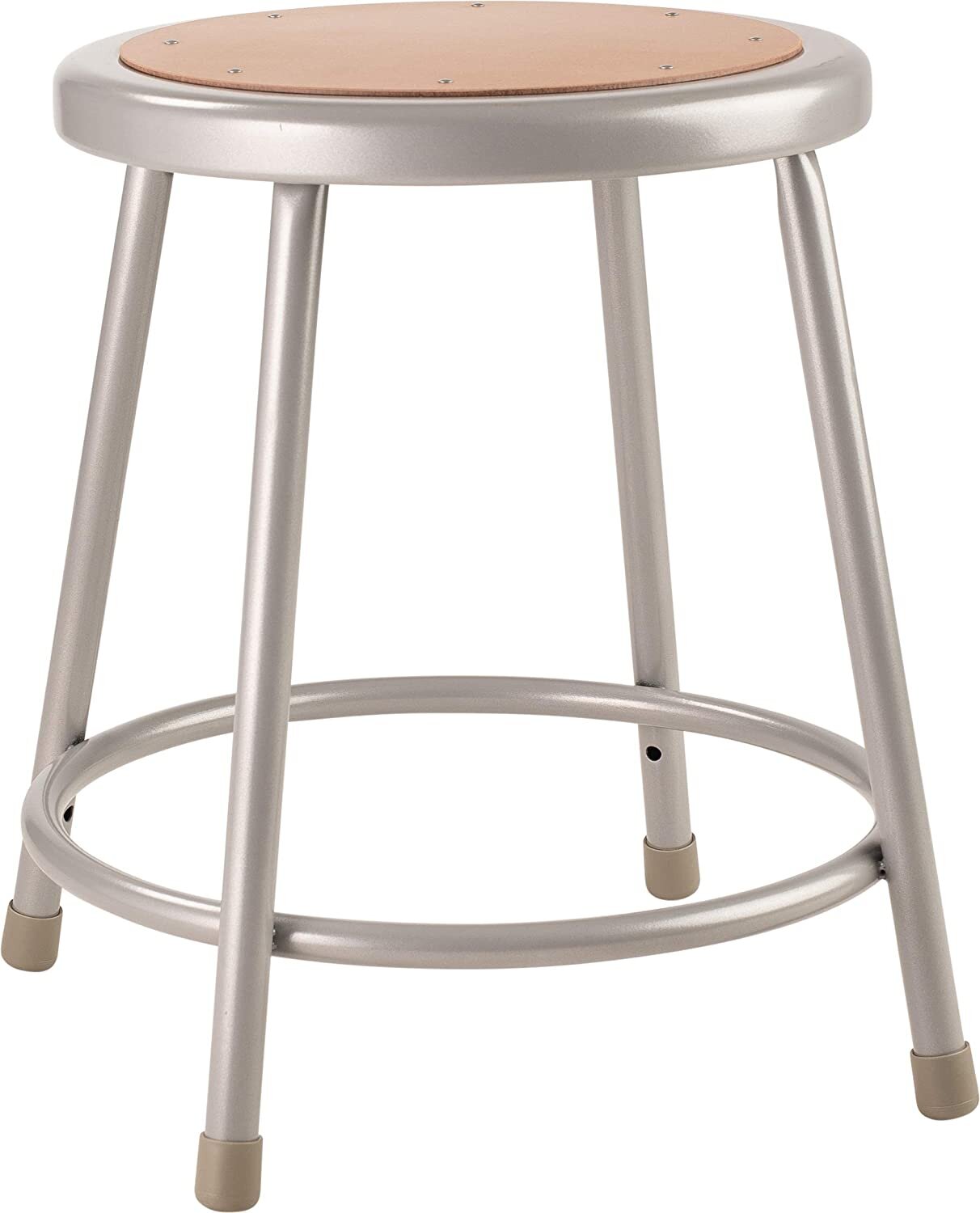
18” Stool from National Public Seating in grey.

18” Stool from National Public Seating in grey.

National Public Seating’s stools are the utilitarian workhorses of studios. Sturdy, stackable, and virtually indestructible, they will last for years of heavy use, and the shorter 18” stool can easily double as a tall step stool or low pedestal for use with your favorite banding wheel. The 18” fixed height stool is a fairly good option for the pottery wheel but some may find it a little short. You can adjust the height by adding a cushion or boards.

There are also adjustable models from 18 to 27 inches however this is a screwed-in adjustment that needs a hex wrench to change. You won’t be making quick adjustments like with the Shimpo Pottery stool.

Another plus to these stools is they are available in a few colors: a basic gray, black, and a grey with a padded vinyl cushion. These stools are very common and widely carried, so it can be good to shop around and see if there’s a sale. Typically they are around $60-$75 and a bit more for the padded or adjustable models, but you might find them on sale or as a multi-pack. They aren’t as versatile as the easily adjustable Shimpo stools, but there’s a lot to be said for having a simple stool around.

National Public Seating 18” Stool in black.

National Public Seating 18” Stool in black.

You can also find these stools with a backrest option. That can be nice for taller chairs used for hand building at a table, but a backrest makes it impossible to turn the chair upside down on a wheel head when not in use.

On Amazon, very similar stools are available in many of the same options from OEF Furnishings. Do they come from the same factory? I don’t know, but you can check out the shopping links below and find what works for you.

National Public Seating 18” Fixed Height Stool with hardboard seat
Black or grey with hardboard seat
Available for $60 at Blick or $67 at Amazon


OEF Furnishings 18” Fixed Height Stool with hardboard seat
Grey or Black with hardboard seat
Available for $53 each or as 2 pack for $90 at Amazon

 
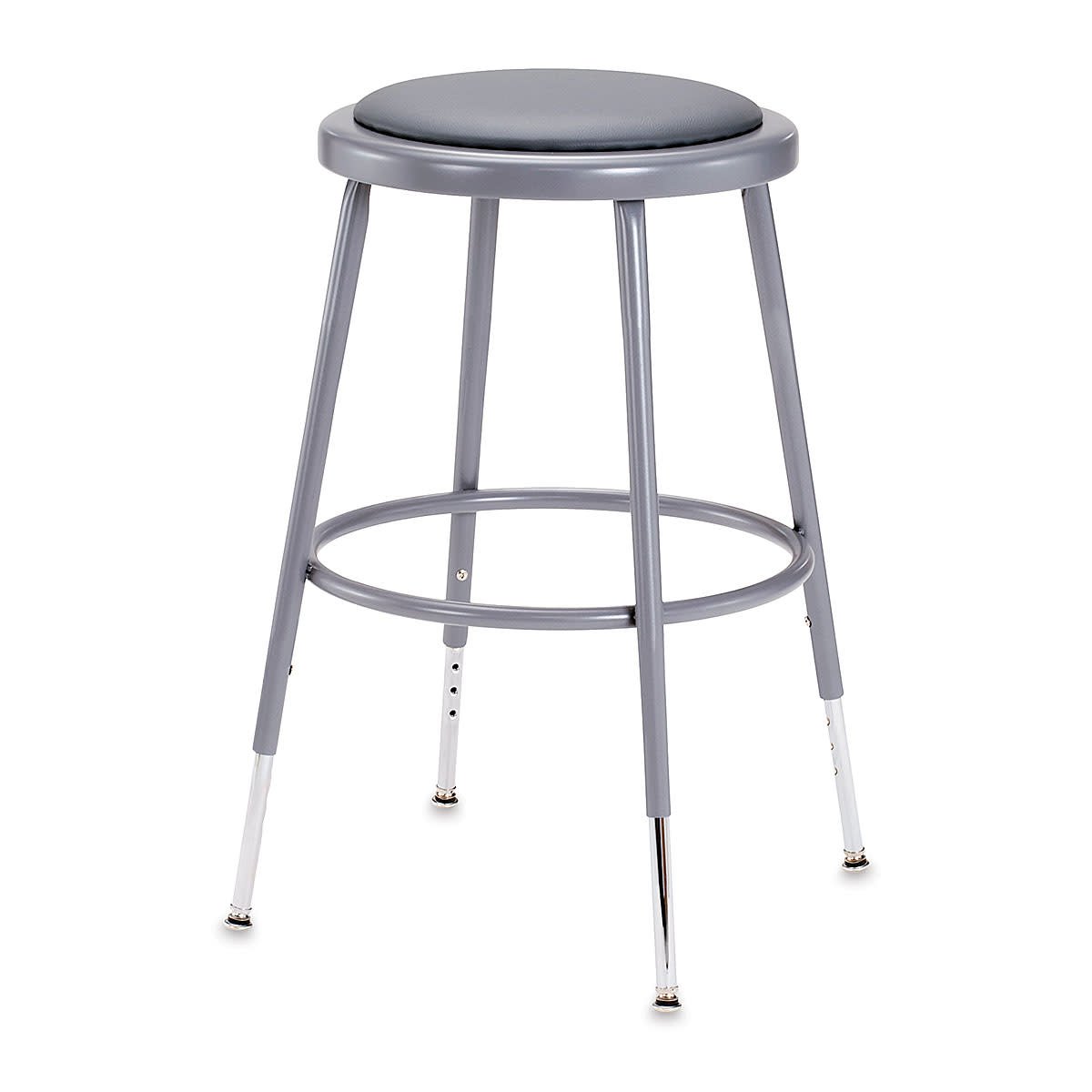
18” Stool in grey with padded vinyl seat from National Public Seating.

18” Stool in grey with padded vinyl seat from National Public Seating.

National Public Seating 18” Fixed Height Stool with padded vinyl seat
Available in grey or black, $60-$65


The National Public Seating 19”-27” adjustable height “small” stool in black with hardboard seat.

National Public Seating 19”-27” Adjustable Height Stool with Hardboard Seat
Available in black or grey
$75-$85


The National Public Seating 19”-27” adjustable height “small” stool with padded seat in grey.

National Public Seating 19”-27” Adjustable Height Stool with Padded Seat
Available in black or grey
$83-$95


Other Options for Pottery Stools

National Public Seating Adjustable Swivel Stool

National Public Seating Adjustable Swivel Stool

Another option is the National Public Seating Adjustable Swivel Stool. Rather than a hydraulic column that can break down over time, this seat is adjustable by turning the seat and moving what is essentially a big screw up or down.

The adjusting mechanism is housed in a steel center sleeve but the “teeth” of the swivel are exposed as you raise the seat. As long as this is kept clean, the stool should last for a long time. It’s great for academic studios, anywhere you need an adjustable stool, but it is heavier and harder to stack. The stool is available in a variety of styles including wood and hardboard seats, and can adjust from 17 3/4” to 24 1/4” high.

National Public Seating Adjustable Swivel Stool
Available in a variety of colors and styles
$125-$160


Artisan CK-21 High Density Foam Potters Stool

The Artisan CK-21 is an adjustable stool with a wide base and high-density foam chair.

The Artisan CK-21 High-Density Foam Potter’s Stool is a comfortable and adjustable stool that can go from 15 to 20 inches in height via a hydraulic column. Speedball used to make a very, very similar chair that is no longer listed on the Speedball website, so I assume this rebranded model is about the same and comes straight from the manufacturer. The Speedball chairs were super comfortable and long lasting, although do expect the hydraulic to not work as well over time (i.e. more than a decade) but it’s great to see the Artisan model as this style is one of the most comfortable and adjustable pottery stools on the market.

There are also two upgrade models of the Artisan stool. One model is the same seat but has a tilt adjustment, or you can choose a model with a flat, round, padded seat.

It is on the heavier side and won’t stack, but otherwise it’s a great option. Available only at Clay King in South Carolina for $111.


How to Find the Best Height for Throwing

Seated throwing at the pottery wheel can be very comfortable if you get your body positioned in the right way. I prefer to sit at least equal or higher to the wheelhead. This allows my upper body and torso to be involved in the throwing. The lower you set your seat in relation to the wheelhead, the more you will only rely on your shoulders and upper back for power, which can lead to strains and problems. You definitely want your abdomen, torso, and even your thighs to be involved in throwing.

Here’s how I suggest you find the position that is right for you. Keep in mind that every body is shaped differently. Different lengths of torsos and arms are really what come in to play with wheelthrowing:

  1. Set your chair or stool to be approximately 1 inch higher than your wheelhead. Keep in mind that bats may change the height of the wheelhead. I always sit higher than the wheelhead and instruct my students to start the same way. This allows you to “lean” in and really get a lot of power simply from the weight of your torso.

  2. If this is not comfortable, adjust your seat higher in lower in approximately 1/2” intervals until you find a comfortable position.

  3. Feel free to move your foot pedal from left to right if possible. You can also raise the footpedal on bricks or boards.

  4. Add a brick or upside down bucket underneath your non-pedal foot. Raising your leg allows your thigh to get a bit involved with adding power to your arms.

  5. While throwing, try to keep a curve in your lower back by keeping your chest up. This is hard to do.

  6. Take frequent breaks to stand up, stretch your arm, or move a bit so your body doesn’t get locked into a static position.

If you have aches and pains, you may need to consider switching your throwing position. It also doesn’t hurt to have a regular stretching routine, either before or after throwing. And adding core / ab exercises to your week will only improve your comfort and ability on the wheel.

If seated throwing is not working for you, keep in mind that many manufacturers make legs for wheels, or you can place a wheel on a table top or elevate it with cinder blocks. (Click here for a guide to table top wheels.) Many people find that a standing wheel is more comfortable and this is what you will find at many factories that work with jigs and molds on wheels. Keep in mind that if you are new to pottery, you may just need to develop new muscles, so start with 30 to 60 minute throwing sessions and grow from there over time.


Conclusion

This post has reviewed the best stools for use at at pottery wheel and covered some ideas on how to find the most comfortable position for throwing. Our top pick is the economical, sturdy, and functional adjustable Shimpo Pottery Stool. But there are other options so that everyone can find the best stool for their studio.


Best Bats for the Pottery Wheel

Updated for 2025

This is a complete guide to all the different types of pottery wheel bats on the market, including different materials, bat systems, and assorted tools that are useful with bats.

Bats are available in various sizes and a variety of materials, including plaster, plastic, medex, MDF, and tempered hardboard such as Masonite. In addition to individual bats, there are also bat systems with inserts that can speed up the throwing process.

This post will attempt to cover all the bats available on the market, explain the options, and help you pick the right bats for your studio. This guide is based on more than 20 years of personal experience with pottery and wheelthrowing, including managing a variety of studios and using all sorts of different bats.

A 12” Speedball Plastic Bat on a 14” wheel head.

A 12” Speedball Plastic Bat on a 14” wheel head.

TOP PICK: Speedball Plastic Bats

The top pick for most studios are Speedball Plastic Bats. Available in 3 sizes and a variety different colors, they have a lip that makes picking up and removing from the wheel a breeze, they don’t warp, and they are long-lasting.

Injection molded, all the bats (even the square!) have universal 9” and 10” pin spacing. They are easy to clean and store, and a good value for the money.

One tradeoff is that plastic bats are not absorbent. Absorbent bats, such as Hydrobats, are a definite upgrade but they often cost almost twice as much. But given the price, durability, and all-around functionality, the Speedball plastic bats definitely have a place in a lot of studios.

Speedball Plastic Bats
7 1/2” square, $8-$10
12” round, $11-$13
14” round, $12-$15


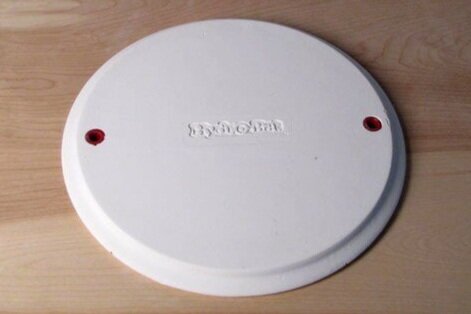
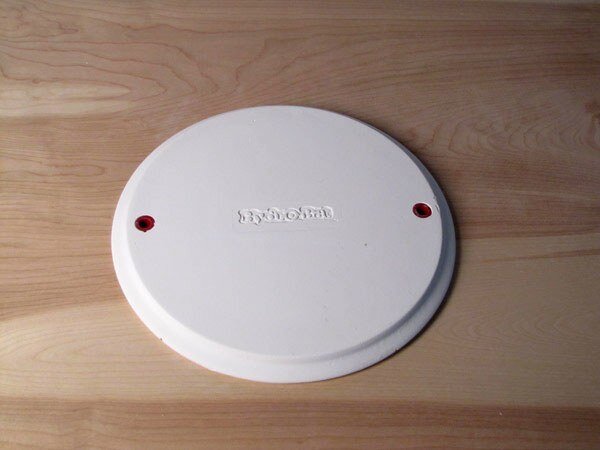
The bottom of a 12.5” HydroBat, note the red rubber bat pin grommets.

The bottom of a 12.5” HydroBat, note the red rubber bat pin grommets.

UPGRADE PICK: Hydro-Bats

Hydro-Bats are made from Hydro-Stone, a gypsum compound that is harder than plaster, and feature rubber grommets cast into the bat. Most have 10” pin spacing but there are other sizes as well. The absorbent Hydro-Stone virtually eliminates the need to cut your works off with a wire, and it is more resistant to chipping and scraping than plaster. They are thicker than plastic bats, about 1/2” thick, but if you have the room, these are a joy to use.

Hyrdo-Bats are manufactured by The Ceramic Shop in Philadelphia, PA and are available there and from a variety of other ceramic suppliers.

Hydro-Bats
Available in almost 20 sizes both flat and shaped like plates, bowls and platters,
Prices range from $10 to $50 each
As an example, the flat 12.5” bats are around $21


About Bats:

Bats are useful for a variety of reasons: they provide a platform to pick up and move your work as it is drying, they protect the wheelhead, and they might even make clean-up easier. You can throw directly on the wheel head, but for wide or flat forms, you will definitely need a bat to successfully move it off the wheel.

Scroll down for a full review of a all types of bats.


Table of Contents:

  • Top Pick: Speedball Plastic Bats

  • Upgrade Pick: HydroBats

  • Amaco Plasti-Bats

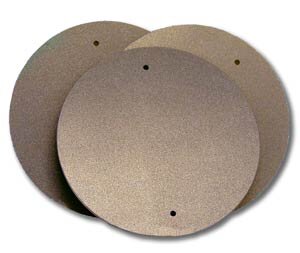
  • Laguna Plaster Bats

  • Masonite Bats

  • Medex Bats

  • Bat Systems

  • Bat Accessories

  • Summary


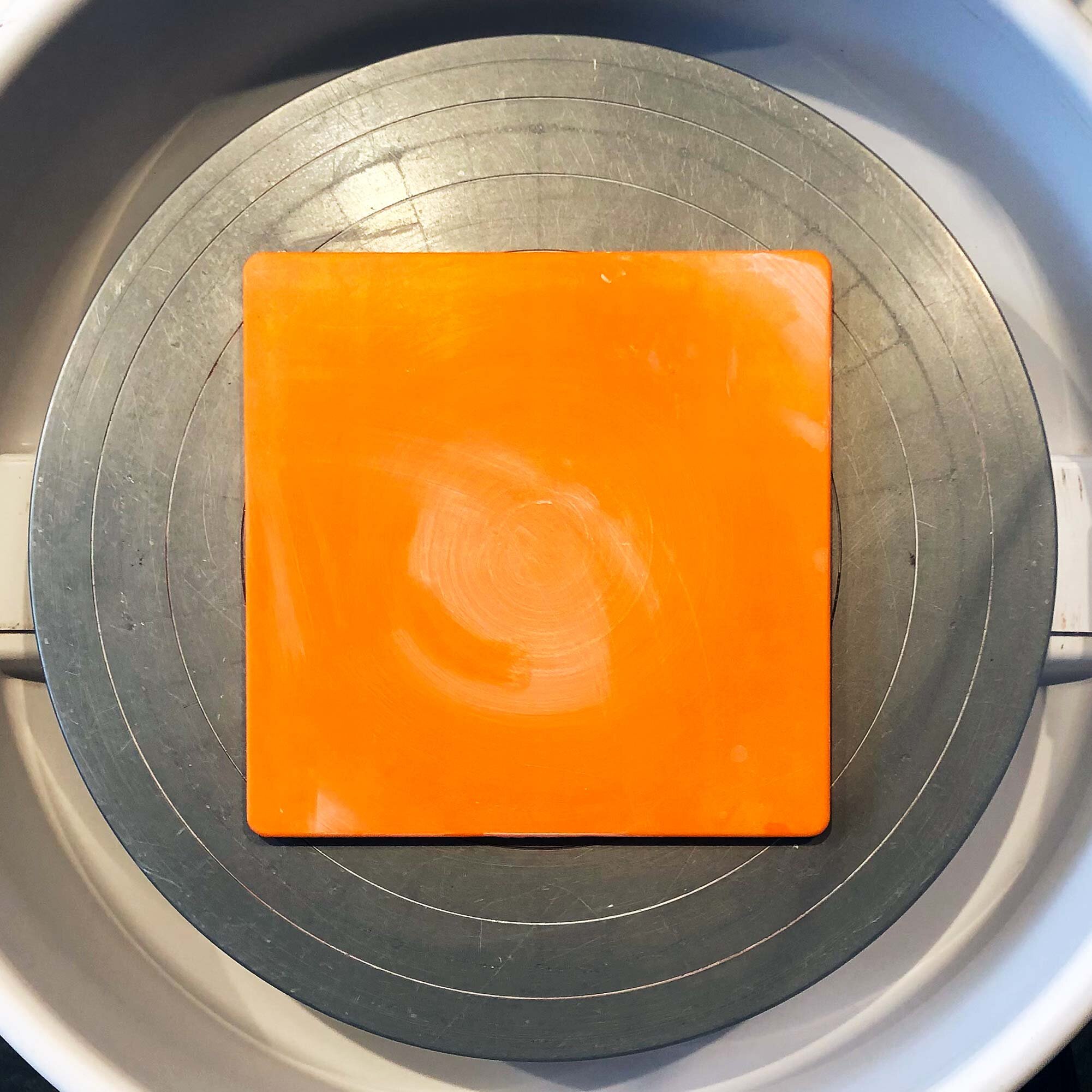
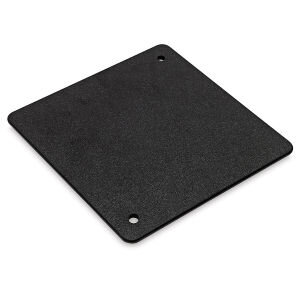
The 7.5 inch square Speedball Plastic Bat

The 7.5 inch square Speedball Plastic Bat

Top Pick: Speedball Plastic Bats

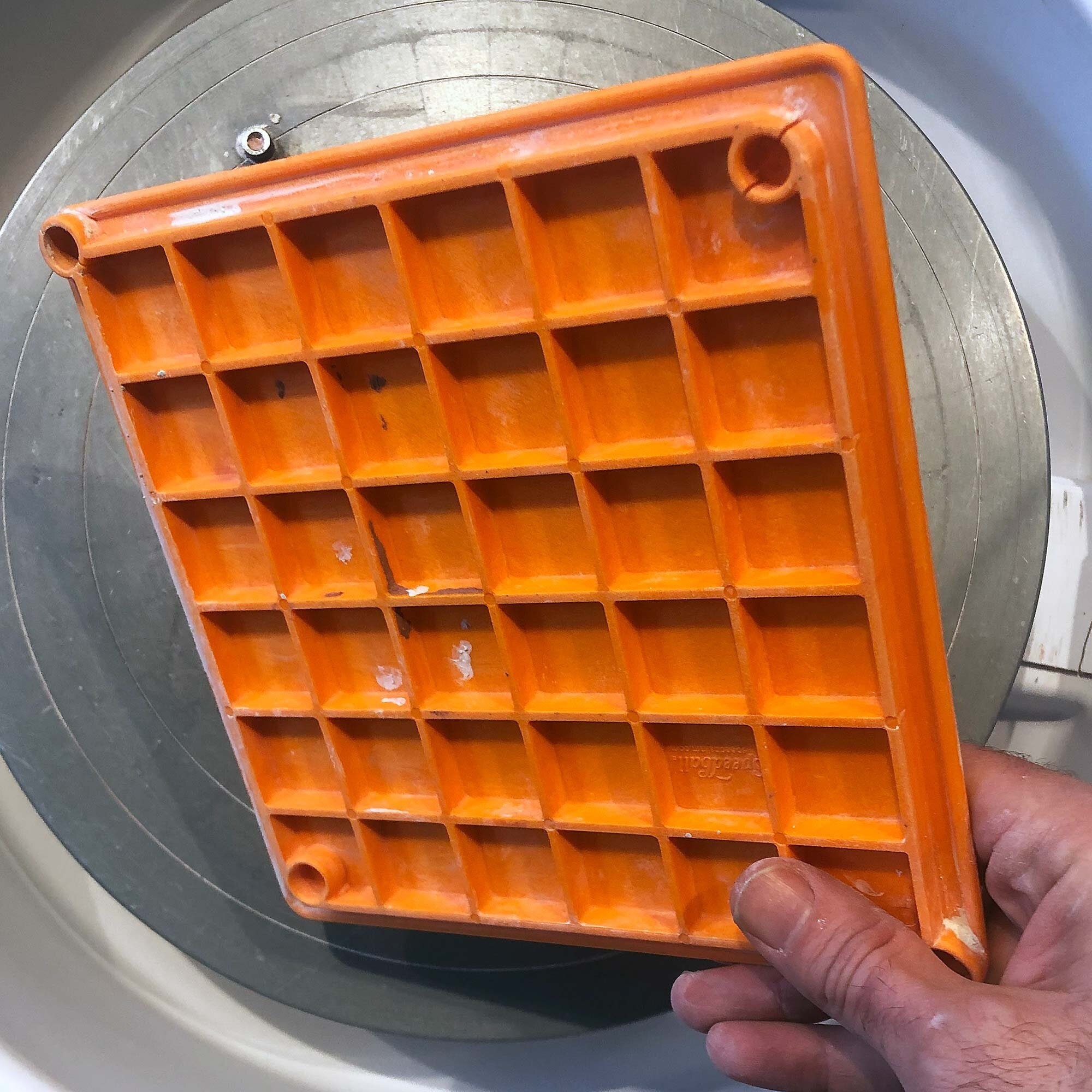
The bottom of the Speedball Plastic Bat.

The bottom of the Speedball Plastic Bat.

Speedball Plastic Bats are injection molded and available in three sizes: 14 inch round, 12 inch round, and 7.5 inch square. All feature universal 9 and 10 inch pin spacing (yes, even the square!). They have a grid of support on the underside, are about 1/4” thick, and do not warp. They don’t chip, but they can be cut by sharp knives.

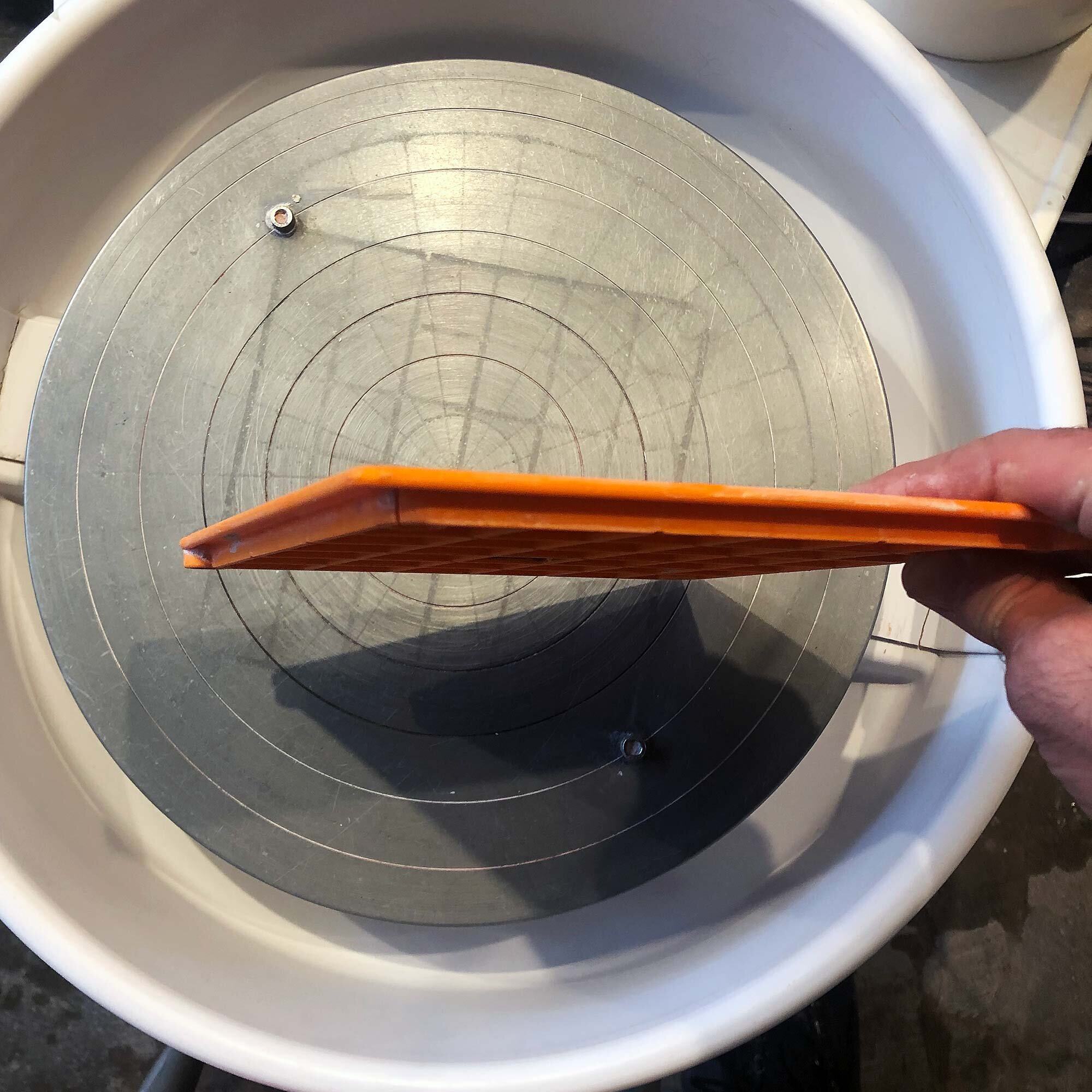
A side view of the lip on the Speedball Plastic Bat.

A side view of the lip on the Speedball Plastic Bat.

The best feature of these bats is the lip on the side. This makes them very easy to remove, as opposed to the Amaco Plasti-bats, which sit flush with the wheel head. The one drawback is with the pin opening on the bottom, you can find yourself hunting to match the bat up with pins.

These bats can be stored horizontally or vertically. The most interesting is the space-saving 7.5 inch square bat, which can really reduce storage space if you are making a variety of bowls or platters.

They are available in a variety of different colors, including brown, blue, green, orange, teal, purple, pink, and red.

Speedball Plastic Bats
7 1/2” square, $8-$10
12” round, $11-$13
14” round, $12-$15

The 12 inch Speedball Plastic Bat on a 14” wheel head.

The 12 inch Speedball Plastic Bat on a 14” wheel head.

The 14 inch Speedball Plastic Bat.

The 14 inch Speedball Plastic Bat.


Upgrade Pick: Hydro-Bats

The bottom of a 12.5 inch diameter Hyrdo-Bat, with the red rubber grommets that fit on standard 3/8” bat pins.

The bottom of a 12.5 inch diameter Hyrdo-Bat, with the red rubber grommets that fit on standard 3/8” bat pins.

Hydro-Bats are a line of bats made from HydroStone, a U.S. Gypsum product that is harder and stronger than plaster but still absorbent. They are widely available, but are manufactured by the team at The Ceramic Shop in Philadelphia. In addition to the absorbent surface, the bats have a lip for easy removal, and rubber grommets that easily fit over bat pins.

The complete line has flat bats, hump bats, and a variety of plate and platter shapes. The flat bats have two sizes of pin spacing: the standard 10” pin spacing comes in diameters ranging from 12.5 to 28 inches, and the smaller 6” pin spacing has bats that are 8.5 and 10 inches in diameter. The 6 inch pins might fit tabletop wheels or there is also a 10” to 6” adapter available.

Hydro-Bats do take up more space, they are about 1/2 inch thick. And if they become saturated with water, they won’t be very useful until they dry out. But the absorbency of the HydroStone makes these a great option for throwing bigger forms, as you will have more even drying on all sides of the vessel. When the clay pulls away from the bat without sticking, your ware will be at the perfect dryness for trimming.

Hydrobats will chip or take cuts from very sharp knives, but from experience I can say that you can drop them without much risk of them breaking (you might get some chips though.) Overall, these are my favorite bats to use because they make trimming much easier, and they are stronger and easier to use than homemade plaster bats, or other absorbent bats without grommets. They do cost more, but it’s worth it.

Hydro-Bats
Available in almost 20 sizes, prices range from $10 to $50 each.
Flat 12.5” bats are around $21


Amaco Plasti-Bats

Amaco Plasti-Bats are available in 12” and 14” diamater.

Amaco Plasti-Bats are available in 12” and 14” diamater.

Amaco Plasti-Bats are 1/4” thick hard plastic with holes for bat pins drilled through. Available in 14 and 12 inch diameter, and 9 inch square, the holes are a universal 10 inch spacing. It would be simple to drill new holes if needed for alternative pin spacing. Simple, easy, and effective, these are functional bats that will get the job done.

There is also a 9” square Amaco Plasti-Bat, which also has holes for 10” pin spacing.

There is also a 9” square Amaco Plasti-Bat, which also has holes for 10” pin spacing.

With no ribs or lip, either side can be used and cleanup is very easy. As with all plastic bats, they are non-absorbent.

The drawback with these is that while they are easy to attach to the wheel head because you can see the pin holes, the lack of a lip makes removal a bit hard. Some sort of tool or knife is needed to wedge one side of the bat up, so that your fingers can get underneath. Without the ribbing, these can warp if stored incorrectly. It’s best to store these horizontally, but they can be stored vertically as long as pressure is not applied.

These bats used to be some of the cheapest on the market, but now they cost almost as much as Hydro-Bats, making them a less attractive pick.

Amaco Plasti-Bats
9” square, $16.75
12” round, $25
14” round, $30


Medex Bats

medex-bats.jpg

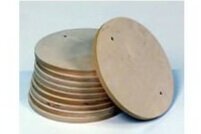
Medex Bats are a made by a variety of manufacturers including Speedball and Penguin Pottery. Medex is a 3/8” thick, engineered particle board that is made with no formaldehyde. It’s smooth, dense, and water resistant. Think of it as thicker Masonite.

With Medex, avoid soaking or long-term ware storage, or the bats may warp and/or grow mold. But if kept clean and cycling through your studio, these bats should stay flat and are cost-effective. They are more prone to warping than plastic bats, but if used correctly, they are a cost-effective option.

Potters choose these over plastic bats as the absorbency of the material will help your ware dry more evenly. Depending on the vendor, these range from half the price of a Hydro-bat to just a few dollars less, so it might be worth it to pay extra and upgrade to the Hydro-bats

Speedball Medex Bats
12” round, $12-$17
14” round, $14-$20
16” round, $17


Penguin Pottery Medex Bats
9” square, set of 5 bats: $45 ($5 each)
12” round, set of 5 bats, $65 ($13 each)


Masonite Bats

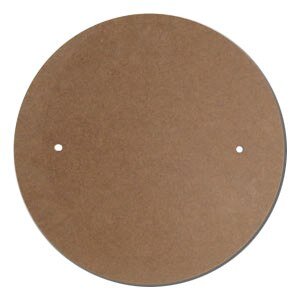
A 12” Masonite bat with universal 10” bat pins.

A 12” Masonite bat with universal 10” bat pins.

Masonite bats are made by a variety of manufacturers. They are affordable, thin, and can be real workhorses if used correctly. Masonite is a 1/4” thick, tempered, water-resistant hardboard that is usable on both sides and is slightly absorbent, making it ideal for helping pots dry. Their affordability also makes these common in production pottery, but if they stay wet for a long time (such as long-term storage of wet ware) or are soaked, they will warp, break down, or get moldy. They will also scratch if metal tools are used too aggressively on the surface.

The best way to use masonite bats is to remove the pot when it is ready for trimming, then clean the bat with a minimum of water, and allow the bat to dry before using again. Also, never soak a Masonite bat or flex it when wet, and store them horizontally. With care, Masonite bats can last a long time.

Masonite bats, generic manufacturers
12” round, around $5 per bat (usually sold in multi-packs)


Baltic Birch / Tiger Ply Plywood Bats

Plywood bats

Plywood bats

Bailey Ceramic Supply in New York makes 3/4” thick Plywood Bats in either Baltic Birch or Tiger Ply. (Baltic Birch Plywood is hard to come by because of the war in Ukraine so they have switched to Tiger Ply.) Absorbent like plaster, these bats are lighter than plaster or Hydro Stone, and won’t break or chip if you drop them. They are also more rigid for larger forms—plastic gets floppy at larger diameters. You could make your own plywood bats but these are predrilled and ready to go.

Like Masonate / Medex / hardboard, plywood will warp and get moldy if clay and ware is stored on them for a few weeks. Clean up with a minimum of water, and remove your piece as soon as you are able. It’s also a good idea to let these dry out in between uses. If properly cared for, plywood bats are long lasting.

Plywood bats
12” round to 29.5” round, $17 to $74


Bat Systems

Bat systems feature a large bat and smaller inserts that can be swapped out. The idea is to save space on the shelf, and not have to bother attaching bats over and over. It’s particularly ideal for smaller work such as mugs, and small cylinders and bowls. The downside is that you commit to one manufacturer if you need extra or replacement bats. Some potters make their own version of these using a drill and a jigsaw. Only commit to a bat system if you know it’s the right system for you, the size of work you make, and your studio. It can be a definite space saver, though, so it is worth considering if it makes sense for you..

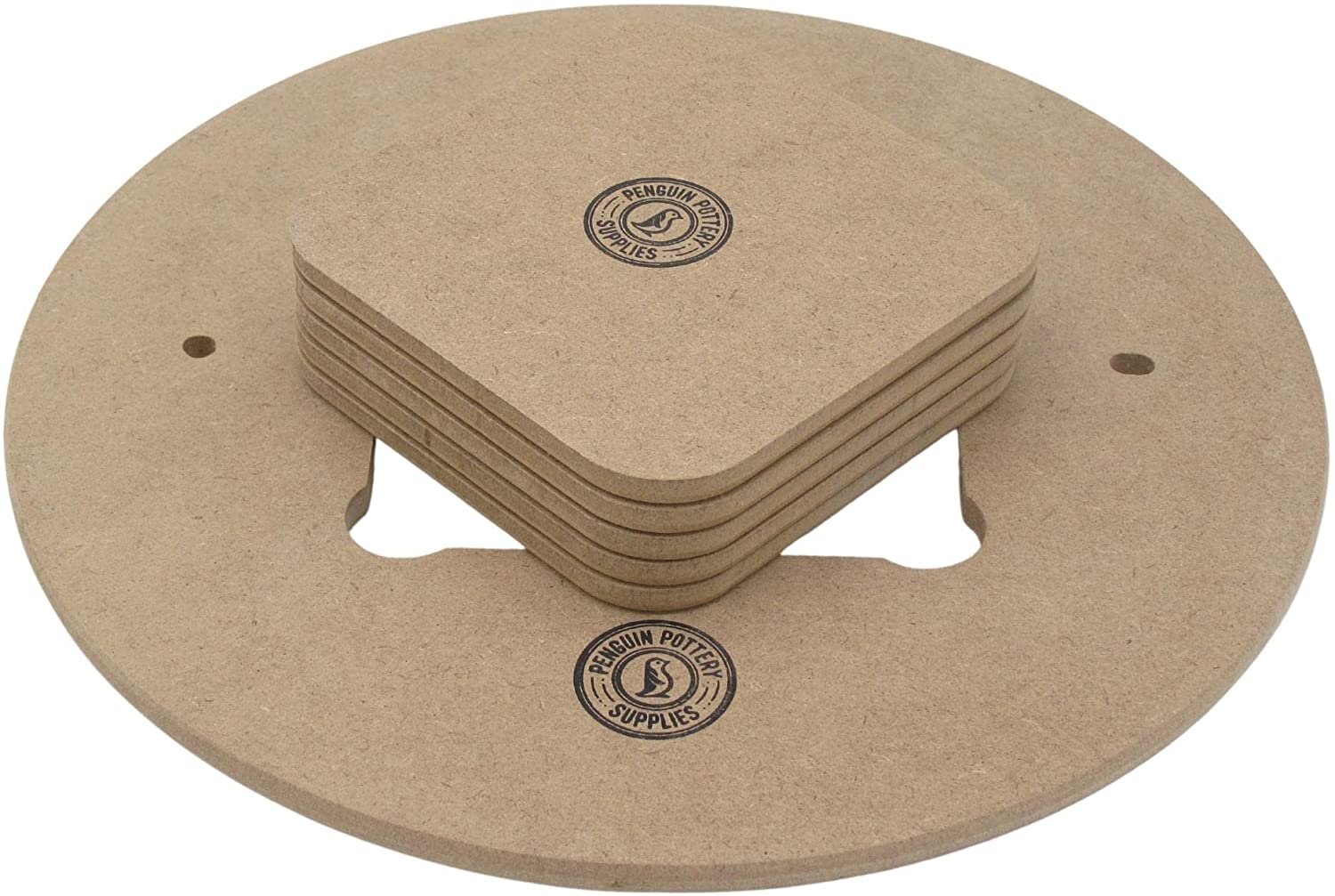
Penguin Pottery Heavy Duty Bat System

The Penguin Pottery Heavy Duty Bat System is made from MDF.

Penguin Pottery Heavy Duty Bat System

This system features a 14” circular bat with 6 inch square inserts, all made of Medex / MDF. The pins on the large bat are set for a 10” bat pin spacing, and the system is made in the USA. The inner bats are easily removable via four finger holes.

The Penguin Pottery Bat System comes with the 14” bat and 5 inserts, along with 2 pins.
Listed at $71


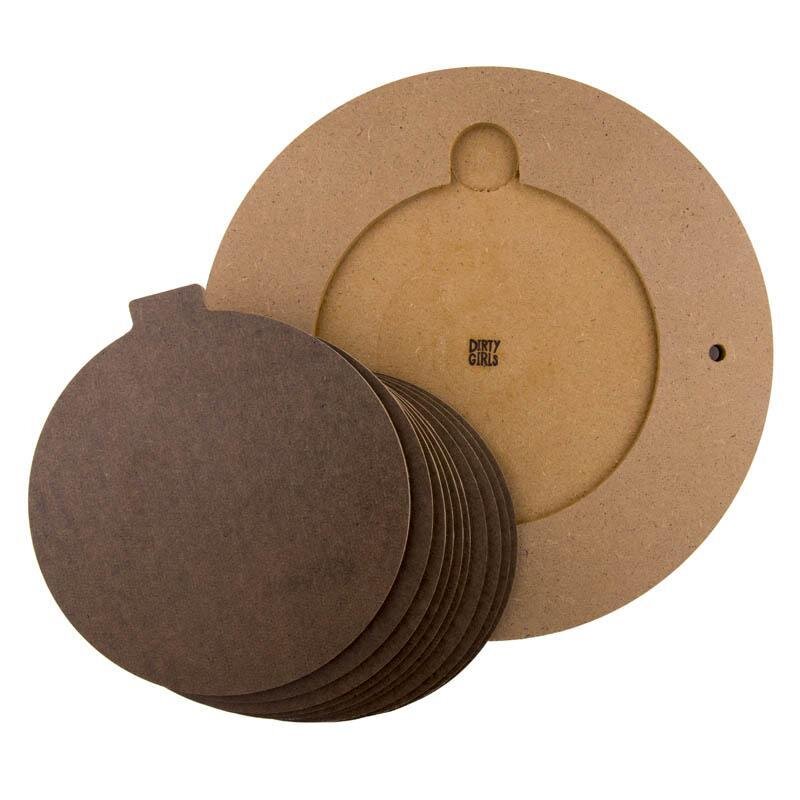
Dirty Girl Bat Systems

The Dirty Girl round bat system.

The Dirty Girl round bat system.

Dirty Girl tools makes two bat system, a square and round set. The large bat is 12.5”, and the smaller bats are 6.5 inches.

It’s not listed on the site, but it appears the larger bat is Medex or pressboard, and the inserts are thinner Masonite or some kind of tempered hardboard.

Dirty Girl Bat System
includes 10 bat inserts, $78


Snap Bat Throwing System

The all plastic Snap Bat system.

The all plastic Snap Bat system.

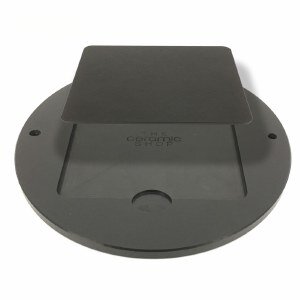
The Snap Bat Throwing System is an all-plastic option developed by The Ceramic Shop in Philadelphia. The large bat is 11.5” round and 1/2 thick, and the smaller bats 7 x 7 inches square and 1/4” thick.

Snap Bat Throwing System
comes with 5 inserts
Listed at $83


Generic Bat Systems

The WonderBat Square Bat System.

The WonderBat Square Bat System.

There are a variety of generic bat systems available on Amazon.

As with all the sort of generic “Amazon Brands,” these products seem to come and go, and are often direct copies of some of the bat systems listed above.

Buyer beware! These may be a great deal, or they might be a piece of junk.


Bat Accessories

There are a variety of accessories and add-ons that can help with bats and the throwing process.

Xiem Studio Tools BatMate.

Xiem Studio Tools BatMate.

Xiem Studio Tools BatMate

The BatMate from Xiem Studio Tools is a 12-inch diameter piece of synthetic fabric that can be placed in between a bat and wheel head to virtually eliminate any wobble, improving the accuracy of throwing and trimming. Many potters, however, wet the fabric and place it directly on a wheel head to use when trimming pots. Pots will stay put just by tension, without adding little balls of clay wadding. This saves time and works just as well.

It’s probably not necessary if you get Speedball Plastic Bats or Hydro-Bats, but it may be helpful for masonite or other bats that might have a slight warp. And it’s also a great tool for trimming small pots. At around $15, this is a tool that gets used all the time once it’s in a potter’s kit.

Xiem BatMate
12 and 14 inch diameters, $11-$14


Xiem Tools Bat Lifter

XSTBL.jpg

If you have bats without a lip, the Xiem Tools Bat Lifter will save your fettling knife or nails, helping you easily pick up one side of the bat. If you have Amaco Plasti-Bats, you definitely want one of these!

Xiem Tools Bat Lifter
$7-$15


WiziWig Tools Clay Shield

The WiziWig Tools Clay Shield.

The WiziWig Tools Clay Shield.

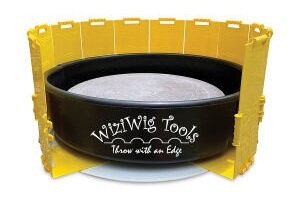
The WiziWig Tools Clay Shield is a set of 14 flexible panels that will guard your throwing area from trimming and throwing splatters. Each panel is 4 1/4” wide, 8 3/4” tall, and has a base that slides under your splash pan. When combined, the Clay Shield will cover a 20 inch diameter. Coverage varies depends on set up and your wheel, but overall, this is a simple tool that can make a big difference in cleanup. It does require some set up and can get in the way, but if you’re working in tight quarters it can really help.

If this doesn’t seem right for you, some people tape newspaper, cardboard, or even flexible cutting boards to achieve the same ends.

WiziWig Clay Shield
$35-$37


Foam Trimming Bat

Foam Trimming Bats by StudioPro.

Foam Trimming Bats by StudioPro.

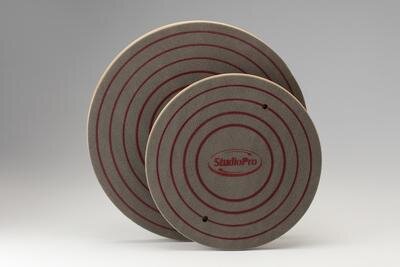
StudioPro and others make foam trimming bats. These are foam glued to a bat. You can make your own, but StudioPro offers two options: one has 1/4 in foam for smaller pots, and another has 3/4” foam for heavier or uneven pots. Simple, easy and time saving, if you think a foam bat is going to help you, it probably will.

StudioPro Foam Trimming Bats
14” or 18” round
1/4” or 3/4” thick foam


Brent Batmobile

Brent Batmobile.jpg

The Brent Batmobile is a mobile cart perfectly designed to hold scores of round bats. It can accommodate bats that are 12 to 14 inches tall, and has locking 4 inch rubber casters. It’s not cheap—you might try a DIY option—but Brent’s entire product line is built to withstand heavy use in a production or busy academic studio. It will last forever.

Brent Batmobile Bat Cart
$790


Grinding Discs

There are now a variety of grinding discs that fit right on your wheel head. A great solution—you’ve already got this spinning motor with a waterproof splash pan! Some grinding discs have sticker backs that can be used with a bat. If you’re interested in this, a good place to start is with our DIY grinding disc tutorial.


Summary

This post covered a variety of bats for use on the pottery wheel. There are bats available in plastic, HydroStone, plaster, Masonite and other hardboards, and even plywood. There’s also a variety of bat systems and other bat accessories. Overall, my favorite bat is the Speedball Plastic Bat for it’s easy to move lip and resistance to warping. Hydro-Bats are my favorite for absorbent bats.

What are your favorite bats?


The Best Banding Wheels for Pottery and Ceramics

blue nidec shimpo banding wheel

The Nidec Shimpo 9 1/2” wide banding wheel.

Banding wheels are one of the most useful tools in a ceramic studio, especially for handbuilding, decorating, and carving. They allow you to turn a piece while building, and can be extremely useful during the glazing process.

A good banding wheel will spin freely and with some speed, allowing you to hold a brush steady and paint a “band” or line of or underglaze glaze. But they can be so much more than that.

This post will cover quality banding wheels that can handle the weight of clay and be cleaned. You don’t want to mess with cheap plastic options, or lazy susans that aren’t designed to get dirty and be cleaned again. Those cheaper options will often break down or don’t have enough weight to spin freely.

The best banding wheels are heavy and made out of metal, but there are a variety of options to fit each studio and budget. Read below for a full buyer’s guide to banding wheels.

This guide is based on personal experience with all the banding wheels, along with observations of what works and holds up in academic and community ceramic studios, and what tends to fall apart and not be worth the money.


Table of Contents

  1. Top Pick: Shimpo Banding Wheels

  2. Budget Pick: CSI Banding Wheels

  3. Great option: Generic Metal Banding Wheels from Falling in Art etc

  4. Other Banding Wheels

  5. Summary


Top Pick: Nidec Shimpo Banding Wheels

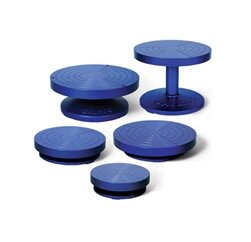
The complete line of Shimpo Banding Wheels.

The complete line of Shimpo Banding Wheels. The three shorter options are 2 1/4” tall while the two “pedestal” banding wheels are 4 3/4” and 7 1/2” tall.

Nidec Shimpo banding wheels are made of cast iron and painted with rust-resisted blue paint and are heavy, durable and will last a lifetime. They have sealed ball bearings, a one-piece design that will not come apart when picked up, and the weight of the cast iron results in a smooth, even spin. These banding wheels are a pleasure to use whether you are coil building, painting, carving, or sculpting.

Once again, these are solid, durable cast iron. Take good care of this banding wheel and it you will be passing it down to the next potter in decades or longer. They are easy to clean, just don’t submerge the whole thing in water.

Shimpo banding wheels come in five sizes ranging from 7” to 11 3/4” wide. The three smaller wheels are all 2 1/4” tall, while the two taller sizes are 4 3/4” tall and 7 1/2” tall.

My preference is for the shorter, lower-profile banding wheels but a pedestal-style banding wheel may work for your studio. Some may find these banding wheels to be on the heavy side, but the weight works to your advantage to create a steady, even, long-lasting spin.

Shopping tip: These banding wheels tend to be cheaper at Blick than Amazon. Yes, the Nidec Shimpo are the most expensive banding wheels out there but they are also the heaviest, most durable, and the weight allows them to spin for much longer than other banding wheels. In the 5 years we have been maintaining this guide to banding wheels, the Nidec Shimpo banding wheel prices have only increased by a few dollars to they have remained a good value.

The Shimpo 25L Banding Wheel is 9 7/8” x 2 1/4” and is the most versatile size.

The Shimpo 25L Banding Wheel is 9 7/8” x 2 1/4”

Shimpo Banding Wheel Specs:
Model number, diameter, height, and weight:

18L 7” x 2 1/4”, 6.5 lbs, $66-$82 (Shop at Amazon | Shop at Blick)

22L 8 3/4” x 2 1/4”, 13 lbs, $77-$90 (Shop at Blick)

25L 9 1/2” x 2 1/4”, 15 lbs, $131 (Shop at Amazon)

25H 9 7/8” x 7 1/2”, 19 lbs, $123-$148 (Shop at Amazon | Shop at Blick)

30M 11 3/4” x 4 3/4”, 28 lbs, $142-$172 (Shop at Amazon | Shop at Blick)

More pics of the Nidec Shimpo banding wheel

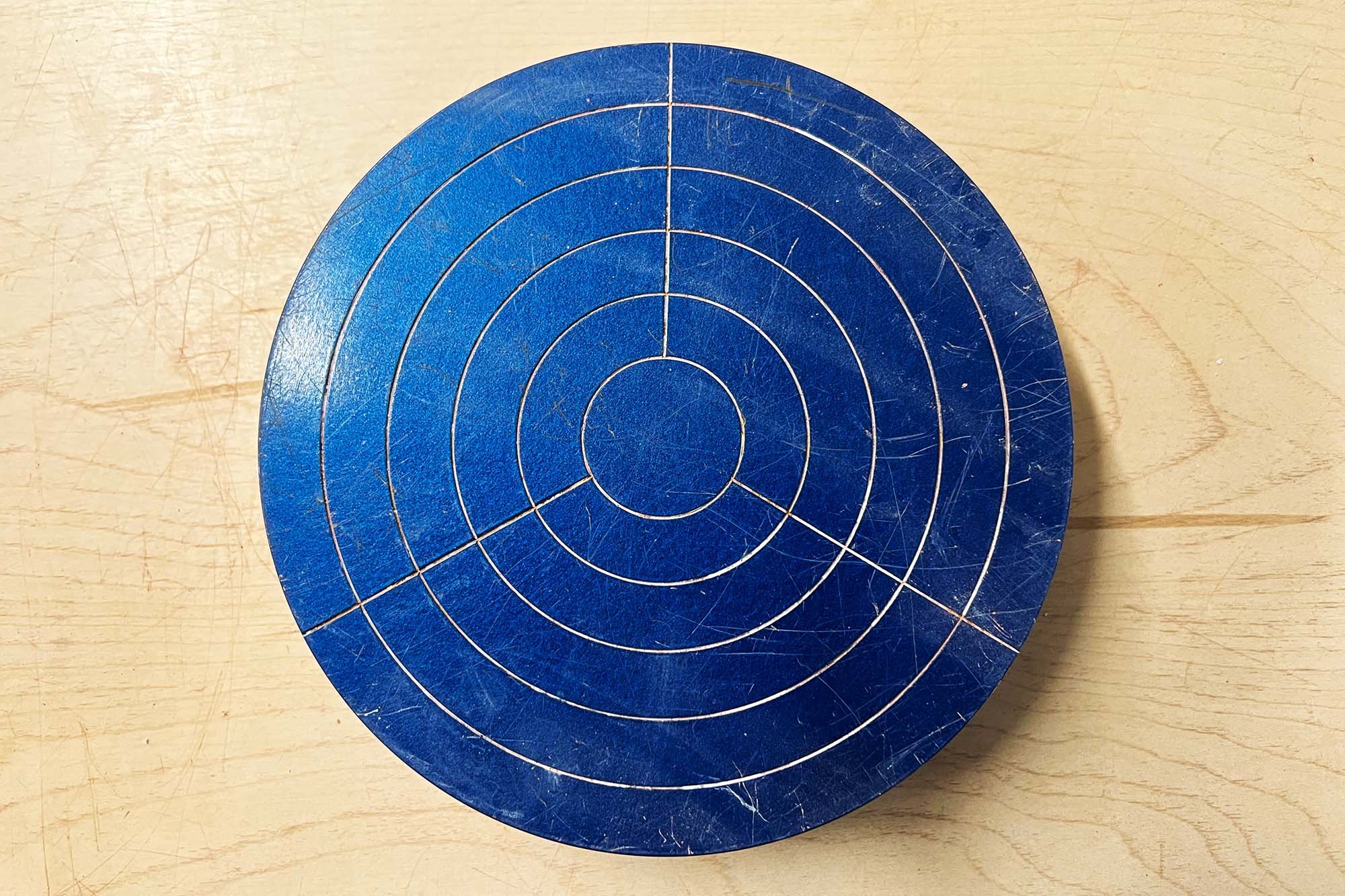
Top view nidec shimpo banding wheel

Top view

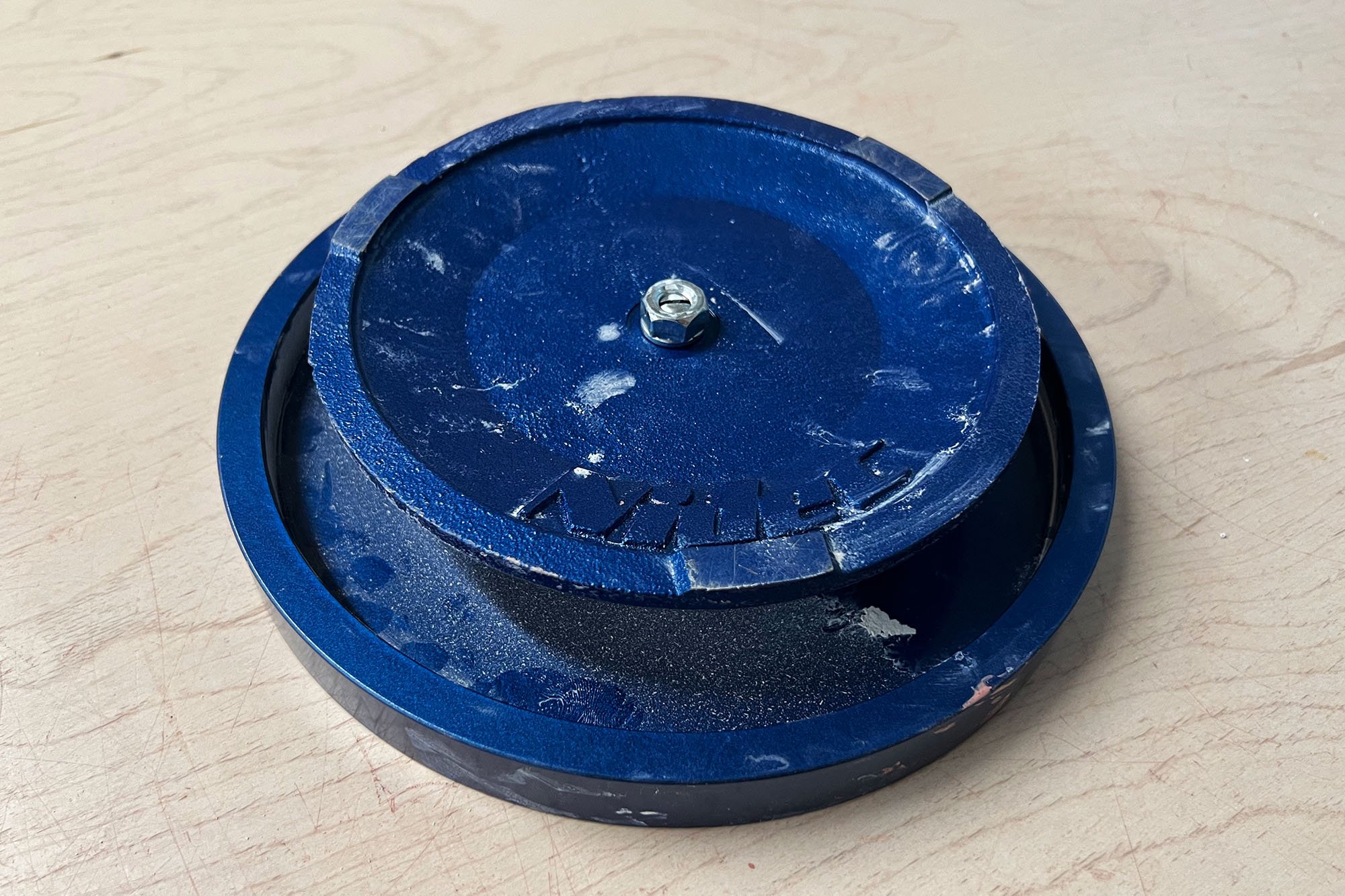
bottom view of Nidec Shimpo Banding wheel

Bottom view


Budget Pick: CSI Banding Wheels

CSI Banding Wheels come in sizes ranging from 8” to 16” in diameter.

CSI Banding Wheels come in sizes ranging from 8” to 16” in diameter.

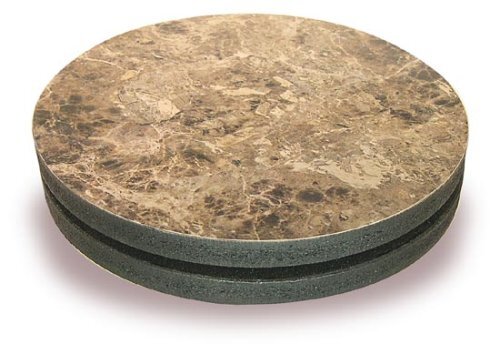
CSI Banding Wheels are heavy-duty, economical banding wheels made from two Formica-covered particle boards with stainless steel ball bearings. They are 2 inches tall and range from 8 to 16” in diameter. These banding wheels are portable and stackable, and are lighter than cast-iron options such as the Shimpo. They have decent turning capacity but they don’t turn as readily and easily as the Shimpo banding wheels. They are great for everything except a very fast and continuous painting of a line or band.

For heavy sculptures or vessels these are great options for handbuilding where you will be turning the piece slowly. The 8” and 10” wheels have a 200 lb capacity, the 12” is rated to 300 lbs, and the 14” and 16” are rated to an 800 lb capacity.

The CSI banding wheels range in price from around $28 to about $42. That’s an incredibly great deal for a heavy-duty banding wheel, making this a great option for educational studios, beginners, or those more focused on sculpture and handbuilding rather than spinning decoration.


Metal Wheel Budget Pick: Falling In Art Banding Wheel

US Art Supply metal banding wheel.jpg

These generic metal banding wheels, available under a variety of names online such as Falling In Art or US Art Supply, are highly rated and run about half the price of the Shimpo banding wheels. Available in 7” and 12” diameter, with a 4 inch pedestal, and a weight of about 10 lbs, these wheels have a set screw to hold the top and bottom pieces together. They are not quite as heavy as the Shimpo, but much heavier than other options such as the CSI Turntables or plastic wheels. For 1/3 to 1/2 of the price of the Shimpo banding wheels, these are a decent option for any studio, especially if you are on a budget.

As with all the banding wheels, do not submerge these in water for cleaning to avoid damaging the ball bearings.

7” banding wheel, generally $28

12” banding wheel, generally $38-$40


Other Banding Wheels options:


Laguna Banding Wheels

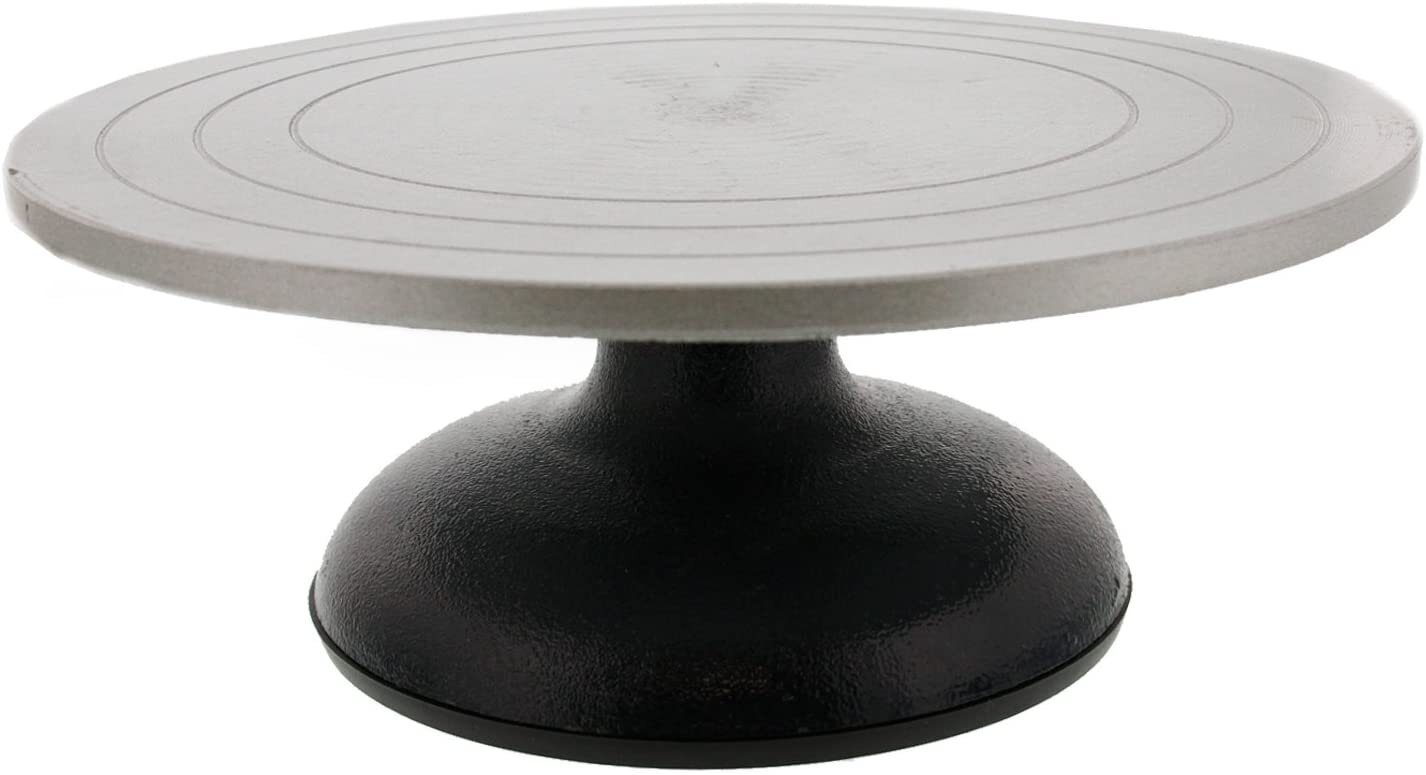
Laguna NL 278 aluminum and cast iron banding wheel turntable 12 inches wide by 2 inches tall with concentric rings on the top wheel head

The Laguna NL-278 Banding Wheel is 12 inches wide and 2 inches tall.

Laguna Clay makes a line of banding wheels with a cast iron base, steel bearings, and aluminum wheel head. Often, the wheel head will be very similar to the wheel head of a regular pottery wheel.

There are 6 options in the Laguna product line; 4 pedestal banding wheels that range from 5” to 6.5” tall, and 2 that are 2 inches tall. My favorite model is NL-278 which is 12 inches wide and 2 inches tall and retails for around $140. It’s basically a full-size wheel head, but as a banding wheel.

Because these are aluminum on top, they don’t spin as long as the Shimpo wheels, but they are well made and hold up. These wheels are available at a variety of ceramic suppliers, or directly from Laguna via their Axner Clay website.


Yncotte 7” Aluminum Banding Wheel

Yncotte aluminum banding wheel for ceramic studios

This light duty banding wheel is 7” wide, made out of aluminum, and is ok for light duty work. It doesn’t spin very long, due to the light weight. But it can be used in either direction and it fits just about anywhere as it is small.

I have used these more recently in a number of academic studios and they are definitely better than a plastic banding wheel, but given the $32 price tag, I would go for either the Falling In Art banding wheel, or spend more and get the Nidec Shimpo Banding Wheel.


Amaco #5 banding wheel.jpg

Amaco #5 Banding Wheel

The Amaco #5 Banding Wheel is a 7” wide aluminum banding wheel that sits on a pedestal stand. Along with the Shimpo and CSI banding wheels, it’s quite common to see this in many ceramic studios. The smaller size, lighter weight, and pedestal stand makes it popular for decorating, carving, scraffitto work, and painting. It is not designed for heavy weight, but it is sturdy.

The drawbacks with this stand is that it is in two pieces and will separate if picked up by the top piece. There are also a variety of mixed reviews online, mentioning poor construction quality. AMACO may be having production issues with this unit, but in my experience, it’s a quality turntable that is great for small decorative tasks.

As of 2025, this turntable doesn’t appear to be listed on the Amaco website or at any stores. It is most likely out of production, but you may still see it for sale used.


Plastic Banding Wheels

Plastic banding wheel.jpg

The Richeson Plastic Banding Wheel is 8” wide and 1 1/2” tall.

To be completely honest, I feel that plastic banding wheels are not worth buying. They can’t really be used for painting or banding, as the light weight doesn’t result in any lasting spin. They are also prone to breaking. You’ll be better off spending a bit more to get a CSI wheel or Falling in Art.

The only reason I can see to get a plastic banding wheel is for working with young children. They are lightweight and stackable (but not robust…treat them carefully!) Or the other reason if you just need a lightweight turntable for detail work such as carving or fine detail sculpting.

Given the price of these, ranging from $21 to $36, the money would be better used to get a metal banding wheel.

Richeson Plastic Banding Wheel
8” diameter, 1 1/2” tall, $21

Amaco Decorating Wheel in brown plastic 8" wide

The Amaco Decorating Wheel is 8” wide, all plastic, and is available in brown or off white.

Amaco Plastic Banding Wheel
8” diameter, $36


Jack Richeson Mobile Sculpture Stand and Turntable

Sculpture Stand.jpg

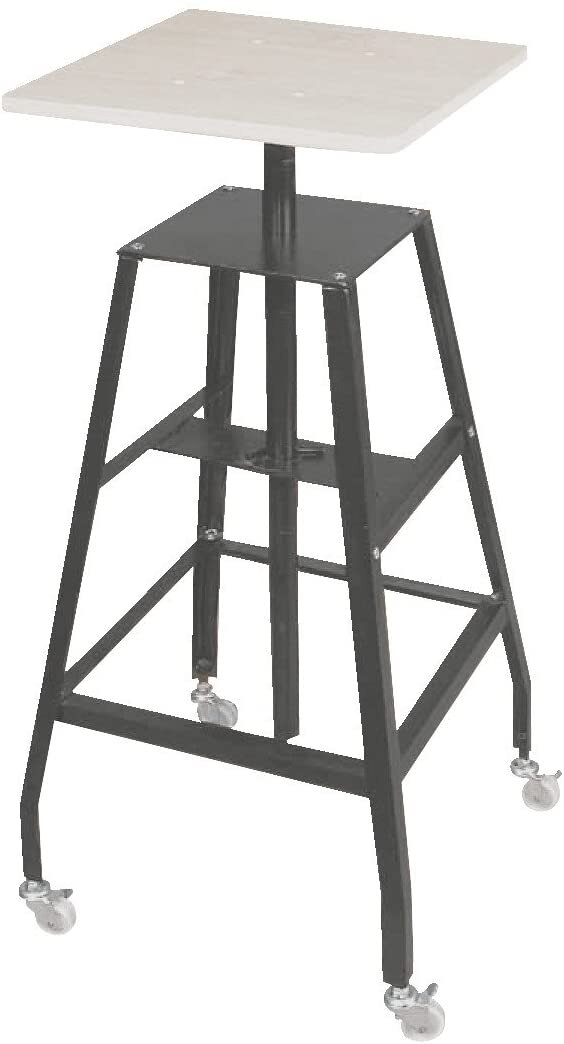
A mobile sculpture stand gives you the freedom to work on pottery and sculptures from all sides, and roll your work station out of the way if needed. This can be a great option for figurative sculpture, or if you want to create an additional workspace without adding another table. To work on this stand comfortably, you’ll need a tall stool or work standing up. The center shaft is adjustable for a working height of 39.5 to 44 inches. The wooden work surface is 12 inches square, and the base is 29 inches square with 4 locking caster wheels. It’s a great stand for working on sculptures, pottery, or as a display stand.

Jack Richeson Mobile Sculpture Stan
$215 to $225.


Summary

This post has covered a variety of banding wheels, turntables, and sculpture stands. In general, the best option is the heavy-duty cast iron Shimpo banding wheels, especially if you need to get a smooth, steady spin for painting pottery. If you are working with heavy sculptures, the CSI Turntables are a sturdy, economical option. And there are other cheaper and lighter options.

What banding wheels do you use? Let us know in the comments.


Best Masks for Silica Dust in Pottery and Ceramic Studios — updated for 2025

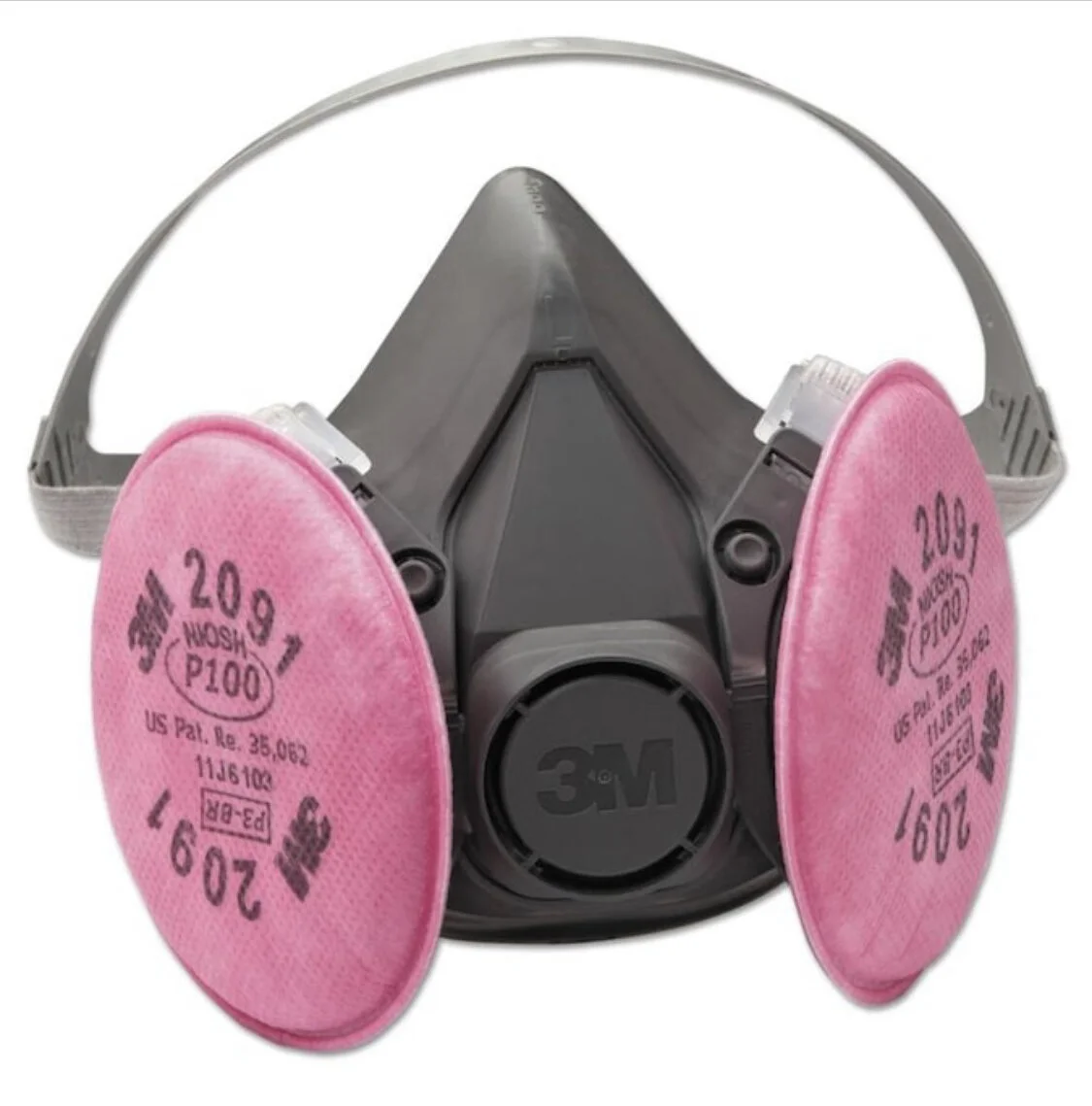
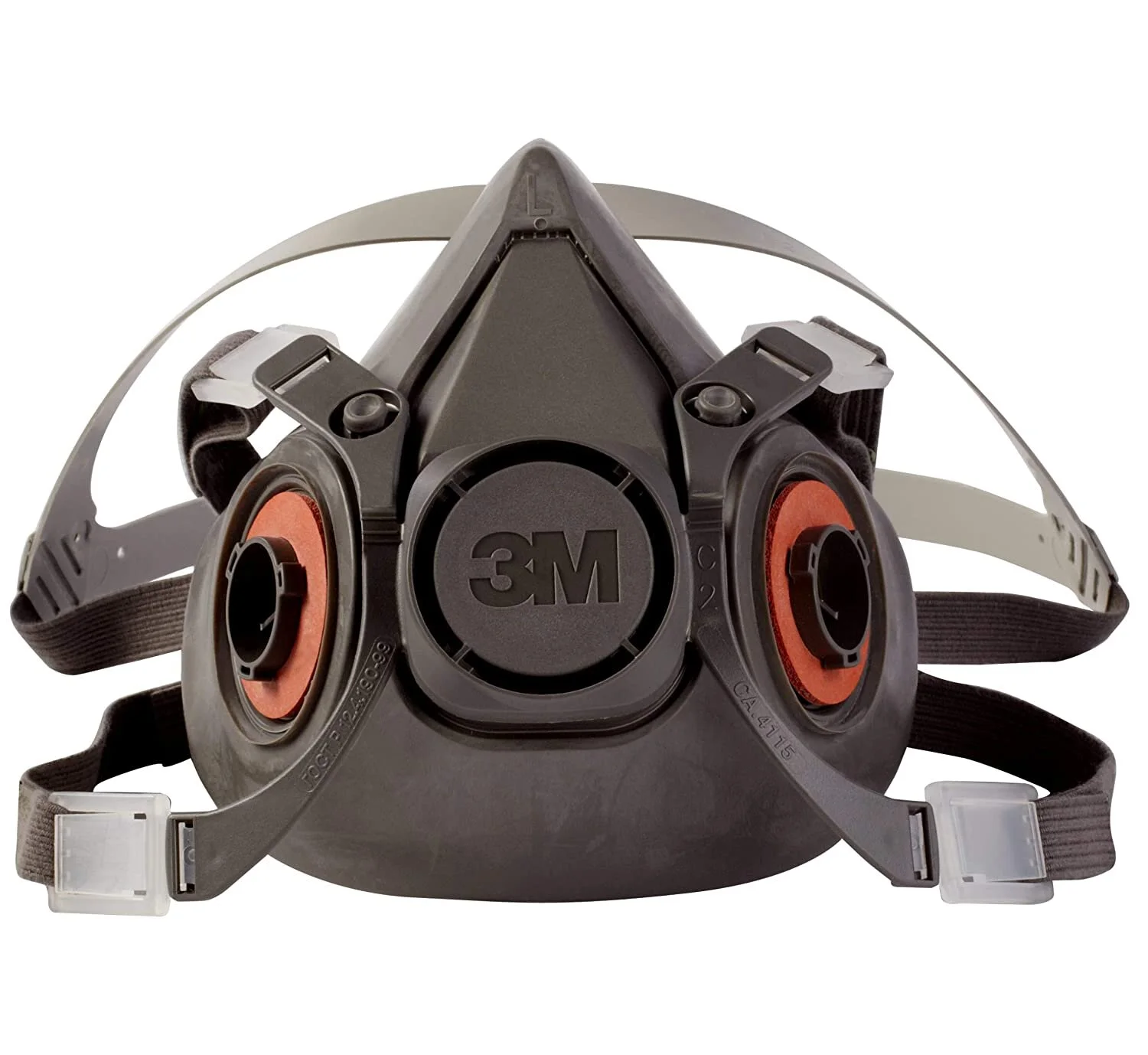
The 3M Half Mask with P100 particulate filters is the best mask option for ceramic studios.

The 3M Half Mask with P100 particulate filters is the best mask option for ceramic studios.

Silica dust is a real hazard in ceramics studios and it’s important to have the right mask. Cloth masks or basic nuisance-grade dust mask will not offer enough protection against silica. The best options are respirators with P100 or P95 filters, or N95/KN95 masks. This is also the level of protection businesses are required by OSHA to provide to employees if silica dust is present.

Respirable silica is very fine with almost invisible particles that can stay airborne for some time, and repeated exposure can lead to silicosis or black lung. To protect against silica, it is important that masks fit correctly. If air can leak around the sides, it really defeats the whole purpose. This is especially of concern if you have facial hair, as that can cause the mask to not be properly sealed to the face. In that case, you may need a full face mask or to trim your beard.

Overall, the best mask is going to be one that you reach for and wear during dust-generating tasks. Any protection is better than none. Personally, I use a respirator with P100 filtration whenever I am working with clay, plaster, wood, or other materials that create dust.

Also consider what is causing dust in your studio and seek to minimize that activity if possible. Keep an organized studio, use wet cleaning and sanding methods, and avoid creating dust. You may want to consider adding a dust collection system. For additional recommendations, visit our guides for cleaning tools and HEPA vacuums.

The reviews in this article are based on personal experience with a wide variety of masks along with experience working in ceramic studios for more than 20 years.

TOP PICK: 3M Half-Facepiece Respirator with P100 Filters

3M 6300 Half-Facepiece Mask without filters attached.

3M 6300 Half-Facepiece Mask without filters attached.

The 3M 6300 Half-Facepiece Respirator is a comfortable, reusable mask with filters that can be replaced as needed. This facepiece will take the round P95 or P100 particulate filters, or the cartridge style filters that are rated for particulates and some types of gases. Either will work, but you might find the round particulate filters to be more breathable. 3M also makes upgraded half masks (see below for more info) but this basic model is affordable, long-lasting, and will get the job done.

The Half-Facepiece respirator can be purchased as a plain mask, or packaged with filters or cartridge filters. Amazon has a variety of options; Home Depot and Lowes and other hardware stores tend to sell the more expensive version with cartridge filters. This may be useful if you also paint or have volatile gases in your studio, but the round P100 filters are perfect for ceramic studios where silica and other airborne dust particles are the main concern.

Note: this half-facepiece mask has unfiltered exhaust valves that are not appropriate for Covid safety in shared spaces.

3M 6300 Half-Facepiece Respirator
Available in size small, medium and large
Typical price
Respirator only: $14-$21
With P100 filters: around $25-$26
With cartridge filters: around $39


The pink, round 3M 2097 P100 filters will fit the half facepiece mask.

The pink, round 3M 2097 P100 filters will fit the half facepiece mask.

P100 Filters and other options

The round, pink 3M 2097 Filters rated to P100 will offer the highest level of particulate protection. You could go with the slightly cheaper, white P95 filters but in my opinion, P100 filters are the way to go.

When using these half masks, there can be some moisture buildup inside, but in general, I find them more comfortable than disposable masks.

Replacement prices:

P100 filters are around $14-$20 for a package of two sets of filters


DISPOSABLE MASK TOP PICK: 3M 8210 N95 Masks

The 3M 8210 N95 mask has straps that go over the head.

The 3M 8210 N95 mask has straps that go over the head.

N95 or KN-95 Masks are NIOSH rated to filter 95 percent of dust particles and are good for multiple uses if kept clean. N95 Masks have straps that go over your head, making them fit more snugly. KN-95 masks typically have ear bands and fit more loosely, however, they often seem to be constructed with a bit more breathing room around your mouth.

A solid option for an N95 is the 3M 8210 N95 Mask. It typically comes in bulk packs where each mask costs about $1 to $1.50 each or around $20-$30 for a box of 20 masks.


ALTERNATE DISPOSABLE PICK: KN-95 Masks

Armbrust KN-95 mask in purple

Armbrust is an Austin, Texas-based mask manufacturer. Their KN-95 masks are available in a variety of colors. Shop at Armbrust

Throughout the Covid pandemic, the availability and quality of masks varied widely, with a variety of manufacturers attempting to fulfill the demand. There also have been reports of fake name-brand masks and other problems. It can be very confusing to buy a “real” N95 or KN-95 mask, as detailed in this NY Times report from 2021.

KN-95 masks, which have ear bands as opposed to the over-the-head N95 style, have become quite common but the number and variety available are confusing. One place to start is by reviewing CDC-approved mask manufacturers as explained here or listed by the CDC here.

The Texas-based, U.S. manufacturer Armbrust makes very high quality surgical masks, KN-95 masks, and kids KN-95 masks. Not only are they NIOSH approved, but the masks are available in a variety of colors and they are made in the USA.

Prices for Armbrust KN-95 range from $15 for a pack of 5 (or $3 per mask) to almost $1,000 for a pack of 540 masks. There are significant discounts if you subscribe to regular mask delivery.


Tightest Fit: Pouch or “Duckbill” Style N95s

The Kimtech Pouch Style N95 has two soft straps that go over your head.

They may look sort of funny, but in my experience, the pouch or “duckbill-style” N95s have the tightest fit of any disposable masks. You can see the mask material move in and out as you are breathing, and it seems to provide excellent coverage for Covid and dust.

A great option for this style of mask is the Kimtech line from Kimberly-Clark. Made in the USA, the Kimtech N95s cost $50 for a box of 50 masks.

More mask reviews below:

Those are my top picks for studio dust masks that are appropriate to use for silica. Keep reading for a deeper look at various half-facepiece masks and other disposable mask options.


Table of Contents

  • Half Facepiece Masks (3M 6300, 3M 6500, 3M 7500)

  • Filters for Half Facepiece Masks

  • RZ Masks

  • Disposable Masks

  • Summary


Half Facepiece Masks: 3M Models

As reviewed above, the top pick for a dust mask for a pottery or ceramic studio is a 3M 6300 Half Facepiece mask. It’s the basic model but will get the job done. But that’s not the only model made by 3M. There is also “upgraded” models made with softer plastic which also have a few different options for valves and latching straps.

The 3M 6300 Half Facepiece Mask.

The 3M 6300 Half Facepiece Mask.

3M 6000 series Half Facepiece Mask

The 6000 series is the standard mask in the 3M line, and seems to be readily available in the 6300 model, but you may occasionally see the 6200 or 6100. From what I can tell, these are all about the same. Made of “thermoplastic elastomer,” the masks will work with 3M filters or cartridge filters, and can be taken apart and cleaned.

The masks are available in size small, medium and large and range in price from around $14 to $20.


3M 6500 Cool Flow Half Facepiece Mask

3M 6503QL Rugged Comfort Quick Latch model.

3M 6503QL Rugged Comfort Quick Latch model.

The 3M 6500 series is termed the “rugged comfort line” and features a softer silicone face seal, a low profile design, a “Cool-Flow” valve, and some models have a quick-latch drop down feature.

The most common and popular model in this series appears to be the 6503QL Rugged Comfort Quick Latch Model. In addition to the silicone lining, this mask features upgraded straps.

Available in small, medium or large sizes, it typically retails for $28 to $31 for the mask and filters are extra. The model sold at Home Depot is around $50 and comes with cartridge-style filters.


3M 7500 Half Facepiece Mask

The 3M 7502 Half Facepiece Mask.

The 3M 7502 Half Facepiece Mask.

The 7500 Half Facepiece line from 3M has the same features as the 6500 line, with the silicone lining and Cool Flow valve, but it has one main difference: the exhalation valve air is routed down to reduce fogging. If you wear glasses or googles, you should consider this mask.

Available in small, medium, and large size, the 7500 line typically retails for $33 to $45 for the mask and filters cost extra. plus filters.


3M Filter Options for Half Facepiece Masks

There are two styles of filters available for 3M masks: round particulate filters and cartridge filters, which work for particulates and gasses. For ceramics, particulate filters are adequate but if you stain wood, paint, or other activities with volatile gases, the cartridges will be a better option.

Particulate Filters

There are two options for round particulate filters: P95 and P100. The P100 offers a higher level of filtration. For a ceramic studio, the 2071 or 2091 filters are your best options. There are a few other filter options aimed at welders, smelting, and chemistry applications.

The P100 filters cost around $14-20 for a box of 4 filters.

p100 filter.jpg
P95_2071_F_F.jpg

3M Cartridge Filters

3M Cartridges are almost all rated P100 and will filter particulates, gases, and vapors. There are a variety of options but the basic 60291 should cover most art studio applications. These are a bit overkill if you are just worried about silica / particulates, but are a good option if you are painting or working with anything that produces volatile fumes. The cartridges are generally about double the cost of particulate filters. At big box hardware stores, they typically only sell the cartridge filters or mask combos, as shown below.

The cartridge filters cost around $20-$30 for a replacement pair of filters. At the time of this write, Home Depot had the best deal on replacement cartridges.

60921_P.jpg
respirator with cartridge filters.jpg

For a complete overview of all the mask and filter options available from 3M, click here or here.


RZ Masks

RZ M3 mask pictured with 2 straps but has 3 strap options

The M3 Mask features 3 strap options. Pictured here is the dual strap configuration.

RZ Reusable Face Masks are an interesting mix of a disposable mask with some features of a respirator. Founded in 2010, you can now find these masks at a lot of hardware and home improvement stores, as well as online. The masks are not yet NIOSH rated but they now have some models with a European FFP2 rating. Full approval of these masks would be helpful in comparing these to other masks on the market, but in general these are great workshop masks and there are a variety of sizes and features. (For technical info on RZ masks and the testing they have undergone, click here. )

The M3 Mask from RZ is the top seller and features 3 different strap options so that you can find the perfect fit. The options include a neck strap, ear loops, or dual head strap (pictured at right). RZ claims a 50% increased airflow with their new filter options, and the same 99% filtration of particles down to 0.1 micron.

The M3 Mask retails for $40 and includes the 3 strap options, a carrying case, and 2 filters. Replacement filters cost $15 for a 3 pack.


The RZ M2.5 Two Strap Mask is an upgraded version of the M2 bask with two head straps.

The M2.5 Two Strap Mask from RZ features a mesh fabric, hook and two straps, with carbon filters that filter 99% of particles down to .1 micron. The filters are somewhat similar to a disposable mask and fit into the bigger mask housing. These masks were designed with unfiltered exhalation valves but the company now makes valve caps for use in shared environments where only filtered exhalation is recommended for the best Covid safety.

You will need to replace the carbon filters over time. Think of this mask as a more comfortable hybrid of a respirator and a disposable mask.

The RZ M2.5 retails for $30 and comes in a variety of colors. Replacement filters are available in a 3 pack for $8 to $15.

The M2 mask from RZ.

The Original M2 mask from RZ has a neck strap.

RZ makes a variety of masks with different strap configurations and colors, along with filter options.

Shop all RZ products by clicking here.


Other Disposable Masks

The 3M N95 and KN-95 masks listed at the top of this post are great options, but there are other disposable masks.

Moldex 2300

The Moldex 2300 Mask.

The Moldex 2300 Mask.

The Moldex 2300 is another N95 particulate respirator that also features an exhaust valve. This helps reduce moisture buildup.

The Moldex 2300 is available in a 10 pack for around $44.

The Moldex 2200 (does not have an exhaust valve) is available in a 20 pack for around $26.


Honeywell Nuisance Masks

Honeywell Nuisance Masks

Honeywell Nuisance Masks

The Honeywell Nuisance Masks are cheap and easy to find, but they are not rated for hazardous dust or particulate use. Too often, I’ve seen these as the masks offered to students in ceramic classes. I guess they are better than no mask but there’s no reason to be casual about silica dust. These might be fine in a pinch, but they are not NIOSH approved and may give a false sense of security. For art studios, it’s best to use the proper N95 or higher masks.

The reason these masks are shown here in this review is that this is what I have seen stocked in many ceramic studios for student use. They are not suitable for silica protection.

These masks cost around $15 for a 50 pack.


Summary

This post has covered a variety of masks to deal with silica and other particulates in a ceramic studio. The first step should be to avoid making dust if possible. But to deal with silica, use a NIOSH approved half facemask respirator, or N95 rated disposable masks. Your long-term health is worth it, and investing in quality personal protective equipment is always a good idea.

What type of mask do you use to protect against silica and other particulates? Let us know in the comments.


The Best Full-Size Slab Rollers for Ceramic Studios

 
Bailey DRD / II ceramic slab roller machine

The Bailey DRD / II gear reduction slab roller pictured here with the shorter 51” table.


Slab rollers are great for slab-built pottery, tiles, and sculptures. While you might be able to get by with a rolling pin, if you use slabs regularly, a slab roller should be an integral part of your studio And while full-size slab rollers can take up a chunk of space, having the ability to easily make slabs is worth it.

This post covers all the full-size slab rollers on the market from five manufacturers: Bailey, Nidec Shimpo, North Star, Brent, and the Hi Roller. For a guide to smaller portable or table top slab rollers, click here.

Top Pick: Bailey DRD / II Gear Reduction models

Bailey DRD / II slab roller with 69 inch table

The 24 inch wide Bailey DRD / II slab roller pictured here with the 69” table. Note the two wheels for ease of moving the table.

The Bailey DRD / II slab rollers with the gear reduction feature are the best slab rollers on the market. These slab rollers are a joy to use, can quickly take up to 2 inches of clay down to an even slab, and are extremely durable and long lasting, suitable for a professional, academic, or personal studio.

The machine features steel rollers, a large 34” wagon wheel handle for easy turning, and one adjustment knob that raises and lowers the top roller. The slab roller can be adjusted from an ultra-thin 1/16” up to 1 1/2” .

This machine feature a reverse-thread handle adapter to prevent damage to the machine, but be careful—what this means in practice is that you can unscrew the wagon wheel handle and it will fall off. (Make sure students are trained on this machine.) On the shorter 51” table, the 34” handle is quite large but it is easy to use and turn, even with large amounts of clay.

The only other (small) drawback is that if one is not careful, canvas can be pulled under the feed table and ends up wrapping around the bottom roller. But once one is accustomed to the roller, it becomes second nature to avoid this.

Bailey makes a few different rollers, but the DRD / II gear reduction models are what you want. The cost about $100 extra for the gear reduction but they are simply the best slab roller on the market.

The Bailey DRD / II gear reduction models are available in a 24” width as a machine only ($1,380), with a 51” table ($1,780), or a 69” table ($1,999). The 30” models have the same option and generally cost about $200 more.


Budget Pick: Nidec Shimpo SR-3050 Slab Roller

Nidec Shimpo ceramic slab roller machine

The Nidec-Shimpo Slab Roller

The Nidec-Shimpo SR-3050 slab roller is a studio workhorse that will turn out great slabs. It features a double roller that sits in the middle of a 30 x 50 inch table with a wagon-wheel handle. Slab thicknesses can range from an ultra-thin 0.1” up to 3 inches, and the top roller is adjusted by moving the two handles.

Adjusting the two rollers can be a bit annoying and the table is somewhat small, but all things considered, this is a great roller that is listed around $1,100 and often can be found for around $900. The short feed area can be fixed by adding a wing or placing the machine next to another table.

The Bailey DRD II and the Shimpo slab roller are just two of many full-sized slab rollers on the market. Keep reading for a complete guide, or click here to read about small and portable table top rollers.


Table of Contents

  1. Top Pick: Bailey DRD / II Gear Reduction Roller

  2. Budget Pick: Shimpo Slab Roller

  3. How to Shop For a Slab Roller

  4. North Star Slab Rollers

  5. The Hi Roller Vertical Slab Roller

  6. All Bailey Slab Rollers

  7. Brent Slab Rollers

  8. Slab Accessories

  9. Summary


How To Shop For A Slab Roller

It can be confusing to shop for a slab roller, as Bailey and North Star in particular make a variety of slab rollers that can be ordered with a variety of table sizes and features. Here’s a guide of how to shop and pick out rollers.

1. Start With Roller Width

Full size table top rollers range from 24 to 40 inches wide. In practice, your widest slab will probably be about 2 inches less than that. Even a 22 inch wide slab can be quite large! But if you are doing large tile projects, the 30 or 40 inch models will be needed. For an individual studio, a 24 inch roller might be quite large—maybe a table top roller is what you need.

2. Table Size

The important considerations here are the size of the table where you feed in the clay, the size of the “output” area, and the total size of the table. In addition to width, the table size will determine how long of a slab you can make. Once again, I’d suggest that a 22” wide slab by say 24” long is quite large! But if you have a larger table, you have more working area.

Shimpo, Brent, and the Hi Roller machines come in one size. But Bailey and North Star let you choose the table size. With Bailey it’s a 51” or 69” long table, and North Star options are 48” or 72” inches, and North Star also sells prop-up “wings” that extend the table. With Bailey and North Star, you can also buy the machine only and build your own table.

With any roller, measure the complete table and make sure it is suitable for your studio.

3. Rollers

Most high-quality rollers have a double roller. This will give your slab pressure from both sides, and results in a more even slab. Brent Rollers just have a roller on one side, which along with the heaviness of the table is why we don’t recommend Brent rollers.

4. Handle / Crank Mechanism

Most of these large rollers come with a wagon wheel handle, but some have a crank. A wagon wheel makes it easy to turn, but does take up more room. Consider the Bailey rollers with the short table: a 34” wide wagon wheel handle is paired with a 51” table. It’s a bit crowded. Smaller table top rollers generally have a crank rather than a wagon wheel.

5. Gear Reduction / Safety Mechanisms

Any slab roller should be treated with respect and they can be damaged if they are turned the wrong way or too much clay is forced through the rollers. Bailey makes a gear-reduction model that is even easier to turn, and also has a reverse-threaded wagon wheel so that you can’t turn the gears the “wrong” way and damage the machine.

6. Durability

All of the machines reviewed here are well built and will be long lasting if not abused. In my experience, the Bailey, Shimpo, and North Star machines hold up best under intense use in academic or community studios. The Hi Roller is fussy but can make nice albeit small slabs. The Brent rollers are extremely heavy and basically bomb proof welded steel, but if the shims get wet they can warp and the wires can snap if used improperly. So many academic studios have Brent rollers but the other four manufacturers make machines that are simpler, lighter, and easier to maintain.


North Star Slab Rollers

The North Star 30 inch wide Super Roller with table.

North Star makes two styles of slab rollers: the “standard” line has crank-driven 2 1/2” double rollers available in 18”, 24”, and 30” width as machine only, table-top portarollers, or in 48” long tables. (Our top pick for a portable roller is the 18” Portaroller from the North Star standard series.) The two larger rollers in the standard line can also be ordered with wagon wheel handles.

The “super” series features wagon-wheel driven 4” wide double rollers with a gear reduction in 24”, 30”, or 36” width in 72” long tables. If you are a production shop or a busy academic studio, the Super series is what you want, whereas the standard line is great for individual studios.

North Star also makes a variety of accessories, such as fold-out wings to extend the length of tables, and extra shelves for the roller table.

These are great rollers. The only drawback compared to the Bailey DRD / II models is that North Star has two height adjustment knobs, rather than one that moves the entire top roller. North Star mentions that this makes “tapered slabs” possible, but truth be told, that’s a concept I’ve only heard mentioned in their marketing copy.

North Star Standard rollers range from around $1100 to $1200 for a roller and table.
Super series rollers start at around $1500 for the 24” roller and table, and go up to $2355 for the 36” roller and table. All the models are available for less as machine only, if you want to build your own table.


The Hi Roller Vertical Slab Roller

The Hi Roller vertical clay slab roller machine

The Hi Roller Vertical Slab roller is a space-saving machine that is easy to crank.

The Hi Roller is an interesting entry for the full size slab roller because it can be wall mounted or stand on its own, taking up very little space while providing great (if somewhat small) slabs. The rollers can be adjusted easily with a dial, clay is placed near the rollers, and a small crank easily moves the clay down between two pieces of canvas. Then, the clay is cranked back up, often sticking just enough to the canvas until you remove it.

This all sounds great, but in practice, this is a fussy machine. Sometimes the clay drops below the rollers and won’t come back up, and it’s hard to make large slabs. So there is some trade off but if floor space is a premium in your studio, this is the roller for you.

The Hi Roller is generally available for around $1,450-$1,500.


Bailey Slab Rollers

Bailey makes a somewhat confusing array of slab rollers so hopefully this outline of their product line will help.

The Bailey 40” DB Drive Board roller with electric motor.

The DRD / II slab roller from Bailey is the top pick for a slab roller (see top of post) and is available in a 24” or 30” model in either direct drive or gear reduction models. It’s worth the extra $100 for the gear reduction—why not make it easier to crank out slabs? The DRD / II models have 2 1/2 inch diameter rollers.

The original DRD model is still in production, and is available in 30” or 40” width. The DRD features 4” diameter rollers, designed for professional studios or heavy use by academic studios. These are amazing, big rollers. They are also available with electric motors.

Finally, Bailey also makes the DB or Drive Board rollers in 30” or 40” widths. These machines have a single roller on top and a drive board that travels with the slab, allowing for more even compression and protecting the slab from bunching or bogging down in the machine. These are best for tile and architectural tile work.


Brent Slab Rollers

Brent SR-30 Slab Roller

The Brent SR-30 Slab Roller

Brent makes three slab rollers with a wagon wheel (the SR-14, SR-20, and SR-30) and one model (the SRC) with a crank handle. All are rather overbuilt with heavy steel bases, and single wheels that move over the top of the slabs, and have wires underneath the roller table covered in sticky grease. The slab thickness is adjusted by adding or removing canvas-covered shims.

These slab rollers are quite common but I would avoid them whether new or used. Here’s why:

> Adding or taking out shims is a pain. Also, this process generally results in a lot of dust being created.

> Single roller, only pressure from the top rather than a double roller.

> Heavy. So heavy. You’ll need a forklift or about 6 people to move these. They are unnecessarily heavy.

> Hard to maintain. Have fun repairing the guide/crank wire when it snaps! (Misuse by students can easily break this wire)

> Warped shims: I once used a Brent roller that had water damage and all the shims were warped, resulting in uneven slabs.

And finally, expensive. All that metal costs money. These rollers ranged from $2,000 up to $3,700. Sure, if properly maintained and used you will get fine slabs, especially if you never change the slab thickness. But any other machine will be better.


Slab Accessories

A few things that will make working with slabs easier:

Slab Mats

Slab mat

Slab mats are available in a variety of sizes and are great for rolling slabs or handbuilding.

Slab Mats are a plastic fabric with one side smooth and the “working” side has a bit of a fuzz. They are less flexible than canvas, but are also great for putting through rollers, moving slabs around, or just as a working surface to protect your table tops. Most normal clay uses (fettling knives, craft knives, needle tools, etc) won’t cut through these. Small sizes can also be used as small bats for handbuilding, or get a larger piece to run through your roller.

Canvas

Unprimed, raw canvas is a great working surface that can be laundered.

For slabs, unprimed canvas is also great for rolling and moving around the studio. With a canvas blanket, you can cut to your desired shape and either hem or leave the edges unhemmed. Canvas can be washed over and over again by hand or in the washing machine. Frequent washing will help keep the dust down, and does soften the material over time. #12 / 12 oz canvas is a great place to start, or go slightly thicker with #10 / 15oz canvas.

Rolling Pin

Solid maple rolling pin

A solid maple rolling pin is a useful studio tool that is easy to clean.

A solid maple rolling pin is a must-have for any ceramic studio, even if you have a slab roller. For small things, it’s usually easier to roll by hand. Pair this with a few wooden slats or yard sticks, and you’ve got an adjustable slab rolling system.

A solid rolling pin is better than a rolling pin with bearings or moving parts, because there is nothing to break and it is easy to clean the entire rolling pin with water. Rolling pins come in a variety of sizes but a 24” wide rolling pin is still easy to maneuver but large enough to make really big slabs. At around $30, this is an affordable studio tool that will last forever.


Summary

This post has covered every large or full-size slab roller on the market, including models from Bailey, North Star, Nidec-Shimpo, Hi Roller, and Brent.

The top pick is the DRD/II gear reduction slab roller from Bailey, but there are lots of options for a wide variety of budgets. All of these rollers, if properly used, will make great slabs but there are some superior options (Bailey, Shimpo, North Star) based on price, weight, and quality of features.

What slab roller do you use in your studio? Let us know in the comments.


Gift Guide for Artists who Paint and Draw

This guide has more than 30 ideas for artists who paint, draw, and create. Most suggestions are priced between $25 and $100, along with a few higher ticket items. There are plenty of ideas for the painter or artist in your life, or perhaps you’ll find a gift for yourself. In general, this guide focuses on high-quality art supplies, equipment, and books.

Note: This site uses affiliate links for sites such as Amazon and Blick. If you click the links and complete a purchase, we may receive a percentage at no extra cost to you.


Blick Noir French Easel

The Blick Noir French Easel.

The Blick Noir French Easel.

Perfect for in the studio or on the go, this black French-style wooden easel from Blick is stylish, functional, and a great deal. The easel combines a sketchbox, easel, and canvas carrier into one unit. Folded, it measures a compact 22 x 16 x 6.5 inches, and it can extend up to 73” tall and accommodate canvases up to 34” tall. It weighs about 10 lbs. This is a great easel for someone setting up an at-home studio and can be carried or folded down for painting in plein air. It retails for around $100.


Golden A-Z Acrylic Explorers Kit

The Golden A-Z Acrylic Explorer Kit.

The Golden A-Z Acrylic Explorer Kit.

This popular set introduces artists to a variety of products Golden Acrylics—the company bills it as a workshop in a box and it basically is. It includes heavy body (i.e. thick) acrylics, fluid acrylics, high flow acrylics as well as pastes, gels and mediums. It’s a great intro to Golden’s high quality product line, and can really expand an artist’s skill set. The kit retails for around $28 and includes 4 tubes of paint, 5 small bottles of paint, 4 tubes of different mediums and a bottle of clear painting medium.


Aquabee Super Deluxe Sketchbook

The Aquabee Super Deluxe Sketchbook.

The Aquabee Super Deluxe Sketchbook.

The Aquabee Super Deluxe Sketchbook from Bee Paper is a favorite mixed media pad that came out on top in our recent review of mixed media pads. It can do everything from light watercolor to ink to marker, colored pencil, and anything else. The sketchbooks are available in a variety of sizes (9x12” is a great option) and has a stiff cardboard back and a leatherette cover with a wire binding for easy turning of pages. The 93 lb / 150 gsm paper is light cream color and is a pleasure to use, and the books range from 6x4 inches to 14x17 inches, with 50 or 60 pages per book.


Williamsburg Oil Paint Sets

The Williamsburg Oil Paint Signature Series has 9 colors in 11 ml tubes.

The Williamsburg Oil Paint Signature Series has 9 colors in 11 ml tubes.

Williamsburg is known for its intensely pigmented, handmade oil paints that are the favorite paints of many professional artists. Available individually or in a variety of sets, try the Signature Series set of 9 for an introduction to these wonderful oil paints. An oil painter will appreciate this, or any set of the high quality Williamsburg paints. The Signature Series set has 9 tubes with 11 ml of paint each, or about 1/3 of an ounce.


The Artist’s Way by Julia Cameron

The Artist’s Way by Julia Cameron

The Artist’s Way by Julia Cameron

This classic, first published almost 30 years ago, helps artists, writers, and creative types unlock their full potential. Through a series of exercises, such as a letter to yourself and the famous “morning pages” of free writing (visual artists can just substitute sketching) everyone can discover their creative path in an open-ended way that accommodates everyone. At times a bit new age-y, this book is still worth a read for the ideas and exercises. The book grew out of a series of workshops that Cameron ran, and the book feels like you are in the room with Cameron’s gentle but insistent guidance.


Faber-Castell 9000 Series Drawing Set

Faber-Castell 9000 Series Drawing Set.

Faber-Castell 9000 Series Drawing Set.

Faber-Castell makes some of the best pencils and is the choice of professionals and serious artists. It’s easy to just reach for the signature green pencils first. This set of 12 pencils from F-C’s signature 9000 series has one pencil each ranging from the soft and dark 8B up to 2H. There’s also a set for designers that ranges from 5B to 5H. The sets come in a hinged metal tin or a soft bag and usually retail for around $15-$20. This is the perfect set for anyone who loves to draw. Pair it with a sketchbook and a sharpener for a perfect gift.


Tote Bag for Tools, Pencils, and Brushes

JJRing Nylon Tote Bag

JJRing Nylon Tote Bag

Every artist can use a little organizational help, and a tote bag keeps everything is at hand and easy to find. The JJRing nylon art/craft bag is has a 16 pockets, is available in eight colors, and is a great value, typically priced at $15 to $25.


Caran D’Ache Luminance Colored Pencils

The Caran D’Ache Luminance pictured here in the 20 pencil box.

The Caran D’Ache Luminance pictured here in the 20 pencil box.

The ultra-premium Luminance colored pencils are a joy to use and the entire set is 100 percent lightfast, which means that the pigments are designed to withstand UV rays. Under museum conditions, these colors will hold up for at least 100 years. The Luminance (and the Derwent Lightfast) were our top picks in a recent test of colored pencils based on the color intensity, quality, and the lightfast ratings. The Luminance also has an easy-to-use cardboard box where each pencil is inset into foam, so the pencils don’t jumble around. Prices range from a set of 20 pencils for $55 to a set of 76 pencils for around $225.


The Story of Painting: How Art Was Made

The Story of Painting: How Art Was Made from DK.

The Story of Painting: How Art Was Made from DK.

This 2019 book covers the entire 25,000 year history of painting with illustrations, texts, and guides to technique, composition, and subject matter. It’s a great overview for a beginning painter, or a wonderful reference book for the more experienced artist. The details, images, and texts make this more than just a coffee table book. It’s available in hardcover for around $25.

 
The book includes detailed examinations of numerous paintings.

The book includes detailed examinations of numerous paintings.


Utrecht Artists’ Watercolor Paint Box

The Utrecht Watercolor Box is a complete painting kit.

The Utrecht Watercolor Box is a complete painting kit.

This set has everything an artist needs to get started with watercolor painting and it’s made by Utrecht, the Brooklyn, NY company known for high quality, artist-grade paints and mediums. It comes in a beechwood box and includes a 9x12” watercolor block, four brushes, a flat knife, a needed eraser, plastic palette with 24 wells, and 18 tubes of watercolor paint. The box usually retails for around $225.

Utrecht also sells smaller sets of just watercolor paints.


Anker Soundcore Q20 Noise Cancelling Headphones

The Anker Soundcore Q20 Noise Cancelling Headphones.

The Anker Soundcore Q20 Noise Cancelling Headphones.

Over-ear noise cancelling headphones can really help you focus on your work, especially if you work in a shared or noisy environment. There are a lot of options for this type of headphone, but the Anker Soundcore Q20 strike a balance between quality and affordability, especially considering they will probably get covered in paint at some point. These headphones have an impressive 40 hour playing time, and a dynamic sound quality that while not quite audiophile level, really deliver a lot for the $50 price tag.


Liquitex Acrylic Gouache

The Liquitex Acrylic Gouache 12 color essentials kit.

The Liquitex Acrylic Gouache 12 color essentials kit.

Gouache is a type of opaque watercolor paint, and the Liquitex Acrylic Gouache is an interesting twist on this product that is really nice to use. Think of it as a matte acrylic paint that is fluid right out of the bottle and will result in a matte finish that doesn’t show brush strokes or cracks. It’s become a favorite acrylic paint of many. It’s available in small squeeze bottles—to use, just press out what you will need on a tray or palette. The colors are available individually or in a variety of sets. Try the 12 color essentials set for around $55 or the fluorescent set is also fun.


Blick Super Value Bulk Canvas Pack

The Blick Super Value Bulk Canvas Pack has 40 16x20” pre-primed canvases.

The Blick Super Value Bulk Canvas Pack has 40 16x20” pre-primed canvases.

Almost a gag gift for the extreme size, this bulk pack of 40 stretched canvases are great for anyone who paints a lot. These 16x20” canvases are pre-primed with acrylic gesso on 5/8” thick stretcher bars. At around $120, these canvases work out to about $3 each—an incredible value. And a gift like this will provide plenty of surfaces for an artist to get to work.


Winsor & Newton Artisan Water Mixable Oil Paint

Winsor & Newton Artisan Water Mixable Oil Paint.

Winsor & Newton Artisan Water Mixable Oil Paint.

Water mixable oil paint is an interesting innovation made by a variety of manufacturers. It allows you to thin paint with water (although most companies do make some mediums as well) but more importantly, you can clean up this paint with water and soap. This makes it so much easier to keep hands, brushes, palettes, and everything clean, especially if you are painting at home. Winsor & Newtown makes a great line of water mixable oil paint called Artisan, and it’s available individually and in sets. The set of 10 colors in the smaller 0.7 ounce tubes is a great introduction to this line.


Foam Daubers

Foam daubers aka sponges on a stick.

Foam daubers aka sponges on a stick.

These sponges on a stick are a fun craft tool for artists of all ages. Variously known as spouncers, daubers, or stick sponges, these are a great way to add polka dots and round shapes to any surface. Use with acrylic, watercolor, or inks. Available in bulk packs for around $10–20, they are a great tool for any artist.


Create Dangerously: The Power and Responsibility of the Artist by Albert Camus

Create Dangerously by Albert Camus.

Create Dangerously by Albert Camus.

This 1957 speech by the Nobel Prize winner was first published as a standalone text in 2019 in this small, pocket-sized book. A call to arms for artists to participate in society, it’s an interesting read for anyone considering a career in the art or who is interested in what role artists might take in civic discourse. The paperback usually retails for $8.


Canson XL Black Drawing Pad

The Canson XL Black Drawing Sketchbook

The Canson XL Black Drawing Sketchbook

A sketchbook with black paper is a fun way to mix things up in the studio. Pair it with opaque colors from pens or pencils, and you’ve got a whole new way to approach color and design. A studio favorite is the student-grade Canson XL Black Drawing Pad. Each pad features 40 pages with 92lb black paper, with micro-perforations at the side if you want to remove a drawing for framing or other purposes. Available in 7x10” or 9x12”, expect to pay $7 to $10 for these pads. For a great gift, pair this with gel pens or colored pencils.


X-Acto Basic Knife Set and Case

The X-Acto Basic Knife Set with case.

The X-Acto Basic Knife Set with case.

Every artist needs X-Acto knives at some point, and this basic set of 3 knives and 10 replacement blades is a great introduction to the variety of blades from this venerable company. Use this for trimming watercolor paper, collages, or any art and hobby purposes, these will get used all the time. This set typically retails for around $23. Pair it with a cutting mat (see below) for a great gift.


Self-Healing Cutting Mat

Alvin Cutting Mats are one option for self-healing cutting mats.

Alvin Cutting Mats are one option for self-healing cutting mats.

Self-healing cutting mats are a great way to protect both your tables from cuts and it helps your knife blades stay sharp longer. Available from a variety of manufacturers (Alvin, Blick, Cricut, X-Acto etc) the main thing is to pick the size and color that works for your space. Traditionally available in green and black from Alvin, there are now a variety of colors and sizes. For at-home use, an 18x24” mat or 24x36” sizes are usually best, but you can go bigger or smaller. In addition to cutting, these make great surfaces for using liquid or hot glue, or for moving around drawings or paintings that are not yet dry. The larger sizes are also useful for covering tables used for drawing, painting, and crafts.


Arches Watercolor Blocks

Arches watercolor blocks come in a variety of paper thicknesses and finishes.

Arches watercolor blocks come in a variety of paper thicknesses and finishes.

Arches makes some of the best watercolor paper and watercolor blocks are a great way to try out their paper. Sealed on the side with glue, each sheet stays in place and won’t warp, and can then be cut off using a dull knife. Then the next sheet is ready to go. These come in hot and cold press in a variety of thickness. Cold press paper has a bit more texture and the mid-weight 140 lb / 300 gsm paper is a good place to start, such as an 8x10 block of 20 sheets that retails for around $33. Pair this with a high-quality set of watercolors (such as Sennilier, Utrecht, etc) and you’ve got a great gift for a watercolor artist.


Sennelier Watercolor Travel Set

Sennelier La Petite Watercolor Travel Set

Sennelier La Petite Watercolor Travel Set

Sennelier makes some of the best watercolors that are rich in hue, depth, and just enough transparency. They are a pleasure to use and when paired with a watercolor block (see above) make a great gift. This travel set includes 12 tubes of watercolor paint and a small palette for adding water. The tubes hold 10ml or .33 oz of watercolor paint, which can go a long way—especially if they are mixed with water and used wet on wet. It’s a great introduction to the Sennelier line of watercolors, and generally retails for $35-$40.


JBL Bluetooth Speaker

The JBL Flip 4 portable bluetooth speaker.

The JBL Flip 4 portable bluetooth speaker.

It’s always great to have music or podcasts in the studio, and a portable bluetooth speaker makes it easy to play anything from your phone, tablet, or laptop. The JBL Flip 4 is slightly older (meaning it’s available at a discount) but is still a great option that sounds great, is easy to pair with devices, and comes with long-lasting build quality. For something bigger and louder, check out the JBL Charge line of speakers. The JBL Flip 4 is waterproof, available in a variety of colors, and usually retails for around $90.


Studio Designs Fusion Center Drafting Table

Studio Designs Fusion Drafting Table and Stool. (Cabinet is not part of the set).

Studio Designs Fusion Drafting Table and Stool. (Cabinet is not part of the set).

Studio Designs is known for high quality but affordable studio furniture (I’ve been using the Graphix II Workstation for years) and the Fusion Center is a great introductory table and stool for artists who draw, paint, or craft. Featuring a work area that is just under 24 x 35 inches, the table can adjust from flat to a 60 degree angle. There’s also a pencil and brush rack, and a slide-out side table, giving the table an overall potential footprint of 24x48 inches, and the table is adjustable from 26.75 to 35.35 high. It’s a great first desk for the serious hobbyist or art student who is ready for their own dedicated table. It typically retails for around $125.


Daybook: The Journal of an Artist by Anne Truitt

An older edition of Daybook by Anne Truitt.

An older edition of Daybook by Anne Truitt.

This classic journal by the American sculptor has been in print continuously since it was published in the early 1980s. In it, Truitt details her daily observations about artmaking as well as her history as an artist and mother. It’s an enlightening read that ranges from the mundane, to money concerns, to the theoretical underpinnings of her works and how she made them. It’s available new and used, including a recent digital edition that includes Daybook and two more books of Truitt’s journals. For more, check out this excerpt of the book. Daybook is available in paperback for around $15.


Holbein Artist’s Gouache Set

The 12 color set of Holbein Artists’ Gouache.

The 12 color set of Holbein Artists’ Gouache.

Gouache is the opaque version of watercolors and Holbein makes some of the finest gouaches around. These professional grade paints are vibrant, dry to a matte finish, and can be thinned with water if less intensity is desired. The colors are available individually or as sets, ranging from five colors for around $30 to all 84 colors for over $700. A set of 12 or 18 colors makes a great introduction to this line of colors and in the smaller .2 ml tubes, these sets range from $44 to $53.


Pentel Pocket Brush

The Pentel Pocket Brush Pen with two refills.

The Pentel Pocket Brush Pen with two refills.

The Pentel Pocket Brush is a portable, easy-to-use, and refillable brush pen that can lay down a super-fine line or a heavier stroke. Perfect for travel and on the go ink sketches, it can also be used in the studio for finished work. It’s good for painting, cartooning, and more, and is available with gray, black, or sepia-colored ink. The brush and two refills typically retails for around $13, and refills are about $3 for a two pack. Pair this with a mixed media sketchbook (such as the Aquabee Super Deluxe Sketchbook) and you’ve got a great gift.


Alice Neel: People Come First

Alice Neel: People Come First is a 2021 monograph published by the Met Museum.

Alice Neel: People Come First is a 2021 monograph published by the Met Museum.

This 2021 monograph focuses on Neel’s history, social activism, and portraits. Published by the Metropolitan Museum of Art in New York and based on the blockbuster exhibition there, the hardcover book includes high-quality reproductions and essays on Neel and her work. A sense of life was in every mark that Neel made and this book is a deep look into a fascinating artist and her body of work.


Sennelier Abstract Kit

The Sennelier Abstract Acrylic Paint Kit with 8 tips.

The Sennelier Abstract Acrylic Paint Kit with 8 tips.

Sennelier Abstract acrylic paints are a new twist on painting. The paint can be squeezed out on a palette like any other paint, or try the various tips directly on these plastic pouches to squeeze paint right out of the bag. It makes the act of painting physical and immediate, and can open up a new way of working for any artist. The set includes 5 paints and 8 tips, and typically retails for around $35.


Blick Studio Black Cotton Canvas

Blick Studio Black Cotton Canvas are pre-primed and stretched and ready to paint.

Blick Studio Black Cotton Canvas are pre-primed and stretched and ready to paint.

Black primed canvases are a completely different way to approach painting, and these pre-primed and stretched cotton canvases from Blick allow you to get right to painting in acrylic or oil. Available in 5 sizes ranging from 8x10 inches to 20x24 inches, these canvases have a traditional 3/4” deep stretcher bar and are suitable for hanging or framing. Pair these with an acrylic or oil painting set for a great gift.


Golden Fluid Acrylics Set

The Golden Fluid Acrylic Set includes 10 paints.

The Golden Fluid Acrylic Set includes 10 paints.

Golden fluid acrylics are high flow, thin paints for artist that spray, brush, stain, or paint. They are highly saturated with pigment and they are almost ink-like in how they lay down and dry. They are a great way to mix things up and can be used with various mediums or thinned even further with water. The set of paints includes 10 colors in 1 oz jars and usually retails for around $42


Blick Super Value Hardbound Sketchbook

The Blick Super Value Hardbound Sketchbook two pack.

The Blick Super Value Hardbound Sketchbook two pack.

Hardbound sketchbooks are great ways to keep all your sketches, thoughts, and notes in one place and this 2 pack is simply an incredible deal. At around $12 for two sketchbooks, it’s the same price you’ll pay for one hardbound sketchbook at other stores. The 65 lb paper measures 8.5x11 inches and is smooth, white, and acid free.


Caran D’Ache Pablo and Supracolor Gift Box

The Caran D’Ache Pablo and Supracolor box set.

The Caran D’Ache Pablo and Supracolor box set.

This handsome wooden box has a full set of Caran D’Ache Pablo colored pencil and Supracolor water-mixable colored pencils. The two lines blend together easily, giving you an unlimited range of possibilities for drawing, shading, blending, and working wet. At $464, it’s quite the statement gift but it includes 180 pencils, for an average cost of $2.58 each.


Other Gift Ideas

Classes: A set of classes at a local studio or art studio can be a great gift.

Magazine Subscriptions: Magazines are great sources of ideas and inspiration.

Tours, Trips, or Conferences: Look for painting-specific travel tours, retreats, or conferences.

What are your favorite gift ideas for artists? Let us know in the comments.
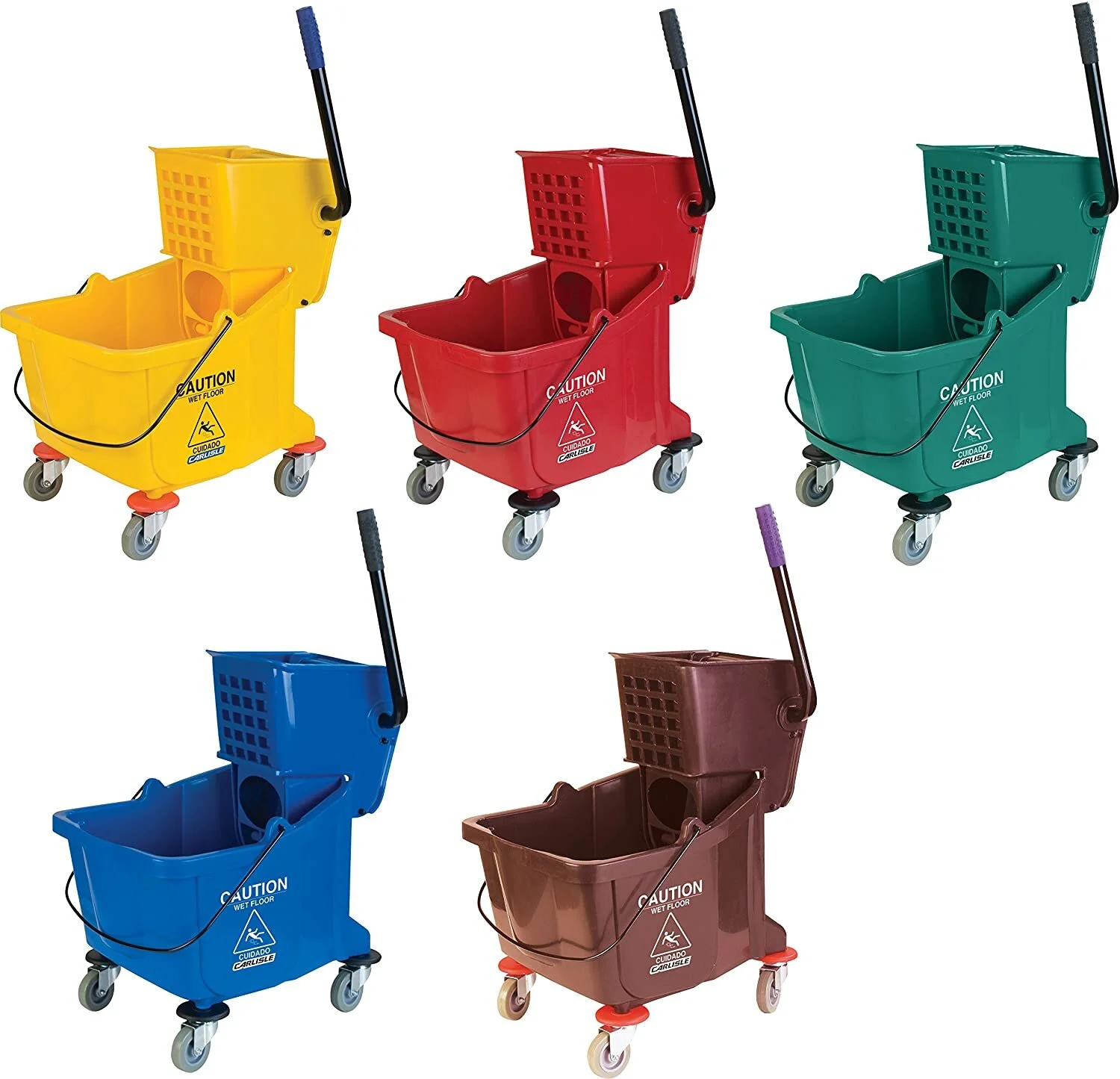
Gift Guides

Check out these posts:

Gift Guide for Potters

Gift Guide for Young Artists and Creative Kids


Handheld Clay Extruder Buyer's Guide

The Shimpo Nidec Handheld Extruder comes with 5 aluminum dies and one blank.

The Shimpo Nidec Handheld Extruder comes with 5 aluminum dies and one blank.

Handheld extruders or “clay guns” are useful tools for making small runs of handles, coils, and small hollow forms. If you are looking to make a repeatable shape in a quick, efficient way, then a handheld extruder is what you need.

These extruders work like a caulk gun: you fill the barrel with clay, screw the cap over the die form, and repeatedly squeeze the trigger to push clay through the die. It can be a bit of a wrist workout, so definitely use soft clay with these.

There are four options when choosing a handheld extruder: 2 sizes from Scott Creek, and one each from Shimpo and Kemper. There are also two miniature clay extruders such as the Kemper Klay Gun, for making extremely small shapes, which I’ll cover at the end of the post.

It’s really a coin toss as all four handheld extruders are well made, but for most studios and hand sizes, I would recommend the Shimpo Handheld Extruder. For about the same price, the Shimpo Handheld Extruder comes with a few more dies than the Scott Creek, and I prefer the circular handle at the back as opposed to the bar handle on the Scott Creek models. And as this is a handheld extruder, I prefer the shorter and wider barrel of the Shimpo because it is easier to squeeze out the clay.

A full review of handheld extruders follows, including the three options from Shimpo or Scott Creek, and two options for smaller decorative clay extruders. For larger extruders, check out our guide to wall-mounted extruders here.


Table of Contents

  1. Shimpo Handheld Extruder

  2. Scott Creek Super Duper Clay Gun and Clay Gun XL

  3. Kemper IKEG Klay Extruder

  4. Small Extruders: Kemper Klay Gun and Bailey Clay Gun

  5. Summary


Top Pick: Shimpo Handheld Extruder

The Shimpo Handheld Extruder comes with 5 dies and one blank die.

The Shimpo Handheld Extruder comes with 5 dies and one blank die.

The Shimpo Hollow Die Kit has 8 shapes. The middle of each shape is screwed on to the larger piece at the bottom.

The Shimpo Hollow Die Kit has 8 shapes. The middle of each shape is screwed on to the larger piece at the bottom.

The Shimpo Handheld Extruder is a quality tool that lets you easily make shaped coils, small hollow forms, or handles. It’s basically a caulk gun with an aluminum barrel and dies. The threaded barrel is 2 1/4” wide and about 10 inches long. The entire model measures about 13 x 9 x 3 inches, weighs just a few pounds, and can easily be stored in a drawer. It can be entirely submerged in water for cleanup, but you may want to oil the hinges and moving metal parts as needed.

Shimpo 4-in-1 Die Kit has 8 shapes of varying sizes and an isolator die.

Shimpo 4-in-1 Die Kit has 8 shapes of varying sizes and an isolator die.

The Shimpo Extruder is the top pick because the kit comes with five dies and one blank, and I prefer the circular handle. I also find the the shorter barrel makes it easier to squeeze out the clay, even though that means more frequent refilling. But it’s really a coin toss if this is better than the Scott Creek Clay Gun and the choice really comes down to personal preference. In my studio, I use a Shimpo Handheld Extruder along with a mixture of dies from Shimpo and Scott Creek.

Shimpo has two die kits: one with a selection of eight hollow forms and another with eight “4-in-1” shapes of varying sizes. You can extrude all four sizes at once, or use the isolation die to select just one. The hollow forms are what most people go for, as those shapes would be extremely hard to make without a die, but both kits would really expand the options in your studio.

The Shimpo Handheld Extruder generally retails for around $60 and the die kits are about $40 each. You can find this tool at ceramic supply stores or online at Blick.


Scott Creek Super Duper Clay Extruder and Clay Extruder XL

The Scott Creek Super Duper Clay Gun.

The Scott Creek Super Duper Clay Gun.

The Scott Creek XL Clay Gun has a 15” barrel.

The Scott Creek XL Clay Gun has a 15” barrel.

Scott Creek makes two handheld extruders and five die kits. The Super Duper Clay Gun has a 10 inch barrel while the XL has a 15 inch barrel. Both feature a bar handle at the rear as opposed to the circular handle on the Shimpo. The barrel is 2 inches wide, which is 1/4” smaller than the Shimpo. Note that the Scott Creek die kits will definitely fit the Shimpo Extruder, but the Shimpo dies may not work with the Scott Creek guns. Both Scott Creek extruders come with one coil die and two blank aluminum dies.
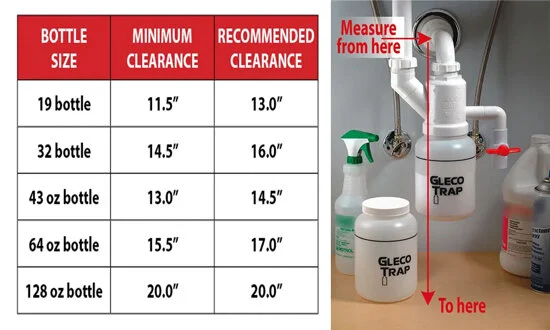
The Scott Creek Handle Die Kit features 8 shapes cut out of clear acrylic. The Scott Creek Dies are compatible with the Shimpo Extruder.

The Scott Creek Handle Die Kit features 8 shapes cut out of clear acrylic. The Scott Creek Dies are compatible with the Shimpo Extruder.

Scott Creek extruders are rugged, well built, and will get the job done. They are a bit harder to find in stores, but are readily available direct from the manufacturer. Scott Creek also makes a hollow aluminum die kit with the same shapes as Shimpo, along with an aluminum die kit of small forms. There are also three die sets made out of clear acrylic including a “shape and coil” kit, tile trim kit, and handle kit. The handle kit is my most used die kit and I would recommend that kit regardless of which extruder you purchase.

Although it might seem attractive to use the larger XL Extruder, keep in mind that the longer barrel may be harder to clean and store, and it is that much harder to squeeze clay out. (Any handheld extruder really relies on wrist strength.)

The Scott Creek Super Duper Clay Extruder usually retails for around $55-60, and the XL goes for around $70, and the die kits generally cost about $40 each.


Kemper IKEG Klay Extruder

The Kemper IKEG Klay Extruder

The Kemper IKEG Klay Extruder

The Kemper IKEG Klay Extruder is an interesting offering from the venerable clay tool manufacturer. It’s even longer than the Scott Creek XL, with a barrel measuring 20 inches in length by 2 inches wide. It comes with 3 aluminum coil dies, 1 blank die, and 2 plastic spouts.

As stated above, I feel that a shorter barrel is easier to use but if you decide to go with this option, you can always just fill the barrel with less clay to make it easier to use. Aside from that, the trigger of this gun is virtually identical to the Shimpo with a circular handle. Kemper has a limited offering of dies, but Scott Creek dies will work with this extruder.

The Kemper IKEG Klay Extruder typically retails for around $60 and can be found at ceramic suppliers such as Bailey.


Mini Extruders: Kemper K45 Klay Gun and Bailey Clay Gun

These miniature clay extruders are useful for making texture or super small coils, such as for hair. They also work with polymer clay, so if you are working in miniatures, this is the clay extruder for you. For typical clay studios, these mini guns often sit unused in studio drawers but if you need a really specific shape, they may work for you. They are virtually identical but the Bailey set also comes with a handy plastic carrying case.

The Bailey Clay Gun is a miniature extruder.

The Bailey Clay Gun is a miniature extruder.

Bailey Clay Gun

The Bailey Clay Gun has 19 dies and a carrying case. It typically costs around $13. Make sure that whatever you put in the barrel is very soft.

Shop at Bailey

 
kemper-k45-klay-gun.jpg

Kemper Klay Gun

The Kemper Klay Gun also has 19 dies and typically costs around $13. It may be exactly the same thing as the Bailey Clay Gun, but it doesn’t have a case.

Shop at Blick


Summary

Handheld extruders are a great way to make small batches of similar shapes, such as handles or hollow shapes. For a long time, I thought of them as an extraneous tool but once I started using them, I found that I really liked the look of extruded handles. Definitely don’t get one of these if it will simply sit unused in a drawer.
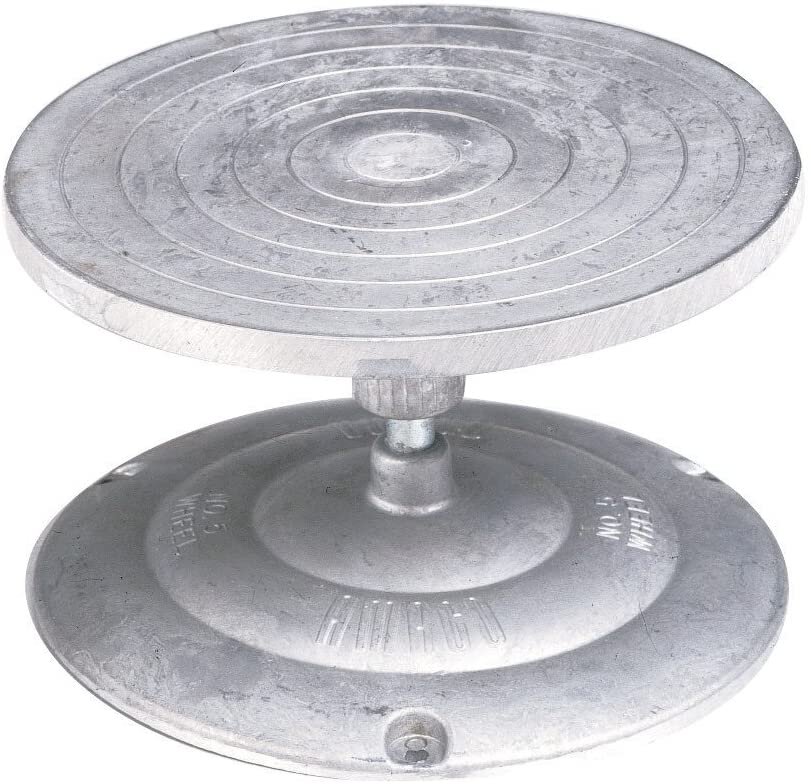
With only four models on the market, all are basically the same with just a few minor differences, so you can’t go wrong. For me, I prefer the slightly wider and shorter Shimpo barrel but my favorite dies are the handle kit from Scott Creek. You will find your own combination that works for you.